Seeing with Light: How Dual-Beam Doppler OCT Revolutionizes Retinal Blood Flow Measurement
A breakthrough in ocular imaging that offers new hope for early detection of vision-threatening conditions
Introduction
Imagine if your eye doctor could precisely measure the blood flow in your retina with a simple, non-invasive scan—detecting circulatory problems before they cause permanent vision loss. This isn't science fiction but the promise of an advanced imaging technology called dual-beam delay-encoded Doppler optical coherence tomography (DDD-OCT). For millions affected by diabetes, glaucoma, and age-related vision disorders, this breakthrough offers new hope for early detection and treatment.
The retina is one of the most metabolically active tissues in our body, demanding constant oxygen and nutrient supply through its delicate blood vessels. When this circulation falters, serious sight-threatening conditions can develop. Until recently, accurately measuring retinal blood flow required invasive procedures or offered only partial information. Now, researchers have developed an ingenious solution that uses two beams of light instead of one, overcoming fundamental limitations of previous technologies. This article explores how this innovative approach works and why it represents such a significant leap forward in ocular imaging.
Did You Know?
The retina consumes oxygen at a higher rate than almost any other tissue in the human body, making continuous blood flow essential for maintaining vision.
Revolutionizing Retinal Blood Flow Measurement
The Challenge of Traditional Methods
To appreciate why DDD-OCT is such a breakthrough, it helps to understand the limitations of conventional methods. Traditional single-beam Doppler OCT systems face a fundamental problem: their velocity measurements depend on the Doppler angle—the angle between the incident beam and blood vessel orientation. This creates a situation similar to trying to judge a car's speed when you can only see it from one vantage point—if it's moving directly toward or away from you, you can measure its speed accurately, but if it's moving perpendicularly, you'll miss its true velocity entirely 1 7 .
In the complex retinal circulation, vessels run in multiple directions, making the Doppler angle unknown and constantly changing. This limitation has hampered accurate blood flow measurement for years, leaving clinicians with either incomplete data or requiring them to use invasive techniques like fluorescein angiography that involve dye injections 2 .

Traditional eye examinations have limitations in measuring detailed blood flow
The Dual-Beam Solution: How It Works
The dual-beam approach introduces an elegant solution to the Doppler angle problem. Instead of relying on a single beam, the system uses two carefully separated probe beams that simultaneously measure blood flow from slightly different angles. Here's the clever part: by knowing the precise separation between these beams and their arrangement, researchers can mathematically calculate the true flow velocity without needing to know the exact vessel orientation beforehand 1 8 .
Think of it as having two observers measuring the same moving car from different positions—by combining their perspectives, you can calculate the true speed and direction. In the DDD-OCT system, a calcite beam displacer splits the light into two parallel probe beams separated by 2.8 mm, which creates an angular separation at the retina 1 .

Dual-beam approach provides more accurate measurements from different angles
Technical Innovations
Delay Encoding
A tiltable glass plate inserted into one beam path creates a consistent 750 μm optical path length difference between the two probe beams. This "delay encoding" ensures that signals from both beams can be distinguished even when using a single detection system 1 .
Single Spectrometer Detection
Unlike earlier dual-beam systems that required separate spectrometers for each beam, this approach uses just one spectrometer to detect both signals, making the system more compact and cost-effective 1 .
Integrated Ophthalmoscopy
The system includes a preview imaging capability that provides real-time fundus images, helping technicians precisely guide the OCT scanning position 1 .
The system operates at an impressive 50,000 lines per second with a lateral resolution of 22 μm, all while maintaining light exposure well within safety limits set by the American National Standards Institute 1 .
In-Depth Look at a Key Experiment: Validating the Technology
Methodology: Step-by-Step Experimental Procedure
System Calibration
The researchers first calibrated their DDD-OCT system using a stationary model to ensure precise measurements and proper alignment between the two probe beams.
Phantom Blood Flow Creation
They set up a capillary tube with a known inner diameter of 135 μm, perfusing it with chicken blood at a constant flow rate using a syringe pump. This created a controlled simulation of retinal blood vessels.
Sampling Optimization
The team tested different sampling steps (distances between adjacent A-scans) to determine the optimal balance between accuracy and efficiency. They found that steps smaller than 1.9 μm provided reliable measurements and selected 1 μm for their experiments.
In Vivo Validation
Finally, they imaged four healthy volunteers, scanning around the optic nerve head to measure total retinal blood flow. The study was approved by the Institutional Review Board and followed ethical guidelines, with all subjects providing informed consent 1 .
Results and Analysis: Proving Accuracy and Clinical Potential
The experimental results demonstrated both the accuracy and clinical potential of the DDD-OCT system:
Phantom Experiment Results
The system successfully measured phantom blood flow with an error of less than 10% across multiple flow rates, confirming its reliability 1 . The researchers discovered that sampling step size significantly affected measurement accuracy, with smaller steps (≤1.9 μm) providing optimal results.
| Set Flow Rate (μL/min) | Measured Flow Rate (μL/min) | Percentage Error |
|---|---|---|
| 10 | 9.2 | 8.0% |
| 15 | 14.1 | 6.0% |
| 20 | 18.9 | 5.5% |
| 25 | 23.4 | 6.4% |
| 30 | 28.5 | 5.0% |
Table 1: Measurement Accuracy at Different Set Flow Rates
Human Study Findings
In vivo experiments with healthy volunteers yielded compelling results 1 . The system successfully measured arterial blood flow with clear pulsatility corresponding to heart rate (67 beats/minute in one subject). The average absolute flow in a representative artery was calculated at 12.2 μL/min during a cardiac cycle.
| Study Group | Number of Subjects/Eyes | Total Retinal Blood Flow (μL/min) | |
|---|---|---|---|
| Arteries | Veins | ||
| Current Study | 8 eyes | 40.16 ± 7.48 | 43.26 ± 4.93 |
| Riva et al. | 12 eyes | 33 ± 9.6 | 34 ± 6.3 |
| Wang et al. | 10 subjects | 45.6 ± 3.8 | Not reported |
| Baumann et al. | 20 subjects | 47.6 ± 5.4 | Not reported |
Table 2: Total Retinal Blood Flow Measurements in Healthy Volunteers
Key Finding
Most importantly, the total retinal blood flow measurements obtained with the new system aligned well with values reported in previous studies using different methodologies, validating its clinical relevance 1 .
The Scientist's Toolkit
Advanced retinal imaging relies on sophisticated technology and specialized components. Here are the key elements that make DDD-OCT possible:
| Component | Function | Example Specifications |
|---|---|---|
| Calcite Beam Displacer | Splits single light beam into two parallel probe beams | 2.8 mm parallel displacement 1 |
| Tiltable Glass Plate | Creates precise path length difference between beams (delay encoding) | Adjustable, currently 750 μm delay 1 |
| SLD Light Source | Provides low-coherence light for imaging | 850 nm central wavelength, 50 nm bandwidth 1 |
| Line Scan Camera | Detects interference patterns for image reconstruction | 2048 elements, 50,000 lines/s 1 |
| Dove Prism | Rotates illumination plane to maintain optimal measurement angle | Adjustable to keep en face angle away from 90° 1 |
| Diffraction Grating | Disperses light by wavelength for spectral analysis | 1200 lines/mm 1 |
Table 3: Essential Research Reagents and Materials for DDD-OCT

Sophisticated laboratory equipment enables precise OCT measurements
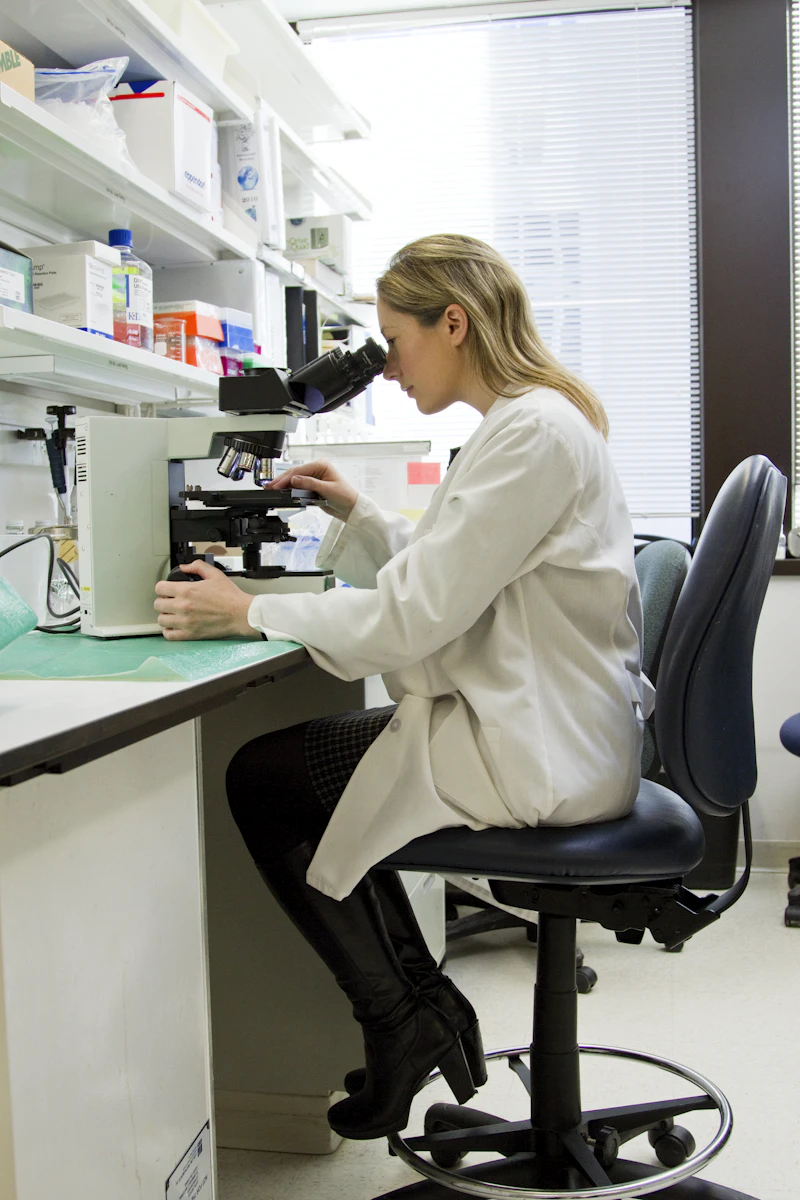
The OCT imaging process requires precise alignment of optical components
Seeing the Future of Eye Care: Applications and Directions
Clinical Applications and Patient Benefits
The implications of accurate retinal blood flow measurement extend to numerous sight-threatening conditions:
Glaucoma
Often linked to reduced ocular perfusion, glaucoma may now be detected earlier through precise blood flow monitoring, potentially allowing intervention before significant optic nerve damage occurs 2 .
Age-related Macular Degeneration
Both dry and wet forms of AMD involve vascular components that could be monitored with this technology, potentially guiding treatment decisions and timing 2 .
Retinal Vein Occlusions
These vascular events directly impact retinal circulation and could be precisely quantified using this technology to monitor both the condition's severity and treatment response 2 .
Current Limitations and Future Directions
Current Limitations
- The angular separation between beams isn't adjustable, which could limit optimization for different patients or conditions.
- Patients with poor fixation remain challenging to image, suggesting a need for integrated eye-tracking technology.
- The current method of manually delineating vessel boundaries introduces some subjectivity that could be improved with automated software 1 .
Future Directions
- Future developments will likely focus on making the systems more compact, faster, and integrated with complementary technologies.
- Artificial intelligence could be used for automated analysis of retinal blood flow data.
- The recent emergence of home OCT devices suggests a future where monitoring retinal blood flow could extend beyond clinical settings 6 .
Conclusion
Dual-beam delay-encoded Doppler optical coherence tomography represents more than just a technical achievement—it offers a new window into the subtle circulatory changes that precede vision loss.
By solving the fundamental Doppler angle problem that plagued single-beam systems, this technology provides clinicians with reliable, non-invasive access to crucial hemodynamic information.
As the technology continues to evolve, it holds the potential to transform how we detect, monitor, and treat vascular eye diseases. From the research lab to the clinic, DDD-OCT exemplifies how innovative engineering can overcome longstanding clinical challenges, ultimately preserving the precious gift of sight for millions worldwide. The future of ocular imaging is bright—and it's looking more precise than ever.
Key Takeaway
DDD-OCT technology enables precise, non-invasive measurement of retinal blood flow, potentially revolutionizing early detection and monitoring of serious eye conditions like glaucoma and diabetic retinopathy.