Systems Physiology Engineering: Bridging Computational Models and Precision Medicine
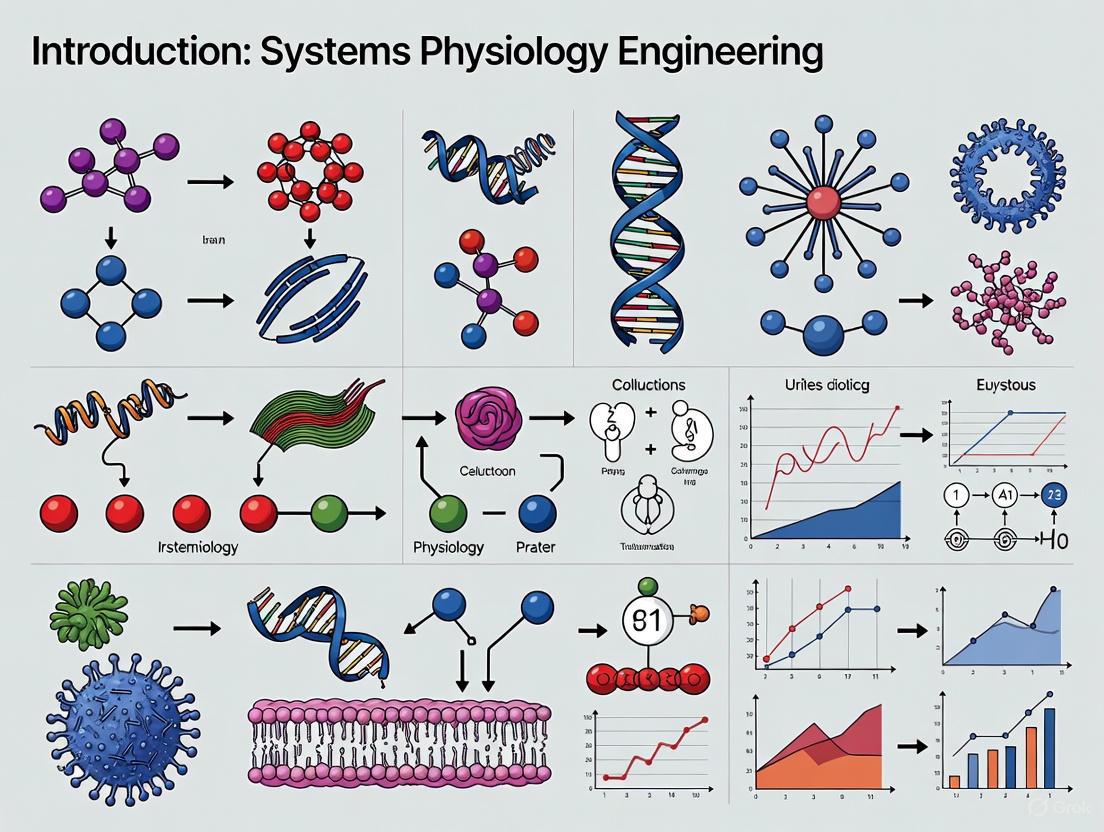
This article provides a comprehensive introduction to Systems Physiology Engineering, an integrated discipline that combines computational modeling, experimental studies, and theoretical frameworks to understand complex physiological systems.
Systems Physiology Engineering: Bridging Computational Models and Precision Medicine
Abstract
This article provides a comprehensive introduction to Systems Physiology Engineering, an integrated discipline that combines computational modeling, experimental studies, and theoretical frameworks to understand complex physiological systems. Tailored for researchers, scientists, and drug development professionals, it explores the foundational principles of analyzing the human body as a series of interrelated subsystems. The scope spans from the core concepts of virtual human projects and physiological control loops to advanced methodologies like high-throughput phenotyping and Digital Twins. It further addresses critical challenges in model scaling and integration, and concludes with a rigorous examination of Verification, Validation, and Uncertainty Quantification (VVUQ) frameworks essential for translating these models into reliable clinical and drug discovery tools.
The Core Principles: From Cellular Circuits to the Virtual Human
Systems Physiology Engineering is an integrated discipline that combines experimental, computational, and theoretical studies to advance the understanding of physiological function in humans and other organisms [1]. It represents the application of engineering principles and frameworks—including design, modeling, and quantitative analysis—to physiological systems, with the goal of creating comprehensive, predictive models of biological function. This field moves beyond traditional reductionist approaches by focusing on the emergent properties and system-level behaviors that arise from the complex interactions between physiological components across multiple spatiotemporal scales [1] [2].
The fundamental premise of Systems Physiology Engineering is that physiological function cannot be fully understood by studying individual components in isolation. Instead, it requires integrative approaches that examine how molecular, cellular, tissue, organ, and whole-organism systems interact dynamically [2]. This perspective is encapsulated by the emerging field of Network Physiology, which focuses specifically on how diverse physiological systems and subsystems coordinate their dynamics through network interactions to produce distinct physiological states and behaviors in health and disease [2].
Core Principles and Theoretical Framework
Foundational Concepts
Systems Physiology Engineering is guided by several key principles that distinguish it from other biomedical engineering approaches. The principle of robustness—how physiological systems maintain function despite perturbations—and its inherent trade-offs has been proposed as a fundamental organizational concept [1]. Biological systems achieve robustness through sophisticated control mechanisms, redundant pathways, and modular architectures that enable functional stability in fluctuating environments.
The discipline employs a multi-scale perspective that integrates phenomena across different biological scales, from molecular interactions to whole-organism physiology. This requires addressing what has been termed the "scaling problem," which encompasses three distinct challenges: problem scaling (developing computational frameworks that can expand to organism-level complexity), layer scaling (incorporating multiple descriptive levels from sub-cellular to organismal), and scope scaling (integrating both interaction networks and physical structures) [1].
Quantitative and Theoretical Foundations
The theoretical framework of Systems Physiology Engineering draws heavily from dynamic systems theory, control theory, and network science [2] [3]. These mathematical foundations enable researchers to model the temporal evolution of physiological states, regulatory feedback mechanisms, and the emergent behaviors that arise from interconnected physiological subsystems.
A key insight from this perspective is that the structure of physiological networks—their topology, connection strengths, and hierarchical organization—fundamentally constrains their dynamic capabilities and functional outputs [2]. Understanding these structure-function relationships is essential for deciphering how physiological systems achieve coordinated activity and adapt to changing conditions.
Table: Fundamental Principles of Systems Physiology Engineering
| Principle | Engineering Analogy | Physiological Manifestation |
|---|---|---|
| Robustness | Redundant safety systems in aviation | Maintenance of blood pressure despite blood loss |
| Multi-scale Integration | Multi-physics simulations | Linking ion channel dynamics to cardiac electrophysiology |
| Feedback Control | PID controllers in process engineering | Baroreflex regulation of cardiovascular function |
| Emergent Behavior | Swarm intelligence in distributed systems | Consciousness emerging from neural networks |
| Modularity | Standardized components in engineering design | Organ system specialization with preserved interoperability |
Computational Modeling and the "Virtual Human"
The Grand Challenge of Comprehensive Physiological Modeling
A central ambition in Systems Physiology Engineering is the creation of highly accurate, broad-coverage computational models of organisms, supported by well-controlled, high-precision experimental data [1]. This "Grand Challenge" aims to develop virtual human models that can simulate and predict, with reasonable accuracy, the consequences of perturbations relevant to healthcare [1]. The implications for drug discovery are particularly significant, as these models would enable more reliable prediction of drug efficacy, side effects, and therapeutic outcomes before clinical trials.
The Tokyo Declaration of 8 formally established the goal of creating "a comprehensive, molecules-based, multi-scale, computational model of the human ('the virtual human')" over a 30-year timeframe [1]. This ambitious project recognizes that effective drug discovery pipelines utilize cell lines and animal models before clinical trials, necessitating the development of complementary computational models with equal quality standards [1].
Engineering Frameworks for Physiological Simulation
Successful implementation of physiological simulations requires learning from engineering disciplines where computational modeling has proven transformative. Computational Fluid Dynamics (CFD) provides an instructive case study, as modern aircraft development now relies extensively on CFD simulations [1]. Three factors explain CFD's success: established fundamental equations (Navier-Stokes), experimental calibration through wind tunnels, and decades of sustained development [1].
Systems Physiology Engineering must similarly establish: (1) fundamental computing paradigms comparable to the Navier-Stokes equations for biological systems; (2) high-precision experimental systems equivalent to wind tunnels for biological validation; and (3) long-term commitment to methodological refinement [1]. Emerging technologies such as microfluidics show promise for providing the necessary experimental precision for model calibration [1].
Methodological Approaches and Experimental Frameworks
Integrated Experimental-Computational Workflows
Systems Physiology Engineering employs iterative cycles of computational modeling and experimental validation. This approach mirrors successful engineering practices in other industries, such as Formula-1 racing car design, where CFD simulations, wind tunnel testing, test course evaluation, and actual racing form a coordinated sequence of design refinement [1]. Each stage in this process provides specific insights: computational design enables rapid exploration of parameter spaces, physical testing validates predictions under controlled conditions, and real-world implementation assesses performance in authentic environments.
For biological systems, this translates to: (1) in silico modeling and simulation; (2) in physico controlled laboratory experimentation; (3) in vitro cell-based studies; and (4) in vivo whole-organism investigation [1]. The critical insight is that computational modeling alone is insufficient—it must be embedded within a broader ecosystem of experimental validation and refinement.
Quantitative Methodologies and Measurement Technologies
Advanced measurement technologies are essential for generating the high-quality data required for model development and validation. The field leverages networked sensor arrays and wearable devices that enable synchronized recording of physiological parameters across multiple systems in both clinical and ambulatory environments [2]. These technologies facilitate the creation of large-scale multimodal databases containing continuously recorded physiological data, which form the empirical foundation for data-driven modeling approaches [2].
Complementing these macroscopic measurements, molecular profiling technologies provide insights into physiological regulation at finer scales. These include single-cell sequencing, spatial transcriptomics, epigenomics, and metabolomics, which collectively enable comprehensive characterization of biological information across genetic, proteomic, and cellular levels [3]. Integration of these disparate data types represents a significant computational challenge that requires sophisticated multi-omic integration approaches [3].
Table: Analytical Methods in Systems Physiology Engineering
| Method Category | Specific Techniques | Primary Applications |
|---|---|---|
| Network Analysis | Dynamic connectivity mapping, Graph theory applications | Identifying coordinated activity between physiological systems [2] |
| Biophysical Characterization | Single-molecule imaging, Cryo-electron microscopy, Atomic-force microscopy | Determining molecular mechanisms underlying physiological function [3] |
| Computational Modeling | Ordinary/partial differential equations, Agent-based modeling, Stochastic simulations | Predicting system dynamics across biological scales [1] |
| Signal Processing | Time-frequency analysis, Coupling detection, Information theory metrics | Quantifying information transfer between physiological subsystems [2] |
| Machine Learning | Deep learning architectures, Dimensionality reduction, Pattern recognition | Classifying physiological states from complex data [2] [3] |
Research Applications and Implementation
The Human Physiolome Project
A major organizing framework in Systems Physiology Engineering is the effort to build the Human Physiolome—a comprehensive dynamic atlas of physiologic network interactions across levels and spatiotemporal scales [2]. This initiative aims to create a library of dynamic network maps representing hundreds of physiological states across developmental stages and disease conditions [2]. Unlike earlier "omics" projects that focused primarily on molecular components, the Physiolome initiative emphasizes the functional interactions and dynamic relationships between physiological systems.
The Physiolome framework recognizes that health and disease manifest not only through structural and regulatory changes within individual physiological systems, but also through alterations in the coordination and network interactions between systems and subsystems [2]. This perspective enables a more nuanced understanding of physiological states as emergent properties of integrated system dynamics rather than merely the sum of component functions.
Drug Development Applications
In pharmaceutical research, Systems Physiology Engineering offers transformative potential for improving the efficiency and success rate of drug development. Mechanistic physiological models provide a framework for predicting both therapeutic effects and adverse responses by simulating how drug interventions perturb integrated physiological networks [1]. These models can incorporate genetic and epigenetic diversity, enabling population-level predictions of drug response variability [1].
The discipline enables a more integrated approach to preclinical testing by creating consistent computational models of human physiology alongside the animal models and cell lines used in drug discovery pipelines [1]. This consistency facilitates more reliable extrapolation from preclinical results to human outcomes. Additionally, quantitative systems pharmacology models—which combine physiological modeling with pharmacokinetic/pharmacodynamic principles—can optimize dosing regimens and identify patient subgroups most likely to benefit from specific therapies.
Essential Research Tools and Reagents
The experimental and computational methodology of Systems Physiology Engineering relies on a diverse toolkit of reagents, technologies, and analytical frameworks. These resources enable researchers to measure, perturb, and model physiological systems across multiple scales of organization.
Table: Research Reagent Solutions in Systems Physiology Engineering
| Reagent/Technology | Function/Application | Representative Uses |
|---|---|---|
| Microfluidic Platforms | Enable high-precision, controlled biological experiments | Serve as "wind-tunnel" equivalents for calibrating computational models [1] |
| Synchronized Sensor Networks | Simultaneous recording of multiple physiological parameters | Mapping dynamic interactions between organ systems [2] |
| Spatial Transcriptomics Reagents | Capture gene expression patterns within tissue architecture | Relating cellular organization to tissue-level function [3] |
| Cryo-Electron Microscopy Reagents | Preserve native structure for high-resolution imaging | Determining macromolecular mechanisms of physiological function [3] |
| Genetically Encoded Biosensors | Monitor specific physiological processes in live cells | Tracking signaling dynamics in real-time [3] |
| SBML (Systems Biology Markup Language) | Standardized model representation | Sharing and integrating computational models [1] |
Future Directions and Challenges
The future development of Systems Physiology Engineering faces several significant challenges that will require coordinated research efforts. The model scaling problem necessitates international collaborative frameworks, as developing comprehensive physiological models exceeds the capabilities of individual laboratories or even national programs [1]. Effective collaboration requires establishing standards for model representation (such as SBML and SBGN) and mechanisms for model sharing and integration [1].
A persistent methodological challenge involves validating multi-scale models against experimental data. While technologies such as microphysiological systems (organs-on-chips) provide increasingly sophisticated experimental platforms for model validation, significant gaps remain in our ability to experimentally verify predictions across all relevant biological scales [1] [4]. Closing these gaps will require continued development of both experimental and computational methodologies.
The ultimate goal of creating truly predictive virtual human models will require sustained investment over decades, similar to the long-term development trajectory that established computational fluid dynamics as an indispensable engineering tool [1]. Success in this endeavor would transform biomedical research, clinical practice, and drug development by enabling accurate simulation of physiological responses to perturbations, thereby accelerating the development of personalized therapeutic strategies.
Systems physiology engineering represents an interdisciplinary approach that analyzes the human body through the principles of engineering. This framework recognizes the body as a complex, integrated system composed of multiple interdependent subsystems regulated by sophisticated control loops. Rather than examining organs in isolation, this perspective focuses on how physiological systems interact through mechanical, electrical, and chemical signaling to maintain homeostasis. For researchers and drug development professionals, understanding these engineering principles provides powerful tools for predicting system responses to pharmaceuticals, modeling disease pathogenesis, and developing targeted therapeutic interventions. The body exemplifies engineering excellence through its capacity to solve numerous complex biological problems simultaneously through coordinated, integrated systems that must function synergistically [5].
Core Engineering Principles in Physiological Systems
Control System Architectures in Physiology
Biological systems employ sophisticated control architectures that mirror engineering control systems. These include:
Negative Feedback Control: The dominant mechanism for maintaining homeostasis, where physiological responses act to counteract deviations from set points. In thermoregulation, for instance, temperature receptors alert the central nervous system to deviations in body temperature, triggering effector mechanisms that restore thermal balance [6].
Feedforward Control: Anticipatory mechanisms that initiate responses before actual deviations occur. For example, human subjects resting in warm environments who begin exercise demonstrate increased sweat rate within 1.5 seconds of starting exercise—far too quickly for traditional temperature receptor activation to have occurred [6].
Proportional and Rate Control: Physiological systems often employ proportional control (response magnitude correlates with deviation size) and rate control (response activation depends on the speed of change). The thermoregulatory system utilizes both modes simultaneously, with temperature receptors in the skin exhibiting strong dynamic responses that trigger rapid reactions to changing conditions [6].
Integrated System Design Principles
The human body demonstrates four fundamental engineering challenges in its development and operation:
- Differentiation: The generation of hundreds of specialized cell types from a single zygote, each with distinct shapes, functions, and internal programming [5].
- Organization: The precise spatial arrangement of cells into hierarchical tissues and organs with complex three-dimensional structures [5].
- Integration: The functional connection of differentiated cells and systems through mechanical, electrical, chemical, and fluid pathways [5].
- Coordination: The precise timing of system activation during development and operation, ensuring all components come online at appropriate stages [5].
These processes represent "problem solving at its finest" and constitute "engineering on steroids," requiring incredible precision with minimal failure rates despite enormous complexity [5].
Major Physiological Subsystems and Their Interactions
Renal System: The Fluid and Electrolyte Regulator
The kidney functions as a sophisticated filtration and regulation system that maintains fluid balance, electrolyte concentrations, and blood pressure. Its engineering features include:
- Multi-nephron architecture with parallel processing units (nephrons) for efficient blood filtration [7]
- Integrated feedback control through tubuloglomerular feedback (TGF) and neurohormonal systems like RAAS [7]
- Dynamic adaptation to changing physiological conditions through flow-dependent reabsorption mechanisms [7]
Table 1: Quantitative Parameters of Renal System Function
| Parameter | Mathematical Representation | Physiological Significance |
|---|---|---|
| Renal Blood Flow (RBF) | RBF = (MAP - P_renal-vein)/RVR + GFR×(R_ea/N_nephrons)/RVR [7] |
Determines filtration rate and oxygen delivery |
| Single Nephron GFR | SNGFR = K_f × (P_gc - P_Bow - π_gc-avg) [7] |
Represents individual filtration unit performance |
| Tubular Na Reabsorption | Φ_Na,pt(x) = Φ_Na,pt(0) × e^(-R_pt x) [7] |
Quantifies sodium conservation mechanism |
Thermal Regulation System
The thermoregulatory system maintains body temperature through integrated feedback and feedforward mechanisms:
- Integrated temperature regulation: Rather than regulating only core temperature, the system integrates inputs from multiple body parts including the skin, enabling faster response times [6].
- Dynamic receptor properties: Temperature receptors in the skin exhibit strong dynamic responses, firing more rapidly during temperature changes than during static conditions, facilitating rapid corrective actions [6].
- Local regulatory networks: Certain body regions with special thermoregulatory needs (e.g., scrotum) operate under local control systems that function within the overarching whole-body temperature regulation [6].
Table 2: Thermal Regulation Control Mechanisms
| Control Mechanism | Activation Trigger | Physiological Effect |
|---|---|---|
| Proportional Control | Deviation magnitude from temperature set point | Response intensity proportional to temperature error [6] |
| Rate Control | Rate of temperature change | Enhanced response to rapidly changing conditions [6] |
| Feedforward Control | Anticipatory cues (e.g., exercise initiation) | Preemptive activation before core temperature changes [6] |
Cardiovascular System
The cardiovascular system functions as a sophisticated hydraulic circuit with multiple integrated components:
- Pulsatile pumping mechanism with pressure and flow regulation
- Multi-compartment circulatory loops for systemic, pulmonary, and coronary circulation [8]
- Dynamic impedance matching through vascular compliance and resistance control [8]
Experimental Modeling and Analysis Methodologies
Quantitative Systems Pharmacology Modeling
Quantitative Systems Pharmacology (QSP) modeling provides a framework for integrating physiological knowledge into a quantitative structure that can predict system behavior:
- Mathematical representation of core physiological processes and feedback mechanisms [7]
- Dynamic simulation of system responses to pharmacological interventions [7]
- Hypothesis testing and identification of knowledge gaps in physiological understanding [7]
The renal QSP model exemplifies this approach, incorporating key processes like glomerular filtration, tubular reabsorption, and regulatory feedback mechanisms to simulate renal and systemic hemodynamics [7].
Mock Circulatory Loops for Cardiovascular Device Testing
Mock Circulatory Loops (MCLs) represent experimental platforms that replicate cardiovascular physiology for device testing and physiological research:
- System architecture: MCLs consist of driver units (simulating cardiac function) and fluidic circuits (simulating vascular systems) [8]
- Classification systems: Modern MCLs can be categorized as simple MCLs, systemic circulation only, systemic-pulmonary circulation, and specially designed configurations [8]
- Advanced applications: MCLs enable performance validation of cardiovascular assist devices, dynamic simulation of physiological and pathological states, and in vitro pre-evaluation of therapeutic regimens [8]
Table 3: Mock Circulatory Loop Research Applications
| Application Domain | MCL Configuration | Key Measurable Parameters |
|---|---|---|
| Ventricular Assist Device Testing | Systemic/pulmonary dual circulation with left ventricular chamber [8] | Head, flow, hemolytic properties, thrombosis risk [8] |
| Pathophysiological Simulation | Windkessel model with modified compliance and resistance [8] | Pressure waveforms, flow dynamics, ventricular interaction [8] |
| Visualization Studies | Glass-blown transparent ventricle with PIV technology [8] | End-flow field characteristics, shear stress patterns [8] |
Research Reagent Solutions and Experimental Tools
Table 4: Essential Research Tools for Systems Physiology Engineering
| Research Tool | Function | Application Example |
|---|---|---|
| Quantitative Systems Pharmacology Models | Integrate physiological knowledge into quantitative frameworks for hypothesis testing [7] | Renal physiology model simulating sodium and water homeostasis [7] |
| Mock Circulatory Loops | Reproduce physiological parameters for cardiovascular device testing [8] | Hemodynamic performance validation of left ventricular assist devices [8] |
| Particle Image Velocimetry | Visualization and monitoring of flow fields in physiological systems [8] | Analysis of end-flow field patterns in ventricular models [8] |
| Isolated Organ Preparations | Replicate mechanical characteristics of biological structures [8] | Isolated porcine hearts as hydraulic actuators in MCL systems [8] |
| Adaptive Closed-Loop Hybrid Systems | Couple real-time digital twins with physical loops for dynamic parameter adjustment [8] | Enhanced reliability of long-term shear stress predictions [8] |
Signaling Pathways and Control Loops
Integrated Thermoregulatory Control System
Figure 1: Integrated thermoregulatory control system showing feedback and feedforward pathways.
Renal System Control Mechanism
Figure 2: Renal control mechanisms showing TGF and RAAS feedback pathways.
Mock Circulatory Loop Experimental Workflow
Figure 3: Mock circulatory loop experimental workflow for cardiovascular device testing.
The engineering perspective on human physiology provides researchers and drug development professionals with powerful analytical frameworks and predictive tools. By recognizing the body as an integrated system of interrelated subsystems governed by sophisticated control loops, we can better understand physiological responses in health and disease. The continued development of quantitative models, experimental platforms like MCLs, and integrated analytical approaches will enhance our ability to develop targeted therapeutic interventions and predict system responses to pharmacological challenges. As research advances, the synergy between engineering principles and physiological understanding will continue to drive innovation in biomedical research and therapeutic development.
The pursuit of a comprehensive virtual human model represents one of the most ambitious "Grand Challenges" at the intersection of systems physiology, bioengineering, and artificial intelligence. This initiative aims to create a molecules-based, multi-scale, computational model capable of simulating and predicting human physiological responses with accuracy relevant to healthcare [9]. The fundamental goal is to develop a predictive digital framework that can simulate human physiology from the cellular level to entire organ systems, thereby revolutionizing our understanding of disease mechanisms, accelerating drug discovery, and enabling personalized therapeutic strategies [9].
This vision is framed within the context of systems physiology engineering, which applies engineering principles to understand the integrated functions of biological systems. As noted in foundational literature, "systems physiology is systems biology with a physiology (i.e., functionally)-centered view" [9]. The field combines experimental, computational, and theoretical studies to advance understanding of human physiology, with a particular focus on identifying fundamental principles such as robustness and its trade-offs that govern biological system behavior [9].
Current State of Virtual Human Research
Major Initiatives and Timelines
Recent years have seen significant institutional investment in virtual human technologies. The Chan Zuckerberg Initiative (CZI) has established "Build an AI-based virtual cell model" as one of its four scientific grand challenges, focusing on predicting cellular behavior to speed up development of drugs, diagnostics, and other therapies [10]. This initiative involves generating large-scale datasets and developing AI tools to create powerful predictive models that will be openly shared with the scientific community [10].
The most explicit timeline for achieving a comprehensive virtual human comes from the Tokyo Declaration of 2008, where researchers agreed to initiate a project to create a "virtual human" over the following 30 years [9]. This declaration stated that "the time is now ripe to initiate a grand challenge project to create over the next 30 years a comprehensive, molecules-based, multi-scale, computational model of the human" [9].
Foundational Technologies and Approaches
Current research leverages several foundational technologies that enable the virtual human quest:
- Single-cell analysis: CZI is building a landmark single-cell dataset of one billion cells to train AI models for understanding cellular behavior and gene function [10]
- Advanced imaging: Development of novel imaging technologies to map, measure and model complex biological systems across scales - from individual proteins to whole organisms [10]
- AI and machine learning: Creation of the largest AI computing system for nonprofit life sciences research to power the computational demands of virtual cell modeling [10]
Table 1: Key Virtual Human Initiatives and Their Focus Areas
| Initiative/Organization | Primary Focus | Key Technologies | Timeline |
|---|---|---|---|
| Tokyo Declaration Project | Comprehensive multi-scale human model | Computational modeling, systems biology | 30-year vision (2008-2038) |
| Chan Zuckerberg Initiative | AI-based virtual cell model | Single-cell genomics, AI/ML, imaging | Ongoing (10-year horizon) |
| Biohub Networks | Disease-specific modeling | Immune system engineering, biosensing | Project-based |
Core Technical Challenges in Systems Physiology Modeling
The Scaling Problem
Creating a comprehensive virtual human model requires solving three distinct aspects of the scaling problem [9]:
Problem Scaling: Developing computational frameworks that enable models to expand substantially to cover a significant part of the organism. This exceeds the capability of any single laboratory and requires international collaborative frameworks and infrastructure [9].
Layer Scaling: Incorporating multiple layers of biological description from sub-cellular, cellular, and tissue levels to the whole organism in a consistent and integrated manner. This is non-trivial because each layer has different modalities of operation and representation [9].
Scope Scaling: Achieving integrated treatment of both interactions between layers and physical structures. Most current models focus on molecular interactions and gene regulatory networks while neglecting intracellular and intercellular structures and dynamics essential for physiological studies [9].
Establishing Biological Validation Standards
A critical challenge identified in the literature is establishing the biological equivalent of engineering's "wind-tunnel" - highly controlled experimental systems that can validate computational models [9]. As with Computational Fluid Dynamics (CFD), which relies on controlled wind-tunnel experiments with error margins as small as 0.01%, virtual human models require high-precision experimental systems for calibration and validation [9]. Emerging technologies such as microfluidics may provide experimental paradigms with remarkably high precision needed for this purpose [9].
Defining Purpose and Use Cases
A fundamental principle emphasized across the literature is that computational models must be developed with clearly defined purposes and use cases [9]. As with CFD used in Formula-1 car design to optimize specific aerodynamics components, virtual human models require precise definition of the insights to be gained and the medical or biological questions to be answered [9]. Without careful framing of scientific questions, determining the appropriate level of abstraction and scope of the model becomes impossible [9].
Experimental Methodologies for Model Development and Validation
Multi-Modal Data Integration Protocols
Developing comprehensive virtual human models requires sophisticated experimental protocols for data generation and integration:
Protocol 1: Multi-scale Imaging and Analysis
- Purpose: Capture biological processes across scales from individual proteins to whole organisms
- Methodology: Utilize advanced imaging technologies including cryo-electron microscopy, super-resolution microscopy, and light-sheet fluorescence microscopy
- Validation: Cross-correlate imaging data with molecular profiling data from single-cell RNA sequencing
- Output: Structured datasets for training and validating virtual cell models [10]
Protocol 2: AI-Driven Cellular Behavior Prediction
- Purpose: Create predictive models of cellular response to genetic and environmental perturbations
- Methodology: Generate large-scale single-cell datasets (target: 1 billion cells) for training deep learning models
- Architecture: Develop neural network architectures capable of integrating multi-omics data (genomics, transcriptomics, proteomics)
- Application: Predict disease progression and drug response at cellular resolution [10]
Physiological System Integration Testing
Protocol 3: Cross-System Functional Validation
- Purpose: Verify model predictions across interconnected physiological systems (cardiovascular, pulmonary, renal, endocrine)
- Methodology: Implement iterative testing cycles comparing in silico predictions with in vitro and in vivo experimental results
- Parameters: Measure system robustness, response to perturbations, and emergent properties
- Benchmarking: Establish quantitative metrics for model accuracy and predictive power [9] [11]
Table 2: Key Research Reagents and Computational Tools for Virtual Human Research
| Category | Specific Reagents/Tools | Function/Purpose | Example Applications |
|---|---|---|---|
| Data Generation | Single-cell RNA sequencing platforms | Cell-type identification and state characterization | Building cellular taxonomies for tissues |
| Mass cytometry (CyTOF) | High-dimensional protein measurement | Immune system profiling and modeling | |
| CRISPR-based screens | Functional genomics at scale | Validating gene regulatory networks | |
| Computational Infrastructure | AI/ML frameworks (TensorFlow, PyTorch) | Deep learning model development | Predictive cellular behavior modeling |
| Spatial simulation platforms | Multi-scale modeling from molecules to organs | Tissue-level phenotype prediction | |
| Model integration standards (SBML, SBGN) | Interoperability between model components | Combining submodels into integrated systems |
Implementation Framework and Technical Considerations
Modeling Architecture Requirements
The virtual human implementation requires a sophisticated architectural framework that addresses several critical technical considerations:
Validation and Verification Methodologies
Establishing rigorous validation methodologies is essential for virtual human model credibility and utility:
Methodology 1: Iterative Physical-Digital Validation
- Adapted from engineering practices where Computational Fluid Dynamics (CFD) is used for initial design, followed by wind-tunnel testing (in physico), and finally actual testing (in vitro) before deployment (in vivo) [9]
- Application to virtual human: In silico simulation → organ-on-a-chip validation → animal model testing → human clinical validation
Methodology 2: Multi-resolution Testing
- Component-level validation: Individual pathway or cellular process verification
- Module-level validation: Organ system functional testing
- Integration testing: Whole-body physiological response prediction
- Each level requires appropriate experimental paradigms and success metrics [9]
Applications in Drug Development and Disease Research
The comprehensive virtual human model has transformative potential for pharmaceutical research and development:
Drug Discovery and Development Applications
- Target Identification: Using virtual cell models to understand disease mechanisms and identify novel therapeutic targets [10]
- Toxicity Prediction: Simulating drug effects across physiological systems to predict adverse effects before clinical trials [9]
- Clinical Trial Optimization: Using virtual patient populations to improve trial design and patient stratification [9]
Specific Disease Applications
Research initiatives are focusing virtual human technologies on particularly challenging disease areas:
- Early Cancer Detection: "Success is being able to detect malignancies, like pancreatic or ovarian cancers, when there is still plenty of time to cure them" using enhanced immune cell detection capabilities [10]
- Inflammatory Diseases: Developing tools to "watch inflammation emerging in real time, and then have ways to turn it around" given that inflammation plays a role in more than 50% of human deaths each year [10]
- Neurodegenerative Disorders: Creating immune cells to detect diseases like Alzheimer's at earlier stages when interventions may be more effective [10]
Table 3: Quantitative Improvements from Advanced Virtual Human Technologies
| Application Area | Current Standard | Virtual Human Enhancement | Potential Impact |
|---|---|---|---|
| Drug Development | 10-15 years timeline | Accelerated preclinical screening | 30-50% reduction in development time |
| Therapeutic Specificity | Systemic drug effects | Targeted cellular delivery | Reduced side effects through precision targeting |
| Disease Detection | Late-stage diagnosis | Early molecular-level detection | >50% improvement in early detection for cancers |
| Treatment Personalization | Population-based dosing | Individualized simulation | 20-40% improvement in therapeutic efficacy |
The pursuit of understanding robustness—the ability of a system to maintain performance in the face of perturbations and uncertainty—and its inherent trade-offs represents a cornerstone of systems physiology engineering research [12]. This principle is recognized as a key property of living systems, intimately linked to cellular complexity, and crucial for understanding physiological function across scales [12] [1]. Physiological systems maintain functionality despite constant internal and external perturbations through sophisticated regulatory networks that embody these principles [13].
The field of Network Physiology has emerged to study how diverse organ systems dynamically interact as an integrated network, where coordinated interactions are essential for generating distinct physiological states and maintaining health [13]. This framework recognizes that the human organism is an integrated network where multi-component physiological systems continuously interact to coordinate their functions, with disruptions in these communications potentially leading to disease states [13]. Within this context, robustness and trade-offs provide a conceptual framework for understanding how physiological systems balance competing constraints while maintaining stability.
Theoretical Framework of Biological Robustness
Foundational Concepts and Definitions
Robustness in biological systems describes the persistence of specific system characteristics despite internal and external variations [12] [14]. This property enables physiological systems to maintain homeostasis despite environmental fluctuations, genetic variations, and metabolic demands. The theoretical underpinnings of robustness draw from both engineering and biological principles, recognizing that biology and engineering employ a common set of basic mechanisms in different combinations to achieve system stability [12].
A crucial aspect of robustness theory recognizes that trade-offs inevitably accompany robust system designs [15] [1]. These trade-offs manifest as compromises between competing system objectives, such as efficiency versus stability, performance versus flexibility, or specialization versus adaptability. Kitano (2004, 2007) has proposed robustness and its trade-offs as fundamental principles providing a framework for conceptualizing biological data and observed phenomena [1].
Quantitative Robustness Assessment
Recent methodological advances have enabled quantitative assessment of robustness in biological systems. The Fano factor-based robustness quantification method (Trivellin's formula) provides a dimensionless, frequency-independent approach that requires no arbitrary control conditions [14]. This method computes robustness as a relative feature of biological functions with respect to the systems considered, allowing researchers to identify robust functions among tested strains and performance-robustness trade-offs across perturbation spaces [14].
The robustness metric can be applied to assess:
- Functional stability: Performance maintenance across different environmental conditions
- System comparison: Similarity of functional responses across different strains or organisms
- Temporal stability: Parameter consistency over time
- Population heterogeneity: Cellular variation within isogenic populations
Table 1: Key Robustness Quantification Approaches in Physiological Systems
| Approach | Application Level | Measured Parameters | Research Utility |
|---|---|---|---|
| Sensitivity Analysis | Molecular/Circuit | Parameter sensitivity functions | Identifies critical parameters governing system behavior [15] |
| Multi-objective Optimization | Network | Pareto-optimal solutions | Reveals fundamental trade-offs between competing objectives [15] |
| Fano Factor-Based Quantification | Cellular/Population | Function stability across perturbations | Enables robustness comparison across strains and conditions [14] |
| Network Physiology Analysis | Organism | Organ system coordination | Maps emergent properties from system interactions [13] |
Methodological Approaches for Analyzing Robustness and Trade-Offs
Sensitivity Analysis Framework
Sensitivity analysis provides a fundamental methodology for quantifying the robustness of biological systems to variations in their biochemical parameters [15]. This approach quantifies how changes in physical parameters (e.g., cooperativity, binding affinity) affect concentrations of biochemical species in a system, revealing which parameters have the greatest impact on system behavior.
For a biological system modeled using ordinary differential equations:
[ \frac{dx}{dt} = f(x, \theta) ]
where ( x ) represents biochemical species and ( \theta ) represents biochemical parameters, the steady-state sensitivity function is defined as:
[ S{\thetaj}^{xi^{ss}} = \frac{\partial xi^{ss}}{\partial \thetaj} \cdot \frac{\thetaj}{x_i^{ss}} ]
This function quantifies the percentage change in a species concentration in response to a 1% change in a parameter [15]. The sensitivity function can be extended to a set of biochemical species at steady-state:
[ S{\theta}^{x^{ss}} = \sum{i=1}^{n} \left| \frac{\partial xi^{ss}}{\partial \thetaj} \cdot \frac{\thetaj}{xi^{ss}} \right| ]
Multi-Objective Optimization for Identifying Trade-Offs
Multi-objective optimization (MOO) provides a theoretical framework for simultaneously analyzing multiple sensitivity functions to determine Pareto-optimal implementations of biological circuits [15]. In MOO problems, objectives often conflict, meaning improving one objective may worsen another. The goal is to find a set of optimal solutions (Pareto-optimal) where no single objective can be improved without worsening at least one other objective.
For biological feedback circuits, the MOO problem can be formulated as:
[ \min{\theta} \left( \left| S{\thetai}^{x^{ss}} \right|, \left| S{\theta_j}^{x^{ss}} \right| \right) ]
This formulation identifies parameter sets that simultaneously minimize pairs of sensitivity functions, revealing fundamental trade-offs in biological system designs [15].
Experimental Robustness Quantification Protocol
The following protocol outlines the implementation of robustness quantification in physiological characterizations:
Materials and Reagents:
- Fluorescent biosensors (e.g., ScEnSor Kit) for monitoring intracellular parameters [14]
- Synthetic-defined minimal media (e.g., Verduyn "Delft" medium) [14]
- Lignocellulosic hydrolysates or other perturbation sources
- High-throughput screening equipment (e.g., BioLector I) [14]
- Cell Growth Quantifier for continuous growth monitoring [14]
Procedure:
- Strain Preparation: Integrate biosensors into genome using available kits (e.g., ScEnSor Kit) [14]
- Perturbation Space Design: Establish a range of environmental conditions (e.g., different hydrolysates, inhibitors, osmotic stress) [14]
- Cultivation Conditions:
- Data Collection:
- Robustness Calculation: Apply Trivellin's robustness equation to quantify function stability [14]
Table 2: Research Reagent Solutions for Robustness Analysis
| Reagent/Kit | Function | Application Context |
|---|---|---|
| ScEnSor Kit | Monitors 8 intracellular parameters via fluorescent biosensors | Real-time tracking of pH, ATP, glycolytic flux, oxidative stress, UPR, ribosome abundance, pyruvate metabolism, ethanol consumption [14] |
| Lignocellulosic Hydrolysates | Complex perturbation source | Provides varied inhibitory compounds, osmotic stress, and product inhibition for robustness assessment [14] |
| Synthetic Defined Media (e.g., Verduyn) | Controlled growth medium | Serves as baseline condition for comparative robustness analysis [14] |
| Fluorescent Biosensors | Single-cell parameter monitoring | Enables population heterogeneity quantification and intracellular environment tracking [14] |
Case Studies in Biological Circuit Robustness
Positive Autoregulation Circuit
The positive autoregulation motif, where a gene or protein enhances its own production, demonstrates remarkable robustness properties [15]. The nondimensionalized model is described by:
[ \frac{dx}{dt} = \alpha \frac{x^n}{1 + x^n} - x ]
where ( \alpha ) represents feedback strength and ( n ) represents cooperativity [15]. Sensitivity analysis reveals:
[ S{\alpha}^{x^{ss}} = \frac{1}{1 - \frac{n(\alpha - 1)}{\alpha}} \quad \text{and} \quad S{n}^{x^{ss}} = \frac{\ln\left(\frac{1}{\alpha - 1}\right)}{1 - \frac{n(\alpha - 1)}{\alpha}} ]
Multi-objective optimization shows no trade-off between sensitivities to ( \alpha ) and ( n ), indicating both sensitivities can be reduced simultaneously without conflict [15]. This flexibility allows positive autoregulation to make decisive responses useful in biological processes requiring all-or-nothing decisions.
Negative Autoregulation and Fundamental Trade-Offs
In contrast to positive autoregulation, negative autoregulation demonstrates constrained robustness with fundamental trade-offs [15]. This circuit type, where a gene or protein inhibits its own production, is ubiquitous in physiological systems for maintaining homeostasis. The analysis reveals that attempts to optimize robustness to certain parameter variations inevitably decrease robustness to others, creating performance trade-offs that must be carefully balanced during system design [15].
These trade-offs exemplify the fundamental principle that perfect robustness against all possible perturbations is impossible, and system designs must prioritize robustness to specific challenges while accepting vulnerability to others.
Network Physiology: Robustness at Organism Level
Integrated Network Perspective
Network Physiology represents a paradigm shift from studying individual organs to investigating how diverse physiological systems dynamically interact as an integrated network [13]. This framework recognizes that coordinated network interactions among organs are essential for generating distinct physiological states and maintaining health [13]. The human organism comprises an integrated network where multi-component physiological systems, each with its own regulatory mechanisms, continuously interact to coordinate functions across multiple levels and spatiotemporal scales [13].
Robustness Through Network Interactions
In physiological networks, robustness emerges from the collective dynamics of integrated systems rather than from individual components [13]. Network interactions occur through various signaling pathways that facilitate stochastic and nonlinear feedback across scales, leading to different coupling forms [13]. These interactions are manifested as synchronized bursting activities with time delays, enabling robust system performance despite component variations.
A key discovery in Network Physiology is that two organ systems can communicate through several forms of coupling that simultaneously coexist [13]. This multi-modal communication enhances robustness by providing redundant pathways for maintaining coordination despite perturbations. Disruptions in these organ communications can trigger cascading failures leading to system breakdown, as observed in clinical conditions such as sepsis, coma, and multiple organ failure [13].
Applications in Biomedical Research and Drug Development
Virtual Human Modeling Initiative
A major grand challenge in systems physiology is creating highly accurate and broad coverage computational models of organisms, known as the "Virtual Human" project [1]. This initiative aims to develop a comprehensive, molecules-based, multi-scale, computational model of the human capable of simulating and predicting healthcare-relevant perturbations with reasonable accuracy [1]. Similar to computational fluid dynamics in engineering, this approach requires:
- Fundamental Computing Paradigms: Establishing basic equations comparable to Navier-Stokes equations in fluid dynamics [1]
- Biological "Wind-Tunnels": Developing highly controlled experimental systems for model validation [1]
- Sustained Research Effort: Maintaining constant focus on these problems for decades [1]
This integrated modeling approach will enable researchers to understand disease mechanisms, predict drug efficacy, side effects, and therapeutic strategy outcomes [1].
Robustness Principles in Therapeutic Intervention
Understanding robustness and trade-offs provides crucial insights for therapeutic development [15] [1]. Many diseases represent breakdowns in physiological robustness, where systems lose their ability to maintain function despite perturbations [13] [12]. Therapeutic strategies can be designed to:
- Enforce Robustness: Strengthen existing regulatory mechanisms to maintain homeostasis
- Exploit Trade-Offs: Target vulnerabilities that emerge from pathological adaptations
- Restore Network Interactions: Reestablish coordinated dynamics between physiological systems
The PBSB (Physiology, Biophysics & Systems Biology) graduate program exemplifies the integrated approach needed to advance this field, combining quantitative training in either "Stream A" (information organization in molecular systems) or "Stream B" (component interactions generating information) to tackle challenging biological problems [3].
Robustness and trade-offs represent fundamental organizing principles of physiological systems across scales, from molecular circuits to whole-organism networks. The theoretical frameworks, methodological approaches, and experimental protocols outlined in this work provide researchers with powerful tools for investigating these principles in physiological and biomedical contexts. As the field advances, integrating multi-scale measurements with computational modeling will continue to reveal how robustness emerges from biological designs and how trade-offs constrain physiological function. These insights will prove invaluable for understanding disease mechanisms, developing therapeutic interventions, and engineering synthetic biological systems with predictable behaviors.
This whitepaper explores the failure of negative feedback mechanisms in type 2 diabetes (T2DM) through the lens of systems physiology engineering. Glucose homeostasis in mammals is maintained by a sophisticated negative feedback loop involving pancreatic alpha and beta cells, which secrete glucagon and insulin respectively [16]. In T2DM, this precise regulatory system deteriorates, leading to dysregulated blood glucose and severe systemic complications. We examine the fundamental design principles of this physiological control system, quantify the consequences of its failure using recent clinical data, and present engineering-based methodologies for researching restoration of feedback control, including computational modeling and clinical experimentation.
Pathophysiology of Glucose Homeostasis and Its Disruption
The Normal Feedback Loop
Glucose homeostasis in mammals maintains blood glucose at approximately 5 mM (90 mg/dL) through the antagonistic hormones insulin and glucagon [16]. This system represents a classic negative feedback mechanism where:
- Elevated blood glucose stimulates pancreatic beta cells to secrete insulin, which promotes systemic glucose uptake and inhibits hepatic glucose production, thereby lowering blood glucose levels [17].
- Low blood glucose triggers pancreatic alpha cells to secrete glucagon, which stimulates hepatic glucose release, thereby raising blood glucose levels [17].
The system exhibits a paradoxical design principle: while insulin inhibits glucagon secretion, glucagon stimulates insulin secretion, creating a circuit that minimizes transient overshoots in response to glucose perturbations and facilitates coordinated hormone secretion during protein meals [16].
Systems Failure in Diabetes
Diabetes mellitus represents a failure of this feedback architecture, characterized by:
- Beta-cell dysfunction: Impaired insulin secretion and inability to overcome insulin resistance.
- Alpha-cell dysregulation: Inappropriate glucagon secretion despite hyperglycemia.
- Peripheral tissue resistance: Diminished response to insulin in liver, muscle, and adipose tissue.
- Control system degradation: Loss of the precise hormonal interplay that maintains glucose set points.
This dysregulation creates a pathological positive feedback cycle: hyperglycemia further impairs beta-cell function and exacerbates insulin resistance, leading to progressively worsening glycemic control [18].
Current Research and Quantitative Evidence
Clinical Evidence and Therapeutic Interventions
Recent clinical investigations focus on restoring pharmacological control through novel compounds that target multiple pathways in the disrupted feedback system. The IDEAL randomized controlled trial (2025) demonstrates the efficacy of fixed-ratio combination (FRC) therapy in re-establishing control [18].
Table 1: Key Efficacy Endpoints from IDEAL RCT (24-week study)
| Parameter | FRC (Gla-Lixi) Group | MDI Group | P-value |
|---|---|---|---|
| HbA1c change (%) | -0.47 ± 0.91 | -0.37 ± 0.77 | Non-inferiority P=0.01 |
| Weight change (kg) | -4.8 | -0.5 | <0.001 |
| Total insulin dose | Significant reduction | No change | <0.0001 |
| Hypoglycemia event rate | 5.5% | 9.6% | 0.029 |
| Treatment satisfaction (DTSQs) | 35.0 | 29.0 | <0.001 |
Multiple real-world studies confirm these findings across diverse clinical scenarios and demonstrate sustained efficacy, with one study showing HbA1c reductions of 0.9-1.0% maintained over 24 months [18].
Socioeconomic Impact of Failed Control Systems
The systemic consequences of impaired glucose regulation extend beyond individual physiology to broader socioeconomic impacts. A 2025 Hong Kong population-based model study quantified these effects using a novel health metric called "Productivity Adjusted Life Years" (PALYs) [19].
Table 2: Economic Impact of Type 2 Diabetes in Working-Age Population (Hong Kong, 2019)
| Demographic | PALYs Lost | Estimated GDP Loss | Age Disparity (20-24 vs 60-64) |
|---|---|---|---|
| Males with T2DM | 17.0% | HKD 119 billion (USD 15.3B) | 15x higher PALY loss |
| Females with T2DM | 27.8% | HKD 113 billion (USD 14.5B) | 25x higher GDP loss per capita |
The study revealed that younger patients (20-24 years) experience disproportionately severe productivity losses, highlighting the critical importance of early intervention to restore feedback control during peak productive years [19].
Experimental Methodologies for Feedback System Analysis
Computational Modeling of Islet Cell Circuits
Mathematical framework for simulating pancreatic feedback loops employs ordinary differential equations to model the dynamics of blood glucose ([BG]), glucagon ([GLG]), insulin ([INS]), and remote insulin ([Rins]) [16]:
Where INPUT represents glucose intake from meals, DROP represents increased glucose consumption (e.g., exercise), and functions g([INS]) and h([GLG]) represent paracrine interactions between alpha and beta cells [16].
Performance criteria for evaluating circuit function include:
- Integral positive error: Ability to avoid hyperglycemia following glucose steps
- Minimum glucose level: Prevention of hypoglycemia during increased systemic glucose consumption
- Overshoot minimization: Dampening of glucose spikes after reversion from hypoglycemia [16]
Clinical Trial Protocol: Insulin De-intensification
The IDEAL RCT methodology provides a template for assessing interventions that restore feedback control [18]:
Study Design: 24-week, multicenter, open-label, parallel-group, phase 4 randomized controlled trial.
Population: T2DM patients (age 18-80) on multiple daily insulin (MDI) injections with total daily dose ≤0.8 U/kg and preserved fasting C-peptide.
Intervention: Randomization 1:1 to either:
- Experimental: Once-daily FRC (glargine/lixisenatide)
- Control: Continued MDI therapy
Endpoints:
- Primary: HbA1c change at 24 weeks (non-inferiority margin 0.4%)
- Secondary: Weight change, insulin dose, hypoglycemia events, CGM metrics (TIR), patient-reported outcomes (DTSQs)
Statistical Analysis: Per-protocol analysis for non-inferiority, intention-to-treat for superiority testing with appropriate adjustment for multiple comparisons.
Visualization of Signaling Pathways and System Dynamics
Glucose Homeostasis Feedback Circuit
Diagram 1: Pancreatic feedback circuit maintaining glucose homeostasis
Diabetes Pathophysiology: Failed Control System
Diagram 2: Vicious cycle of dysregulation in established diabetes
FRC Therapeutic Action Mechanism
Diagram 3: Multi-target pharmacological restoration of glucose control
The Scientist's Toolkit: Research Reagent Solutions
Table 3: Essential Research Materials for Diabetes Feedback Studies
| Reagent/Technology | Function | Application Examples |
|---|---|---|
| Continuous Glucose Monitoring (CGM) Systems | Measures interstitial glucose concentrations in real-time | Assessment of glucose time-in-range (TIR) in clinical trials [18] |
| Glucose Clamp Technique | Maintains predetermined blood glucose levels via variable insulin/glucose infusion | Precise measurement of insulin sensitivity and beta-cell function |
| Mathematical Modeling Software (MATLAB, R) | Solves systems of differential equations for physiological models | Simulation of pancreatic feedback circuits and hormone dynamics [16] |
| Radioimmunoassay/ELISA Kits | Quantifies hormone concentrations (insulin, glucagon, C-peptide) | Assessment of beta-cell function and insulin resistance in clinical studies |
| Human Pancreatic Islet Cultures | Primary cell systems maintaining native architecture | Study of paracrine interactions between alpha and beta cells [16] |
| Stable Isotope Tracers | Tracks metabolic fluxes through biochemical pathways | Quantification of hepatic glucose production and peripheral glucose disposal |
The engineering principles governing physiological feedback systems provide a powerful framework for understanding diabetes pathophysiology and developing targeted interventions. The failure of negative feedback control in diabetes represents not merely a hormonal deficiency but a system-level regulatory collapse with far-reaching physiological and socioeconomic consequences.
Future research directions in systems physiology engineering should prioritize:
- Multi-scale computational models that integrate molecular, cellular, and organ-level dynamics to predict system behavior under perturbation.
- Personalized feedback restoration strategies that account for individual variability in system parameters.
- Closed-loop therapeutic systems that automate glucose regulation through continuous sensing and responsive hormone delivery.
- Preventive engineering approaches that identify pre-failure states in glucose regulatory systems for early intervention.
As the field progresses toward the "grand challenge" of creating a comprehensive virtual human model, the insights gained from studying diabetes as a failure of control systems will inform broader understanding of physiological regulation and its breakdown in disease states [9].
Methodologies and Real-World Applications in Biomedicine and Drug Development
The field of systems physiology engineering faces the fundamental challenge of integrating biological processes that operate across vast spatial and temporal scales. Biological systems are regulated across many orders of magnitude, with spatial scales spanning from molecular dimensions (10⁻¹⁰ m) to entire organisms (1 m), and temporal scales ranging from nanoseconds (10⁻⁹ s) to years (10⁸ s) [20]. This multi-scale nature requires computational frameworks that can bridge these disparate levels of biological organization while maintaining the essential features of the underlying physiology. The IUPS Physiome Project represents a major international collaborative effort to establish precisely such a public domain framework for computational physiology, including modeling standards, computational tools, and web-accessible databases of models of structure and function at all spatial scales [21].
Two primary approaches have emerged for modeling these complex systems: bottom-up and top-down methodologies [20]. The bottom-up approach models a system by directly simulating individual elements and their interactions to investigate emergent behaviors, while the top-down approach considers the system as a whole using macroscopic variables based on experimental observations. Multi-scale modeling represents a synthesis of these approaches, aiming to conserve information from lower scales modeled by high-dimensional representations to higher scales modeled by low-dimensional approximations [20]. This integration enables researchers to link genetic or protein-level information to organ-level functions and disease states, providing a powerful framework for understanding physiological systems and developing therapeutic interventions.
Ordinary Differential Equation Models: Foundation of Quantitative Systems Biology
Fundamental Principles and Formulations
Ordinary Differential Equations serve as the cornerstone of quantitative modeling in systems biology, providing a mathematical framework to describe the dynamics of biological networks. ODE models enable the prediction of concentrations, kinetics, and behavior of network components, facilitating hypothesis generation about disease causation, progression, and therapeutic intervention [22]. The general ODE formulation for biological systems follows the structure:
dCᵢ/dt = ∑ʸ⁼¹ˣⁱ σᵢⱼfⱼ
Where Cᵢ represents the concentration of an individual biological component, xᵢ denotes the number of biochemical reactions associated with Cᵢ for the yth reaction, σᵢⱼ represents stoichiometric coefficients, and fⱼ is a function describing how concentration Cᵢ changes with biochemical reactions of reactants/products and parameters within a given timeframe [22].
Application to the Complement System
The complement system, an effector arm of the immune system comprising more than 60 proteins that circulate in plasma and bind to cellular membranes, exemplifies the complex networks amenable to ODE modeling [22]. Research groups have developed increasingly sophisticated ODE models to describe the complement system's dynamics under homeostasis, disease states, and drug interventions. These models typically capture the bi-phasic nature of the complement system: (1) initiation in the fluid phase, (2) amplification and termination on pathogen surfaces, and (3) regulation on host cells and in the fluid phase [22].
Table 1: Key Applications of ODE Models in Biological Systems
| Application Domain | Biological System | Model Characteristics | Key Insights |
|---|---|---|---|
| Complement System | Immune response pathways | 670 differential equations with 328 kinetic parameters | Predicts biomarker levels under homeostasis, disease, and drug intervention [22] |
| Cardiac Electrophysiology | Cellular action potentials | Hodgkin-Huxley type equations | Links ion channel properties to whole-cell electrical behavior [20] |
| Metabolic Pathways | Biochemical networks | Stoichiometric balance equations | Predicts flux distributions and metabolic capabilities [22] |
Methodological Protocols for ODE Model Development
Protocol 1: Model Formulation and Parameter Estimation
- System Boundary Definition: Delineate the biological system to be modeled, specifying included components and interactions.
- Reaction Network Assembly: Compile all known biochemical reactions and interactions based on experimental literature.
- Stoichiometric Matrix Construction: Create a matrix defining relationships between all components across reactions.
- Kinetic Parameter Collection: Extract known kinetic parameters from experimental studies or estimate unknown parameters.
- Equation Implementation: Transform the reaction network into a system of ODEs following mass action kinetics or more complex rate laws.
- Numerical Integration: Implement appropriate solvers for stiff or non-stiff systems based on reaction timescales.
Protocol 2: Model Validation and Sensitivity Analysis
- Steady-State Validation: Compare model predictions to experimental steady-state measurements.
- Dynamic Response Testing: Validate against time-course experimental data.
- Local Sensitivity Analysis: Perform one-at-a-time parameter variations to identify critical components.
- Global Sensitivity Analysis: Implement methods like Sobol or Morris to assess parameter importance across the entire parameter space.
- Predictive Capability Assessment: Test model predictions against experimental data not used in parameterization.
Multi-Scale Modeling: Bridging Biological Scales
Conceptual Framework and Scale Integration
Multi-scale modeling addresses the fundamental challenge of representing dynamical behaviors of high-dimensional models at lower scales by low-dimensional models at higher scales [20]. This approach enables information from molecular levels to propagate correctly to cellular, tissue, and organ levels. The cardiac excitation system provides a compelling example of this hierarchical organization: random opening and closing of single ion channels (e.g., ryanodine receptors) at sub-millisecond timescales give rise to calcium sparks at millisecond scales, which collectively generate cellular action potentials, eventually manifesting as synchronized organ-level contractions with minimal randomness due to averaging across millions of cells [20].
The multi-scale approach employs different mathematical representations at different biological scales. Markov models simulate stochastic opening and closing of single ion channels, ordinary differential equations model action potentials and whole-cell calcium transients, and partial differential equations describe electrical wave conduction in tissue and whole organs [20]. The key challenge lies in appropriately reducing model dimensionality while preserving essential dynamics when transitioning between scales.
Table 2: Multi-Scale Transitions in Biological Modeling
| Biological Scale | Spatial Dimension | Temporal Scale | Mathematical Framework | Key Emergent Properties |
|---|---|---|---|---|
| Molecular/Channel | 10⁻¹⁰ - 10⁻⁸ m | Nanoseconds - milliseconds | Molecular dynamics, Markov models | Stochastic opening/closing, conformational changes [20] |
| Cellular | 10⁻⁶ - 10⁻⁵ m | Milliseconds - seconds | Ordinary differential equations | Action potentials, metabolic oscillations, whole-cell responses [20] |
| Tissue/Organ | 10⁻³ - 10⁻¹ m | Seconds - minutes | Partial differential equations | Wave propagation, synchronization, organ-level function [20] |
| Organism | 1 m | Minutes - years | Coupled organ models | Integrated physiological responses, homeostasis [23] |
Methodological Approaches for Multi-Scale Integration
Protocol 3: Bottom-Up Model Development
- Element Identification: Define the fundamental units at the lower scale (e.g., ion channels, receptors).
- Interaction Mapping: Specify rules governing interactions between elements.
- Stochastic Simulation: Implement algorithms to simulate system behavior from element interactions.
- Emergent Property Characterization: Identify and quantify higher-level behaviors arising from lower-level interactions.
- Model Reduction: Develop simplified representations capturing essential emergent behaviors.
Protocol 4: Top-Down Model Reduction
- System Behavior Characterization: Quantify macroscopic system behaviors through experimental observation.
- Variable Selection: Identify key variables describing system-level dynamics.
- Mathematical Formulation: Develop equations relating system variables based on phenomenological observations.
- Parameter Estimation: Determine parameter values that best reproduce experimental observations.
- Validation Across Conditions: Test reduced models under varying conditions not used in parameterization.
Multi-Scale Modeling Framework
Integrated Multi-Scale Solutions for Systems Biology Challenges
Parameter Estimation Through Multi-Scale Methods
A significant challenge in comprehensive biological modeling is the lack of experimentally determined kinetic parameters. Multi-scale approaches provide powerful solutions by using computational methods to predict unknown parameters. For the complement system, which involves complex networks with numerous unknown kinetic parameters, techniques such as Brownian Dynamics, milestoning, and Molecular Dynamics simulations can predict association rate constants and binding behaviors [22].
Molecular Dynamics simulations follow the motions of macromolecules over time by integrating Newton's equations of motion, while Brownian Dynamics simulates system behavior based on an overdamped Langevin equation of motion, enabling the study of diffusion dynamics and association rates [22]. These methods create a powerful pipeline where molecular-scale simulations inform parameters for higher-scale ODE models, effectively bridging spatial and temporal scales.
Application to Disease Modeling and Therapeutic Development
Multi-scale modeling enables the development of patient-specific models by incorporating clinical data to predict how specific mutations or variations affect entire physiological systems. For disorders such as C3 glomerulonephritis and dense-deposit disease associated with mutations in complement regulatory protein factor H, patient-specific FH levels can reparameterize ODE model starting concentrations to examine how mutations affect activation and regulation of biological pathways [22].
Additionally, multi-scale models facilitate therapeutic development by enabling comparison studies of how different therapeutic targets perform under disease-based perturbations. Research on complement inhibitors compstatin (C3 inhibitor) and eculizumab (C5 inhibitor) has demonstrated how multi-scale models can predict differential regulatory effects on early-stage versus late-stage biomarkers, informing patient-tailored therapies [22].
Multi-Scale Therapeutic Development
Successful implementation of computational physiology frameworks requires both wet-lab reagents and dry-lab computational resources. The following toolkit outlines essential components for multi-scale modeling research.
Table 3: Research Reagent Solutions for Multi-Scale Modeling
| Reagent/Resource | Type | Function | Application Example |
|---|---|---|---|
| Compstatin | Biological Inhibitor | C3 complement protein inhibitor | Regulates early-stage complement biomarkers; used for validating model predictions of therapeutic intervention [22] |
| Eculizumab | Biological Inhibitor | C5 complement protein inhibitor | Regulates late-stage complement biomarkers; compares therapeutic efficacy across disease states [22] |
| Factor H Mutants | Protein Reagents | Complement pathway regulatory proteins | Models specific disease mutations (e.g., C3 glomerulonephritis) and patient-specific pathophysiological responses [22] |
| Brownian Dynamics Software | Computational Tool | Predicts association rate constants | Estimates unknown kinetic parameters for comprehensive ODE models [22] |
| Molecular Dynamics Packages | Computational Tool | Simulates molecular motions and interactions | Provides atomic-level insights into protein behavior and conformational changes [20] [22] |
| ODE Solvers | Computational Tool | Numerical integration of differential equations | Simulates system dynamics across various biological scales [20] [22] |
| Sensitivity Analysis Tools | Computational Framework | Identifies critical parameters and components | Pinpoints key regulatory elements and potential therapeutic targets [22] |
Future Directions and Computational Challenges
As computational biology continues to evolve, several key challenges emerge for multi-scale modeling. Future developments will need to address efficient coupling across the interface between stochastic and deterministic processes, particularly as models increase in complexity [23]. Additionally, new computational techniques will be required to solve these complex models efficiently on massively parallel computing architectures [23].
The IUPS Physiome Project continues to drive development of open standards, tools, and model repositories to support the growing computational physiology community [21]. Future work will likely focus on improving markup languages for standardizing model representation, developing more sophisticated methods for parameter estimation, and creating increasingly accurate multi-scale representations of physiological systems. These advances will further enhance our ability to understand complex biological systems and develop targeted therapeutic interventions for human disease.
High-throughput phenotyping (HTP) has emerged as a transformative framework in systems physiology engineering, enabling the non-invasive, quantitative assessment of plant morphological and physiological traits at unprecedented scale and temporal resolution. This approach serves as a critical bridge between genomic information and functional outcomes, allowing researchers to capture complex dynamic responses to environmental challenges that traditional methods inevitably miss. Where conventional phenotyping typically provides single-timepoint snapshots that obscure dynamic physiological processes, HTP platforms facilitate continuous monitoring of living systems throughout experimental timelines, revealing the precise timing and sequence of physiological events that underlie stress acclimation and resilience mechanisms [24] [25].
The fundamental advancement lies in HTP's capacity to resolve temporal patterns and transient responses that define how organisms cope with challenges. By employing automated, non-destructive imaging sensors and precision weighing systems, researchers can now quantify physiological performance indicators repeatedly throughout an experiment, capturing critical transition points such as the onset of stress symptoms, activation of compensatory mechanisms, and recovery capacity [24] [25]. This dynamic perspective is particularly valuable for understanding complex stress responses in both plants and animal models, where the timing and coordination of physiological events often determine overall resilience.
Quantitative Insights from Dynamic Phenotyping Studies
Table 1: Key Physiological Parameters Captured Through High-Throughput Phenotyping
| Parameter Category | Specific Metrics | Experimental System | Temporal Resolution | Key Findings |
|---|---|---|---|---|
| Water Use Dynamics | Transpiration rate (TR), Transpiration maintenance ratio (TMR), Transpiration recovery ratios (TRRs) | Watermelon (30 accessions) | 3 minutes | PCA of dynamic traits explained 96.4% of variance (PC1: 75.5%, PC2: 20.9%) [25] |
| Photosynthetic Performance | Quantum yield, Photosystem II efficiency, Chlorophyll fluorescence | Potato (cv. Lady Rosetta) | Daily imaging | Waterlogging caused most drastic physiological responses related to stomatal closure [26] |
| Growth Metrics | Relative growth rate, Plant volume, Biomass accumulation | Potato, Soybean, Maize | Daily to weekly | Under combined stresses, growth rate reduced in early stress phase [26] [27] |
| Canopy Properties | Canopy temperature, Leaf reflectance indices, Digital surface models | Potato, Soybean | Daily imaging | Drought and combined stresses increased canopy temperature with stomatal closure [26] [27] |
| Immunological Parameters | Immune cell subsets, Activation states, Response to challenges | Mouse (530 gene knockouts) | Terminal timepoints at 16 weeks | 140 monogenic "hits" identified (25% hit-rate), 57% with no prior immunological association [28] |
Table 2: Platform Comparison for High-Throughput Physiological Phenotyping
| Platform Name | Primary Application | Key Measured Traits | Experimental System | References |
|---|---|---|---|---|
| Plantarray 3.0 | Continuous water relations analysis | Whole-plant transpiration, Water use efficiency, Biomass | Watermelon, Tomato, Legumes, Barley | [25] |
| 3i Immunophenotyping | Comprehensive immune profiling | Lymphoid/myeloid cells, Activation states, Challenge responses | Mouse (530 gene knockouts) | [28] |
| LemnaTec 3D Scanalyzer | Salinity tolerance assessment | Morphological and physiological traits | Rice | [29] |
| PHENOVISION | Drought response monitoring | Plant growth, Water status | Maize | [29] |
| UAV Remote Sensing | Field-based biomass estimation | Plant height, Canopy structure, Biomass | Soybean (198 accessions) | [27] |
Technical Protocols for Dynamic Physiological Assessment
Plantarray System for Water Relations Analysis
The Plantarray 3.0 platform employs an integrated network of precision weighing lysimeters to continuously monitor whole-plant physiological performance. Each experimental unit consists of a pot placed on a precision scale integrated with soil moisture sensors and an automated irrigation system. The system operates through the following methodological workflow:
Plant Material and Growth Conditions: Utilize 30 genetically diverse accessions of watermelon (Citrullus lanatus) representing four Citrullus species. Seeds are germinated in peat moss substrate at 30°C, then seedlings at the three-leaf stage are transplanted into individual pots (16 cm × 13 cm × 18 cm, 1.5 L volume) filled with Profile Porous Ceramic substrate with characterized field capacity of 54.9%. Maintain plants in a controlled glass greenhouse environment with average daytime temperature of 34±5°C and RH of 50±10%, and nighttime temperature of 24±5°C with RH of 80±10% [25].
System Calibration and Data Collection: Calibrate each weighing lysimeter prior to experiment initiation. The system automatically records plant weight every 3 minutes, simultaneously monitoring environmental parameters (PAR, VPD, temperature, RH). The high temporal resolution enables detection of diurnal patterns and transient stress responses. Calculate transpiration rate (TR) based on weight changes between irrigation events, excluding evaporation through appropriate controls. For drought experiments, implement progressive water withholding while continuously monitoring TR responses [25].
Data Processing and Trait Extraction: Process raw weight data to derive physiological indices including: (1) Transpiration Maintenance Ratio (TMR) - the proportion of TR maintained under stress compared to pre-stress levels; (2) Transpiration Recovery Ratios (TRRs) - the recovery capacity after rewatering; (3) Water Use Efficiency (WUE) - biomass accumulation per unit water transpired. Employ principal component analysis (PCA) to identify patterns in dynamic trait data, which typically explains >95% of variance in drought response strategies [25].
Image-Based Phenotyping for Stress Response Profiling
Experimental Setup for Combined Stress Assessment: Implement controlled environment conditions with five treatment groups: control, drought, heat, waterlogging, and combined stress. For potato studies (cv. Lady Rosetta), apply treatments at the onset of tuberization. Utilize multiple imaging sensors (RGB, thermal, hyperspectral) mounted on automated platforms to capture data daily throughout stress imposition and recovery phases [26].
Image Acquisition and Standardization: Deploy a ColorChecker Passport Photo (X-Rite, Inc.) within each image as a reference panel of 24 industry-standard color chips. Apply color standardization using a homography transform calculated through Moore-Penrose inverse matrix to adjust pixel values (R, G, B) from source images to match a target reference, eliminating technical variation introduced by fluctuating environmental conditions [30]. The standardization method employs the following mathematical approach:
- Let T and S be matrices containing measurements for the R, G, and B components of each ColorChecker reference chip in target and source images
- Extend S to include square and cube of each element to account for non-linearities
- Calculate M, the Moore-Penrose inverse matrix of S: M = (S* × S)^(-1) × S*
- Estimate standardization vectors for each R, G, and B channel by multiplying M with each column of T [30]
Trait Extraction and Analysis: Extract morphological traits (plant volume, projected leaf area) through segmentation and 3D reconstruction. Quantify physiological parameters including photosynthetic efficiency (through chlorophyll fluorescence imaging), canopy temperature (thermal imaging), and specific leaf reflectance indices (hyperspectral imaging). Analyze temporal patterns to identify critical transition points in stress response trajectories [26].
High-Density Immunophenotyping Platform (3i)
Mouse Model and Experimental Design: Utilize age-matched, co-housed isogenic C57BL/6N mice with targeted disruptions in 530 protein-coding genes. Conduct steady-state immunophenotyping at 16 weeks alongside challenge models including infection with Trichuris muris, influenza, and Salmonella typhimurium, as well as response to dextran sulphate sodium (DSS)-induced epithelial erosion [28].
High-Content Flow Cytometry: Prepare single-cell suspensions from spleen, mesenteric lymph nodes, bone marrow, and peripheral blood. Employ comprehensive antibody panels to quantify lymphoid and myeloid populations and activation states using automated gating approaches to minimize technical variation. Implement quality control measures including longitudinal monitoring of data reproducibility and instrument calibration [28].
Quantitative Image Analysis of Intraepidermal Immune Cells: Apply object-based imaging to quantify lymphoid and myeloid cells in situ within epidermal sheets. Measure anti-nuclear antibodies (ANA) as indicators of impaired immunological tolerance. Assess functional immunocompetence through CD8 T cell-mediated cytolysis assays [28].
Visualization of High-Throughput Phenotyping Workflows
High-Throughput Phenotyping Integrated Workflow - This diagram illustrates the comprehensive pipeline from experimental design through data acquisition, processing, and systems integration, highlighting the multi-phase approach required for capturing dynamic physiological responses.
3i Immunophenotyping Platform Architecture - This diagram details the comprehensive immunophenotyping workflow, from sample collection through analysis methods to genetic discovery outcomes, demonstrating the platform's capacity to identify novel immune regulators.
Essential Research Reagent Solutions
Table 3: Key Research Reagents and Platforms for High-Throughput Phenotyping
| Reagent/Platform | Specific Function | Application Example | Technical Considerations |
|---|---|---|---|
| Plantarray 3.0 System | Continuous monitoring of whole-plant water relations via precision weighing lysimeters | Drought tolerance screening in watermelon; quantification of transpiration rate, water use efficiency | Requires controlled environment; 3-minute measurement intervals; integrates soil and atmospheric sensors [25] |
| ColorChecker Passport | Image standardization and color correction across experimental batches | Elimination of technical variation in image-based phenotyping datasets; enables robust segmentation | 24 industry-standard color reference chips; requires homography transform for color transfer [30] |
| Multi-Sensor Imaging Platforms | Simultaneous capture of RGB, thermal, and hyperspectral image data | Potato stress response profiling; assessment of photosynthetic efficiency and canopy temperature | Requires sensor calibration and data fusion approaches; compatible with ground and aerial platforms [26] [29] |
| High-Content Flow Cytometry Panels | Comprehensive immunophenotyping of lymphoid and myeloid populations | Mouse immune system characterization in 3i platform; quantification of activation states | Automated gating reduces technical variation; enables quantification of rare populations [28] |
| UAV Remote Sensing Platforms | Field-based high-throughput phenotyping using aerial imagery | Soybean biomass estimation using RGB and digital surface models | Compatible with convolutional neural networks for trait estimation; enables genomic prediction [27] |
| Profile Porous Ceramic Substrate | Standardized growth medium for precise water relations studies | Drought stress experiments in controlled environments | Characterized field capacity (54.9%); stable physical properties; enables precise water withholding [25] |
Discussion and Future Perspectives
The integration of high-throughput phenotyping approaches across plant and animal systems reveals common challenges and opportunities in systems physiology engineering. The massive datasets generated by these platforms—exceeding one million datapoints in comprehensive screens—necessitate advanced computational approaches including machine learning and deep learning for meaningful pattern recognition [29]. Furthermore, the consistent observation of substantial sexual dimorphism in physiological parameters (affecting approximately 50% of immune cell subsets) underscores the critical importance of considering sex as a biological variable in experimental design and data interpretation [28].
Future developments in HTP will likely focus on increasing temporal resolution while expanding the range of physiological processes that can be monitored non-invasively. The emerging field of "physiolomics"—high-throughput physiology-based phenotyping—represents a paradigm shift from static morphological assessments to dynamic functional characterization [24]. This approach is particularly valuable for dissecting complex response strategies to combined stresses, which often elicit non-additive effects that cannot be predicted from single-stress responses [26]. As these technologies become more accessible and computationally manageable, they will increasingly support the identification of resilience mechanisms and genetic regulators across biological systems, ultimately accelerating the development of stress-adapted crops and therapeutic interventions.
Digital Twins (DTs) represent a transformative paradigm in systems physiology engineering, creating dynamic, virtual representations of physical entities that enable real-time simulation, monitoring, and prediction. In precision medicine, this concept has evolved into Medical Digital Twins (MDTs)—virtual replicas of patients or their physiological systems that are continuously updated with multimodal health data [31]. The emergence of MDTs marks a significant convergence of engineering principles with biological complexity, allowing researchers and clinicians to bridge the gap between computational models and clinical reality [32].
The fundamental value proposition of MDTs in systems physiology research lies in their capacity to simulate complex biological processes across multiple scales—from molecular interactions to organ-system dynamics. This multi-scale modeling capability provides an unprecedented platform for in-silico testing of therapeutic interventions, predictive analytics for disease progression, and personalized optimization of treatment strategies [33] [32]. By creating a bidirectional flow of information between the physical patient and their digital counterpart, MDTs enable a closed-loop system where computational predictions can inform clinical decision-making in real-time [34].
The engineering principles underlying MDTs derive from industrial applications where they have been used for decades to simulate and optimize complex systems. The translation of these principles to human physiology requires sophisticated integration of multi-omics data, clinical parameters, and real-time biosensor inputs [32]. This integration facilitates the creation of computational frameworks that can capture the dynamic, non-linear relationships inherent in physiological systems, ultimately supporting the goals of predictive, preventive, personalized, and participatory (P4) medicine [35].
The Five-Pillar Framework for Medical Digital Twins
A robust framework for Medical Digital Twins, as recently defined in a Lancet Digital Health health policy paper, consists of five essential components that work in concert to create a functional digital twin system [31]. This framework provides the structural foundation for implementing MDTs in both research and clinical settings.
Patient (Physical Entity)
The physical patient represents the foundational element of the MDT system. In systems physiology research, this component may encompass the entire human organism or specific subsystems of interest, such as the cardiovascular network, neurological pathways, or metabolic processes [31]. The patient serves as the primary data source and ultimate validation target for any insights generated through digital simulation.
From an engineering perspective, the patient constitutes a complex adaptive system characterized by multi-scale organization, non-linear dynamics, and emergent behaviors [33]. Capturing this complexity requires comprehensive data acquisition across multiple biological scales:
- Molecular data: Genomic, proteomic, metabolomic profiles
- Cellular data: Transcriptomic signatures, cellular function metrics
- Organ-level data: Imaging parameters, physiological measurements
- System-level data: Integrated physiological responses, systemic biomarkers
- Environmental data: Lifestyle factors, environmental exposures, social determinants
The fidelity of the digital representation depends fundamentally on the richness and quality of data extracted from this physical entity [32]. In research settings, this requires sophisticated instrumentation for capturing high-resolution physiological data across multiple dimensions simultaneously.
Data Connection
The data connection component establishes the bidirectional information pipeline between the physical patient and their digital counterpart. This infrastructure must handle diverse data types, including electronic health records, medical imaging, genomic sequences, wearable sensor outputs, and patient-reported outcomes [31]. The engineering challenges in this domain include data harmonization, temporal alignment, and interoperability across disparate data sources.
Advanced technologies enabling robust data connections include:
- Internet of Things (IoT) platforms for continuous data streaming from wearable biosensors
- Cloud computing infrastructures for scalable data storage and processing
- AI-driven data fusion algorithms for integrating multimodal datasets
- Edge computing devices for real-time data preprocessing at the source
- Blockchain-based systems for ensuring data integrity and auditability
The data connection must support both synchronous (real-time) and asynchronous (batch processing) data transfers, depending on the clinical or research application [36]. For time-sensitive interventions such as closed-loop insulin delivery systems, latency requirements may be particularly stringent, necessitating optimized data pipelines with minimal processing delays.
Patient-in-Silico
The patient-in-silico represents the core computational model that simulates disease progression and treatment response. This component transforms raw data into actionable insights through sophisticated mathematical modeling approaches [31]. Two primary modeling paradigms have emerged in MDT development:
Mechanistic Models leverage established principles from physics and physiology to create biologically-grounded simulations. These models employ:
- Differential equations to represent physiological dynamics
- Finite element methods for anatomical modeling
- Network analyses for systems-level interactions
- constraint-based modeling for metabolic processes
Data-Driven Models utilize artificial intelligence and machine learning to extract patterns from large datasets. These approaches include:
- Deep learning networks for pattern recognition
- Reinforcement learning for treatment optimization
- Bayesian networks for probabilistic inference
- Recurrent neural networks for temporal forecasting
Increasingly, hybrid approaches that integrate both mechanistic and data-driven methods are proving most effective, combining the interpretability of mechanistic models with the adaptive learning capabilities of AI systems [33] [32]. Physics-Informed Neural Networks (PINNs) represent a particularly promising framework that embeds physical laws directly into neural network architectures [31].
Interface
The interface component serves as the human-interaction layer that enables researchers and clinicians to engage with the MDT system. Effective interfaces translate complex computational outputs into clinically actionable information through visualization dashboards, conversational AI, and decision-support tools [31].
Advanced interface architectures include:
- Large Language Model (LLM) integration for natural language querying of MDT outputs
- Immersive visualization environments using virtual and augmented reality
- Interactive simulation controls for testing intervention scenarios
- Explainable AI (XAI) components that provide rationale for model recommendations
- Alerting systems that flag critical changes in patient status
The interface must be appropriately tailored to different user roles—researchers may require access to low-level model parameters and sensitivity analyses, while clinicians typically need simplified presentations of key findings and recommendations [32]. Usability testing is essential for ensuring that interface designs actually support efficient decision-making in high-complexity environments.
Twin Synchronization
Twin synchronization maintains temporal alignment between the physical patient and their digital counterpart through continuous or episodic updates [31]. This component ensures that the computational model remains an accurate reflection of the current physiological state, adapting to disease progression, treatment responses, and lifestyle changes.
Synchronization strategies include:
- Continuous real-time updating for critical parameters (e.g., cardiac rhythm, glucose levels)
- Event-triggered recalibration following significant clinical events
- Scheduled model refinement based on periodic comprehensive assessments
- Transfer learning approaches for adapting population-level models to individual trajectories
The synchronization process must account for concept drift—the natural evolution of physiological patterns over time—through adaptive learning algorithms that continuously refine model parameters based on incoming data [37]. Effective synchronization also requires version control mechanisms to track model evolution and maintain reproducibility across the research lifecycle.
Digital Twin Synchronization Workflow: This diagram illustrates the continuous alignment process between the physical patient and their digital counterpart, highlighting the bidirectional data flow and synchronization mechanisms that maintain model fidelity over time.
Experimental Implementation and Validation Protocols
Methodological Framework for DT Development
Implementing a robust Medical Digital Twin requires a systematic methodological approach that integrates data acquisition, model construction, and validation. The following experimental protocol outlines a comprehensive framework for MDT development in systems physiology research:
Phase 1: Multi-Modal Data Acquisition and Preprocessing
- Establish IRB-approved protocols for longitudinal data collection
- Deploy wearable biosensors for continuous physiological monitoring (ECG, EEG, glucose, activity)
- Conduct comprehensive baseline assessments (genomic sequencing, advanced imaging, clinical labs)
- Implement data quality control pipelines with automated anomaly detection
- Apply harmonization algorithms to align temporal data streams
Phase 2: Model Architecture Selection and Training
- Determine appropriate modeling paradigm (mechanistic, data-driven, or hybrid) based on research question
- For mechanistic models: Define system boundaries and identify key physiological parameters
- For data-driven models: Curate training datasets with appropriate representation of pathophysiological states
- Implement transfer learning from population-level models to individual patients
- Establish model calibration protocols using Bayesian optimization techniques
Phase 3: Validation and Iterative Refinement
- Conduct retrospective validation using historical patient data with known outcomes
- Perform prospective validation in controlled clinical settings
- Employ k-fold cross-validation with temporal partitioning to prevent data leakage
- Compare model predictions against established clinical benchmarks
- Implement continuous model performance monitoring with alert thresholds
This methodological framework ensures that MDTs are developed with appropriate scientific rigor while maintaining clinical relevance [37] [32]. The validation phase is particularly critical for establishing trust in MDT predictions and facilitating translation from research to clinical application.
Quantitative Performance Metrics Across Medical Specialties
MDTs have demonstrated significant potential across various medical specialties, with validated performance metrics illustrating their clinical utility. The following table summarizes key quantitative outcomes from recent implementations:
Table 1: Performance Metrics of Digital Twin Applications Across Medical Specialties
| Medical Specialty | Application Focus | Key Performance Metrics | Clinical Impact |
|---|---|---|---|
| Cardiology | Cardiac arrhythmia management [35] | 40.9% vs. 54.1% recurrence rate with DT-guided therapy85.77% classification accuracy for real-time ECG monitoring | 13.2% absolute reduction in arrhythmia recurrenceSignificant improvement in treatment selection |
| Oncology | Brain tumor radiotherapy planning [35] | 92.52% segmentation accuracy16.7% radiation dose reduction while maintaining outcomes | Improved therapeutic ratioReduced radiation toxicity |
| Endocrinology | Type 1 Diabetes management [35] | Time in target glucose range: 80.2% → 92.3%Hypoglycemia during exercise: 15.1% → 5.1% | Enhanced glycemic controlReduced acute complications |
| Neurology | Neurodegenerative disease prediction [35] | 97.95% prediction accuracy for Parkinson's diseaseEarly detection 5-6 years before clinical onset | Opportunities for early interventionImproved prognostic accuracy |
These quantitative outcomes demonstrate the tangible benefits of MDT implementations across diverse clinical domains. The consistent pattern of improved outcomes highlights the potential of MDTs to transform conventional approaches to disease management and treatment optimization.
Research Reagent Solutions for Digital Twin Development
Building and validating Medical Digital Twins requires a sophisticated toolkit of computational resources, data platforms, and analytical frameworks. The following table outlines essential "research reagents" for MDT development in systems physiology:
Table 2: Essential Research Reagents for Digital Twin Development
| Research Reagent | Function | Representative Examples |
|---|---|---|
| Multi-Omics Data Platforms | Comprehensive molecular profiling for mechanistic model parameterization | SOPHiA DDM Platform [38]Whole-genome sequencing pipelinesSingle-cell RNA sequencing platforms |
| AI/ML Frameworks | Data integration, pattern recognition, and predictive modeling | Physics-Informed Neural Networks (PINNs) [31]Reinforcement learning algorithmsBayesian inference engines |
| Biosensor Networks | Real-time physiological data acquisition for model synchronization | Continuous glucose monitorsWearable ECG patchesSmart inhalers with adherence tracking |
| Cloud Computing Infrastructure | Scalable computational resources for model simulation and storage | Federated learning architecturesHigh-performance computing clustersContainerized simulation environments |
| Mechanistic Modeling Tools | Implementation of physiological principles in computational frameworks | Finite element analysis softwareSystems biology markup language (SBML)Compartmental modeling libraries |
These research reagents represent the essential technological components for constructing, validating, and deploying MDTs in both research and clinical contexts. Their strategic integration enables the development of sophisticated digital representations that can accurately simulate complex physiological processes.
Technical Implementation and Computational Architecture
Data Integration and Fusion Strategies
The computational architecture for MDTs requires sophisticated data integration strategies to harmonize heterogeneous data types across multiple temporal and spatial scales. Effective implementation employs a layered data fusion approach:
Primary Data Layer: Raw data acquisition from source systems
- Genomic variant calling pipelines with quality control metrics
- Medical image preprocessing and feature extraction algorithms
- Time-series data normalization and alignment procedures
- Natural language processing for unstructured clinical notes
Intermediate Fusion Layer: Cross-modal data integration
- Graph neural networks for modeling relationships between data types
- Attention mechanisms for weighting data source importance
- Temporal convolutional networks for aligning asynchronous data streams
- Transfer learning from large-scale population models to individual patients
Decision Support Layer: Generation of clinically actionable insights
- Ensemble methods for combining predictions from multiple submodels
- Uncertainty quantification for confidence estimation in predictions
- Causal inference frameworks for intervention planning
- Explainable AI techniques for model interpretability
This layered architecture enables robust data integration while maintaining the provenance and quality metrics essential for scientific validation [37]. The implementation typically requires cloud-native architectures with containerized microservices to ensure scalability and reproducibility across research environments.
Modeling Approaches for Systems Physiology
MDTs for systems physiology employ diverse modeling paradigms tailored to specific research questions and data availability. The selection of appropriate modeling strategies depends on the spatial scale, temporal dynamics, and mechanistic understanding of the physiological system under investigation:
Mechanistic Modeling Approaches:
- Ordinary Differential Equations (ODEs): For modeling temporal dynamics of biochemical networks
- Partial Differential Equations (PDEs): For spatial-temporal processes like electrophysiology
- Agent-Based Models: For emergent behaviors in cellular populations
- Finite Element Models: For biomechanical simulations of tissues and organs
Data-Driven Modeling Approaches:
- Recurrent Neural Networks: For temporal forecasting of disease trajectories
- Transformer Architectures: For multimodal data integration and prediction
- Graph Neural Networks: For modeling complex biological networks
- Generative Adversarial Networks: For synthetic data generation and augmentation
Hybrid Modeling Approaches:
- Physics-Informed Neural Networks (PINNs): Embed physical constraints into deep learning architectures
- Mechanistic Regularization: Incorporate biological knowledge as regularization terms in loss functions
- Model Stacking: Combine predictions from multiple modeling paradigms
- Bayesian Mechanistic Modeling: Incorporate prior knowledge through Bayesian inference
The integration of these modeling approaches enables the creation of comprehensive digital representations that leverage both first principles and data-driven insights [33] [32]. This hybrid strategy is particularly valuable in biomedical applications where data scarcity in individual patients can be mitigated by incorporating population-level knowledge and physiological constraints.
Model Integration Framework for Systems Physiology: This diagram illustrates the complementary relationship between mechanistic and data-driven modeling approaches, highlighting integration strategies that leverage both physiological principles and observational data.
Validation Frameworks and Clinical Translation
Hierarchical Validation Protocol
Establishing the credibility of Medical Digital Twins requires rigorous validation across multiple dimensions. A comprehensive validation framework should address both technical performance and clinical utility through hierarchical testing:
Technical Validation:
- Predictive Accuracy: Comparison of model predictions against observed outcomes using time-series cross-validation
- Parameter Identifiability: Assessment of whether model parameters can be reliably estimated from available data
- Sensitivity Analysis: Evaluation of how model outputs change with variations in input parameters
- Uncertainty Quantification: Estimation of confidence intervals for model predictions
Clinical Validation:
- Retrospective Validation: Testing model performance on historical patient datasets with known outcomes
- Prospective Validation: Evaluating model predictions in real-time clinical settings
- Comparative Effectiveness: Assessing whether DT-guided decisions outperform standard care
- Safety Monitoring: Ensuring that model recommendations do not introduce unacceptable risks
Practical Validation:
- Usability Testing: Assessing interface design and workflow integration
- Computational Efficiency: Evaluating model performance within clinical time constraints
- Interoperability Testing: Verifying integration with existing clinical systems
- Scalability Assessment: Testing performance across diverse patient populations
This multi-layered validation approach ensures that MDTs meet the necessary standards for research and clinical applications [32]. The validation process should be iterative, with model refinement based on performance feedback from each validation stage.
Implementation Roadmap and Future Directions
The successful implementation of MDTs in precision medicine requires a strategic roadmap that addresses both technical challenges and translation barriers. Key priorities for advancing the field include:
Short-Term Priorities (1-2 years):
- Standardization of data models and interoperability frameworks
- Development of open-source reference implementations for common use cases
- Establishment of validation benchmarks and performance metrics
- Creation of curated datasets for model training and testing
Medium-Term Priorities (3-5 years):
- Implementation of federated learning architectures for privacy-preserving model training
- Development of regulatory pathways for DT-based decision support systems
- Integration of MDTs into clinical trial designs for predictive enrichment
- Creation of reimbursement models for DT-guided interventions
Long-Term Vision (5+ years):
- Establishment of global learning health systems where MDTs continuously improve from population data
- Development of whole-body digital twins integrating multiple organ systems
- Implementation of preventive healthcare strategies based on DT risk predictions
- Creation of digital clinical trials where virtual control arms reduce recruitment needs
The realization of this vision requires interdisciplinary collaboration across medicine, engineering, computer science, and data science [39]. The growing investment in MDT research—with the market projected to reach $183 billion by 2031—reflects recognition of the transformative potential of this approach [39].
The five-component framework for Medical Digital Twins—encompassing the physical patient, data connection, patient-in-silico, interface, and synchronization—provides a robust architecture for implementing digital twin technology in precision medicine and systems physiology research. This engineering approach enables the creation of dynamic, virtual representations that can simulate disease progression, predict treatment response, and optimize therapeutic interventions.
The successful implementation of MDTs requires sophisticated integration of multi-modal data streams, hybrid modeling approaches, and rigorous validation frameworks. As demonstrated by clinical applications across cardiology, oncology, endocrinology, and neurology, MDTs have already shown significant potential to improve patient outcomes through personalized prediction and optimization.
The future trajectory of MDT development will likely focus on enhancing model interpretability, computational efficiency, and clinical integration. As these technologies mature, they hold the promise of transforming healthcare from a reactive, population-based paradigm to a proactive, personalized approach—ultimately realizing the vision of precision medicine through engineering innovation.
The Engineering of Biomedical Systems (EBMS) program at the U.S. National Science Foundation supports fundamental and transformative research that integrates engineering and life sciences to solve biomedical problems and serve humanity in the long term [4]. This program is a cornerstone of the Engineering Biology and Health cluster, which also includes Biophotonics, Biosensing, Cellular and Biochemical Engineering, and Disability and Rehabilitation Engineering programs [4]. The EBMS program specifically aims to create discovery-level and transformative projects that use an engineering framework, such as design or modeling, to increase understanding of physiological or pathophysiological processes [40]. Projects must include objectives that advance both engineering and biomedical sciences simultaneously, focusing on high-impact methods and technologies with the potential to broadly address biomedical challenges [40].
The philosophical foundation of this integrative approach traces back to systems biology, which Nobel laureate Denis Noble described as "putting together rather than taking apart, integration rather than reduction" [41]. This perspective requires developing rigorous ways of thinking about integration that differ from traditional reductionist approaches. The current EBMS program embodies this philosophy by supporting research that tackles the inherent complexity of biomedical systems, including their non-linearities, redundancy, disparate time constants, individual variations, and emergent behaviors [41].
NSF Funding Priorities and Program Structure
Active NSF Funding Programs
The NSF maintains multiple funding mechanisms supporting engineering biomedical systems research, with two prominent programs detailed below.
Table 1: Active NSF Funding Programs in Engineering Biomedical Systems
| Program Name | Agency | Focus Areas | Key Dates | Award Details |
|---|---|---|---|---|
| Engineering of Biomedical Systems (EBMS) [4] | NSF/ENG/CBET | Fundamental research integrating engineering and life sciences; validated tissue/organ models; living/non-living system integration; advanced biomanufacturing | Unsolicited proposals accepted during announced windows | Typical award: ~$100,000/year; Duration: 1-3 years |
| Smart Health and Biomedical Research in the Era of AI [42] | NSF/NIH Multiple Institutes | Transformative advances in computer science, engineering, mathematics to address biomedical challenges; intelligent data collection and analysis | October 3, 2025 (due by 5 p.m. submitting organization's local time) [42] | Collaborative, high-risk/high-reward projects |
EBMS Research Scope and Exclusions
The EBMS program specifically supports research in these core areas [4] [40]:
- Development of validated models (living or computational) of normal and pathological tissues and organ systems
- Design and validation of systems that integrate living and non-living components for understanding, diagnosing, monitoring, and treating disease or injury
- Advanced biomanufacturing of three-dimensional tissues and organs
- Application of technologies and tools to investigate fundamental physiological and pathophysiological processes
The program explicitly does not support proposals centered on [4]:
- Drug design and delivery
- Development of biomedical devices without living biological components
- Development of animal models of disease
- Clinical trials (though feasibility studies with human volunteers may be supported)
- Projects where biomaterials, cellular biomechanics, or manufacturing systems constitute the central theme rather than integrated biomedical applications
Core Research Focus Areas
Integrative Physiological Modeling and Systems Biology
A primary focus within EBMS-supported research is the development of multiscale, integrative models that bridge molecular, cellular, organ, and system-level physiological responses [41]. This approach addresses the critical challenge in translational research: understanding how genetic and molecular changes manifest as physiological relevance at the organism level [41]. The historical foundation for this work dates to Arthur Guyton's pioneering circulatory system model in 1972, which contained approximately 150 distinct variables describing cardiovascular physiology [41] [43]. Current efforts have dramatically expanded this scope, with contemporary models like HumMod encompassing approximately 5,000 variables and simulating interconnected responses across cardiovascular, renal, neural, respiratory, endocrine, and metabolic systems [41].
These integrative models enable researchers to address fundamental physiological complexities, including non-linear responses with varying sensitivity ranges, redundant mechanisms operating simultaneously, processes with disparate time constants (from neural milliseconds to hormonal hours), and individual variations based on sex, age, and body composition [41]. Several major physiome projects worldwide continue advancing this field, including the IUPS Physiome Project, which develops computational frameworks for understanding human physiology; the NSR Physiome Project at the University of Washington; SimBios with focus on multi-scale modeling; the SAPHIR Project in France focusing on blood pressure regulation; and HumMod, which extends the original Guyton model into a comprehensive simulation environment [41].
Advanced Biomanufacturing and System Integration
EBMS research emphasizes creating integrated living-nonliving systems for biomedical applications, particularly through advanced biomanufacturing approaches [4] [40]. This includes developing three-dimensional tissue and organ constructs that more accurately replicate native physiology compared to traditional two-dimensional cell cultures [4]. These engineered systems serve as crucial platforms for fundamental studies of physiological and pathophysiological processes, enabling investigation of cell and tissue function in both normal and pathological conditions [40]. The long-term impact of these projects includes potential applications in disease diagnosis, treatment, and improved healthcare delivery, though immediate goals prioritize advancing fundamental understanding and biomedical engineering capabilities [4].
Quantitative Systems Pharmacology Modeling
Quantitative Systems Pharmacology (QSP) represents an important emerging focus at the intersection of engineering biomedical systems and therapeutic development [43]. QSP modeling combines computational and experimental methods to elucidate how drugs modulate molecular and cellular networks to impact pathophysiology, moving beyond the traditional "one drug-one target-one pathway" paradigm to a network-centric view of biology [43]. These models provide formal multiscale representations of human physiology and pathophysiology, creating repositories of current biological understanding that help identify knowledge gaps requiring further experimental inquiry [43].
QSP modeling exemplifies the iterative interplay between experiments and mathematical models, where new data inform model development, and models subsequently guide experimental design and data interpretation [43]. This approach is increasingly valuable across therapeutic areas including cardiovascular disease, cancer, immunology, and rare diseases, with applications spanning target identification, translational medicine strategies, proof-of-mechanism studies, and understanding variability in treatment response [43].
Experimental Methodologies and Protocols
Standardized Experimental Systems
The reliability of data for mathematical modeling in biomedical systems engineering depends critically on standardized experimental protocols and well-characterized biological systems [44]. Key considerations include:
Cell System Selection: Traditional tumor-derived cell lines (e.g., Cos-7, HeLa) present challenges due to genetic instability and signaling network alterations that vary with culture conditions and passage number [44]. Primary cells from defined genetic background animal models or carefully classified patient-derived material offer more reproducible alternatives [44].
Culture Condition Documentation: Standardization requires thorough documentation of preparation methods, culture conditions, and passage history, as well as recording of critical parameters including temperature, pH, and reagent lot numbers [44].
Quantification Methods: Advanced quantitative techniques like immunoblotting require systematic establishment of procedures for data acquisition and processing to generate reproducible, comparable data across laboratories [44].
Table 2: Essential Research Reagents and Materials for EBMS Research
| Reagent/Material | Function/Application | Standardization Considerations |
|---|---|---|
| Primary Cells [44] | Physiologically relevant models for pathway analysis | Use defined genetic background sources; standardize preparation protocols |
| Antibodies [44] | Protein detection and quantification in assays | Record lot numbers; validate between batches |
| Culture Media [44] | Cell system maintenance | Document composition and preparation methods |
| SBML Models [44] | Computational model representation | Use systems biology markup language for model exchange |
| Sensor Systems [42] | Data collection from biological systems | Develop intuitive, intelligent sensing capabilities |
Data Generation and Processing Frameworks
Generating high-quality quantitative data for systems biology requires rigorous standardization across the entire experimental workflow [44]:
This workflow highlights the iterative, hypothesis-driven approach that combines quantitative experimental data with mathematical modeling [44]. The process begins with comprehensive knowledge gathering using controlled vocabularies and ontologies like Gene Ontology (GO) that provide standardized frameworks for describing molecular functions and cellular distributions [44]. Experimental design incorporates careful documentation of all relevant parameters, followed by automated data processing to reduce bias in normalization and validation steps [44]. Mathematical modeling using standardized languages like Systems Biology Markup Language (SBML) enables model sharing and collaboration, with subsequent experimental validation driving iterative refinement of both biological knowledge and computational frameworks [44].
Computational Modeling Approaches
Multi-Scale Integrative Modeling Frameworks
Computational modeling in biomedical systems engineering employs hierarchical frameworks that connect molecular, cellular, tissue, organ, and system levels [41] [43]. The Physiome Project represents a worldwide public domain effort to establish computational frameworks for understanding human physiology through databases, markup languages, and software for computational models of cell and organ function [41]. These approaches address the challenge of translational medicine by creating functional and conceptual linkages from genetics to proteins, cells to organs, and systems to the entire organism [41].
Mathematical Formulations and Implementation
EBMS research employs diverse mathematical approaches to represent biological complexity:
Deterministic Models: Ordinary differential equations (ODEs) describe population-average behaviors of biological systems, suitable for representing biochemical networks and physiological processes with sufficient molecular concentrations [44].
Stochastic Models: Account for random fluctuations in biological systems, particularly important for systems with low copy numbers of key components [44].
Spatial Models: Partial differential equations (PDEs) and agent-based approaches capture spatial heterogeneity and compartmentalization in tissues and organs [44].
The Systems Biology Markup Language (SBML) has emerged as the standard format for computational biology model exchange, enabling interoperability between different modeling platforms and supporting model sharing, validation, and collaborative development [44]. This standardization is crucial for advancing the field, as it facilitates community-wide model evaluation and refinement.
Proposal Development and Funding Strategy
EBMS Proposal Requirements
Successful EBMS proposals must demonstrate several key elements [4]:
Novelty and Transformative Potential: Proposals must clearly articulate how the proposed work advances beyond previous research in the field, with this description included at a minimum in the Project Summary [4].
Dual Advancement: Projects must include objectives that advance both engineering and biomedical sciences, not merely applying existing engineering approaches to biological questions [4].
Engineering Framework: Research should employ engineering frameworks such as design principles or modeling approaches to increase understanding of physiological processes [40].
Broader Impacts: Proposals should project potential societal impact and address importance in terms of engineering science [4].
Award Characteristics and Submission Guidelines
EBMS program awards typically have the following characteristics [4] [40]:
- Duration: One to three years for unsolicited proposals
- Budget: Approximately $100,000 per year for single-investigator projects, with allowances up to $130,000 per year for multidisciplinary collaborative projects or $200,000 per year for multi-institution projects
- Career Development: Strong encouragement for Faculty Early Career Development (CAREER) program proposals with July submission deadlines
- Special Proposal Types: Grants for Rapid Response Research (RAPID), EArly-concept Grants for Exploratory Research (EAGER), and Grant Opportunities for Academic Liaison with Industry (GOALI) require prior discussion with program directors before submission
Principal investigators are strongly recommended to contact program directors before submission for proposals outside specific EBMS research areas or those requesting substantially higher funding amounts than typical awards [4]. This pre-submission consultation can help determine program fit and avoid return without review.
Future Directions and Emerging Opportunities
The future of engineering biomedical systems research at NSF will likely be shaped by several converging technological and scientific trends:
Advanced Data Science Integration: The growing availability of multiscale data from genomics, proteomics, and other -omics technologies presents opportunities for more comprehensive model development and validation [43]. The Smart Health and Biomedical Research in the Era of Artificial Intelligence program specifically addresses this intersection, supporting interdisciplinary teams that develop novel methods to intuitively and intelligently collect, sense, connect, analyze and interpret data from individuals, devices and systems [45] [42].
Personalized Medicine Applications: As modeling frameworks become more sophisticated, they offer potential for understanding individual variations in disease progression and treatment response, supporting the development of personalized therapeutic approaches [41].
Whole-Cell and Whole-Body Modeling: Emerging efforts to develop comprehensive models of cellular and organismal function represent ambitious future directions, with consortium-based approaches proposed for human whole-cell models that could transform therapeutic development [43].
Open Model Repositories and Community Standards: Continued development of shared resources like BioModels, Physiome Model Repository, and Drug Disease Modeling Resources Consortium will be essential for advancing the field through community-wide model sharing, evaluation, and refinement [43].
These emerging directions highlight the evolving nature of engineering biomedical systems research, which continues to integrate advances from computational science, engineering, and biomedical research to address increasingly complex challenges in human health and disease.
The fields of cardiac electrophysiology (EP) and oncology are experiencing a transformative shift, moving beyond traditional silos through the unifying principles of systems physiology engineering. This discipline employs a quantitative, model-driven approach to understand complex biological systems, focusing on the interplay between components across multiple scales—from molecular pathways to whole-organ function [9]. In cardiology, this manifests as sophisticated computational and tissue models that decipher arrhythmia mechanisms. In oncology, it powers quantitative frameworks that predict tumor dynamics and therapeutic resistance. The synergy between these fields is accelerating therapeutic innovation, enabling more predictive, personalized, and effective treatment strategies for two of the world's leading causes of mortality [46].
Engineering the Cardiac Microenvironment: From Tissue Models to Clinical Translation
Advanced In Vitro Systems for Arrhythmia Research
Cardiac microphysiological systems (MPS), often called "heart-on-a-chip" models, are engineered to replicate key aspects of human heart tissue with unprecedented control. These systems utilize microfabrication techniques to create two- and three-dimensional cardiac tissue substitutes with defined architecture from dissociated cells [47] [48]. The core objective is to mimic the structure of both healthy and diseased hearts, from single cells to complex cell networks, enabling systematic studies of arrhythmias in vitro [48].
Key Methodologies and Reagents: Researchers employ synthetic and natural biomaterials to independently control critical extracellular matrix (ECM) parameters such as rigidity and composition, thereby mimicking pathological remodeling seen in cardiovascular disease [47]. Optical mapping using voltage and calcium-sensitive dyes allows for precise correlation between tissue structure and function across microscopic and macroscopic spatial scales. Furthermore, these engineered tissues are often integrated with computer models that incorporate cell-specific ion channels, cell geometry, and intercellular connections to aid in experimental design and data interpretation [48].
Disruptive Clinical Technologies and Their Evidence Base
Recent clinical trials have highlighted several paradigm-shifting technologies in cardiac electrophysiology. The data below summarize key quantitative findings from recent studies that are impacting clinical practice.
Table 1: Clinical Evidence from Recent Electrophysiology Studies
| Technology/Technique | Study/Trial Name | Key Quantitative Findings | Clinical Impact |
|---|---|---|---|
| Pulsed Field Ablation (PFA) | PULSAR IDE, Omny-IRE [49] | Successful paroxysmal AFib treatment with novel PFA systems; FieldForce catheter enabled transmural ventricular lesion with contact-force sensing. | Disruptive ablation technology for AFib and ventricular tachycardia (VT). |
| Conduction System Pacing | I-CLAS Multicenter Registry [49] | LBBAP associated with significantly lower rate of death/HF hospitalization (20.5% vs. 29.5%, p=0.002) and narrower paced QRS (129 vs. 143 ms, p<0.001) over 6 years. | Superior alternative to traditional biventricular pacing in CRT. |
| Subcutaneous ICD (S-ICD) | PRAETORIAN-XL Trial [49] | At 8 yrs, S-ICD had fewer major complications (5.7% vs. 10.2%, p=0.03) and lead-related complications (2.4% vs. 8.3%, p<0.001) than transvenous ICD. | Improved long-term safety profile for defibrillator therapy. |
| Cardioneuroablation | U.S. Multicenter Registry [49] | 78% of patients free of syncope recurrence at 14 months; major adverse event rate of 1.4%. | Compassionate treatment for refractory functional bradycardia/vasovagal syncope. |
| CT-Guided VT Ablation | InEurHeart Trial [49] | Mean procedure duration significantly less with CT-guidance (107.1 vs. 148.8 min, p<0.001); 1-yr VT freedom was not significantly different. | AI-generated 3D models streamline procedural efficiency. |
The following diagram illustrates the integrated workflow from basic science discovery in engineered tissue models to clinical validation and application.
Quantitative Oncology: Modeling Therapeutic Resistance and Trial Design
Mathematical Modeling of Tumor Dynamics and Resistance
A cornerstone of systems biology in oncology is the use of mathematical models to decipher the timing and mechanism of therapeutic resistance. A seminal study on cetuximab resistance in head and neck squamous cell carcinoma (HNSCC) utilized a family of ordinary differential equation (ODE) models to represent different resistance scenarios [50].
Experimental Protocol for Modeling Resistance:
- Data Generation: Tumor volume data is obtained from patient-derived xenograft (PDX) models. Mice bearing HNSCC tumors are treated with either a control (PBS) or cetuximab (5 mg/kg, intraperitoneally, once every 7 days), with tumor volumes tracked longitudinally [50].
- Model Family Definition: A family of mathematical models is proposed, with each model representing a different resistance mechanism (pre-existing, randomly acquired, or drug-induced) [50].
- Model Fitting and Selection: An algorithm is used to fit each model to individual tumor volumetric data. Model selection criteria (e.g., information criteria) and profile likelihood analysis are then employed to identify the most parsimonious model that explains the experimental data [50].
- Experimental Design Recommendation: The modeling analysis can reveal what additional data (e.g., initial resistance fraction from single-cell experiments or dose-escalation volumetric data) are required to unambiguously distinguish between competing resistance mechanisms [50].
Table 2: Research Reagent Solutions for Key Experimental Fields
| Field of Application | Reagent / Material | Core Function |
|---|---|---|
| Cardiac Tissue Engineering | Synthetic/Natural Biomaterials (e.g., Alginate) [47] | Mimics pathological extracellular matrix (ECM) rigidity and composition. |
| Cardiac Tissue Engineering | Voltage- and Calcium-Sensitive Dyes [48] | Enables optical recording of action potential and calcium handling in engineered tissues. |
| Oncology Xenograft Studies | Patient-Derived Tumor Xenograft (PDX) Models [50] | Provides a clinically relevant in vivo platform for testing therapeutic response and resistance. |
| Oncology Xenograft Studies | Cetuximab (Anti-EGFR) [50] | Targeted therapeutic used to study mechanisms of intrinsic and acquired resistance. |
Model-Informed Clinical Trial Designs in Oncology
The transition from preclinical models to clinical trials is being optimized by model-based designs, particularly in Phase I oncology studies. The traditional, rule-based "3+3" design is increasingly being supplanted by more efficient model-based designs like the continuous reassessment method (CRM) [51].
Protocol for a Model-Based Phase I Trial:
- Define Target Toxicity: A target dose-limiting toxicity (DLT) rate is defined (commonly 0.16 to 0.33) based on the disease severity and therapeutic window [51].
- Assume a Dose-Toxicity Model: A mathematical model (e.g., a logistic relationship) is assumed a priori to describe the increasing probability of DLT with higher drug doses. Bayesian methods are often used [51].
- Dose Escalation with Reassessment: As patient DLT data are collected, the model is continuously updated. The estimated probability of DLT at each dose is recalculated, and the next patient cohort is assigned to the current best estimate of the maximum tolerated dose (MTD) [51].
- Clinician Input: Clinicians review the model's recommendation along with patient medical history and trial data to make the final dose-escalation decision, incorporating expert judgment [51].
This approach utilizes all available data more efficiently than rule-based designs, treats more patients at or near the therapeutic dose, and has been shown to identify the true MTD with a higher probability, potentially saving 3-4 patients and 10 months of trial time per study [51].
The Computational Backbone: AI and Digital Twins
Artificial intelligence (AI) serves as a powerful connector between cardiology and oncology, providing tools to analyze high-dimensional data and build predictive models. Deep learning (DL) is revolutionizing diagnostics in both fields, from interpreting electrocardiograms (ECGs) and cardiac images to analyzing digital pathology slides in oncology [46]. Furthermore, foundation models pretrained on vast datasets of omics, imaging, and electrophysiology data are emerging as general-purpose engines for linking biological signals to clinical outcomes [46].
A key application is the development of digital twins—comprehensive computational models of a patient's physiology that can simulate disease progression and treatment response. These are informed by the "grand challenge" of systems physiology to create a "virtual human" [9]. In clinical trials, digital twins and other AI tools improve patient stratification, site selection, and enable virtual simulations of therapeutic strategies, thereby enhancing efficiency and reducing costs [46].
The following diagram outlines the workflow for developing and applying a foundational digital twin in therapeutic development.
The integration of systems physiology engineering into cardiac electrophysiology and oncology is yielding a new paradigm in biomedical research. Through the synergistic application of engineered tissue models, quantitative mathematical frameworks, and AI-powered computational tools, researchers are uncovering fundamental principles of disease progression and therapeutic failure. This interdisciplinary approach enables a more predictive and personalized path for drug development and treatment optimization, ultimately leading to improved patient outcomes for devastating diseases like heart failure and cancer. The continued convergence of these fields, underpinned by a shared engineering mindset, promises to be a cornerstone of 21st-century medical science.
Overcoming Scalability and Integration Hurdles in Complex Model Development
The pursuit of performance in artificial intelligence through model scaling confronts fundamental physical and computational boundaries. This technical guide examines the scaling problem through the triad of problem, layer, and scope scalability in large-scale models, with particular relevance to systems physiology engineering research. Evidence indicates that scaling laws which determine large language model (LLM) performance severely limit their ability to improve prediction uncertainty, raising critical questions about their reliability for scientific inquiry [52]. Meanwhile, engineering approaches like Microphysiological Systems (MPS) offer scalable experimental frameworks for drug development by recapitulating human physiology in vitro [53]. This whitepaper synthesizes current quantitative scaling relationships, provides experimental methodologies for scalability assessment, and positions these findings within the context of physiological systems engineering, offering researchers a comprehensive framework for navigating scalability challenges in complex biological and computational systems.
Scaling laws provide mathematical relationships that predict how model performance improves with increased computational resources, dataset size, and parameter count. The functional form of these laws incorporates components that capture the number of parameters and their scaling effect, the number of training tokens and their scaling effect, and the baseline performance for the model family of interest [54]. These relationships allow research teams to efficiently weigh trade-offs and test how best to allocate limited resources, particularly useful for evaluating the scaling of specific variables like the number of tokens and for A/B testing of different pre-training setups [54].
However, recent research reveals that the scaling laws confronting LLMs create a fundamental tension between learning power and accuracy. The very mechanism that fuels much of the learning power of LLMs – the ability to generate non-Gaussian output distributions from Gaussian input ones – may be at the roots of their propensity to produce error pileup, ensuing information catastrophes, and degenerative AI behavior [52]. This tension is substantially compounded by the deluge of spurious correlations that rapidly increase in any dataset merely as a function of its size, regardless of its nature [52]. For researchers in systems physiology and drug development, these limitations carry significant implications for relying on LLMs in scientific discovery processes where reliability and uncertainty quantification are paramount.
Quantitative Analysis of Scaling Relationships
Scaling Law Parameters and Performance Prediction
Table 1: Scaling Law Hyperparameters and Their Impact on Model Performance
| Hyperparameter | Impact on Performance | Optimal Configuration Guidelines |
|---|---|---|
| Number of Parameters | Explains majority of performance variation in scaling laws [54] | Select 5 models across a spread of sizes for robust scaling law prediction [54] |
| Training Tokens | Strong correlation with other hyperparameters; explains nearly all model behavior variation [54] | Discard very early training data before 10 billion tokens due to noise [54] |
| Intermediate Checkpoints | Improves scaling law reliability when included [54] | Use training stages from fully trained models as if they are individual models [54] |
| Model Family | Three hyperparameters can capture nearly all variation across families [54] | Borrow scaling law parameters from model families with similar architecture when budget constrained [54] |
Practical Scaling Law Implementation Metrics
Table 2: Quantitative Metrics for Scaling Law Assessment and Optimization
| Metric | Target Value | Interpretation |
|---|---|---|
| Absolute Relative Error (ARE) | 4% | Best achievable accuracy due to random seed noise [54] |
| ARE for Decision-Making | Up to 20% | Still useful for practical decision-making [54] |
| Partial Training for Prediction | ~30% of dataset | Enables cost-effective extrapolation for target models [54] |
| Model Size vs. Brain Alignment | 774M to 65B parameters | Significant improvement in alignment with human eye movement and fMRI patterns [55] |
Experimental Protocols for Assessing Scalability
Protocol 1: Brain Alignment Assessment for Cognitive Plausibility
Objective: To evaluate whether scaling or instruction tuning has greater impact on LLMs' alignment with human neural processing during naturalistic reading [55].
Materials:
- Human subjects (50 native English speakers)
- fMRI and eye-tracking equipment
- STEM articles (5 English articles, average 29.6±0.68 sentences each)
- LLM series (GPT-2 models, LLaMA 7B-65B, fine-tuned variants Alpaca, Vicuna, Gemma-Instruct, Mistral-Instruct)
Methodology:
- Collect concurrent eye-tracking and fMRI data during self-paced reading
- Extract LLM self-attention matrices for each sentence in stimuli
- Calculate mean Jensen-Shannon divergence (D_J-S) for attention matrices across all attention heads at each model layer
- Regress LLM self-attention against human eye movement and fMRI activity patterns
- Compare base vs. instruction-tuned models across different model sizes
Analysis:
- Quantitative comparison of scaling effects (model size increase) vs. fine-tuning effects
- Assessment of model sensitivity to instructions vs. naturalistic text processing
- Evaluation of trivial attention patterns (first-word focus, preceding word focus) across model sizes
Protocol 2: Microphysiological System Validation for Physiological Scaling
Objective: To establish MPS as scalable, physiologically relevant platforms for drug discovery and evaluation [53].
Materials:
- Microfluidic cell culture platforms
- Primary cells or cell lines representing target organs
- 3D extracellular matrix components
- Physiological flow control systems
- Analytical instruments for functional assessment
Methodology:
- Design MPS platforms to recapitulate in vivo cellular microenvironment
- Incorporate fluid flow, mechanical cues, and tissue-tissue interfaces
- Validate system against known physiological responses
- Apply to specific contexts of use: target identification, preclinical evaluation, clinical trial support
- Assess reproducibility and reliability across multiple system iterations
Analysis:
- Functional validation against human physiological responses
- Assessment of predictive accuracy for drug efficacy and toxicity
- Evaluation of scalability for high-throughput applications
The Systems Physiology Context: Bridging Computational and Biological Scaling
MPS as Scalable Physiological Platforms
Within systems physiology engineering, MPS technology represents a critical approach to scalable experimental design. These systems combine microsystems engineering, microfluidics, and cell biology to create three-dimensional, multi-cellular models with fluid flow, mechanical cues, and tissue-tissue interfaces [53]. The scalability challenge in this context involves faithfully reproducing tissue heterogeneity while maintaining physiological relevance – encompassing crucial cell-to-cell interactions such as intratumoral heterogeneity, tumor-stroma interactions, and interactions between tumor cells and immune cells or endothelial cells [53].
The U.S. Food and Drug Administration's elimination of the requirement for animal data in preclinical drug evaluation has paved the way for MPS adoption, positioning these systems as scalable alternatives to conventional models [53]. Their implementation across the drug discovery pipeline – from target identification and validation to preclinical evaluation and clinical trial support – demonstrates how scalable engineering approaches can address complex physiological questions without compromising biological relevance.
Research Reagent Solutions for Scalable Systems
Table 3: Essential Research Reagents for Scalable Physiological Modeling
| Reagent/Category | Function in Scalable Systems | Application Context |
|---|---|---|
| Microfluidic Platforms | Provides 3D culture environment with physiological flow | MPS for organ-on-chip applications [53] |
| Multi-Channel Systems with Porous Membranes | Enables tissue-tissue interfaces and compartmentalization | Recreation of biological barriers [53] |
| Primary Human Cells | Maintains physiological relevance in scalable systems | Patient-specific modeling and personalized medicine [53] |
| SBGN-ML (Systems Biology Graphical Notation Markup Language) | Standardized visual representation of biological networks | Network mapping and interpretation in systems biology [56] |
| Modular MPS Templates | Predefined biological patterns for rapid system assembly | High-throughput screening applications [53] |
Technical Implementation and Visualization
Scaling Law Optimization Workflow
Scalability-Limiting Factors in LLMs
MPS Scalability Framework for Drug Discovery
The scaling problem in large-scale models presents both formidable challenges and strategic opportunities for systems physiology engineering research. Evidence indicates that simply making LLMs larger leads to a closer match with the human brain than fine-tuning them with instructions [55], yet fundamental limitations in uncertainty quantification persist [52]. Conversely, MPS platforms demonstrate how engineered biological systems can achieve scalability while maintaining physiological relevance, offering a complementary approach to purely computational models [53].
For researchers and drug development professionals, navigating this landscape requires careful consideration of scaling law principles, validation methodologies, and the strategic integration of computational and biological systems. The experimental protocols and quantitative frameworks presented here provide a foundation for assessing scalability across different domains, enabling more informed decisions in resource allocation and technology development. As both computational and biological engineering approaches continue to evolve, their synergistic application holds significant promise for addressing complex challenges in systems physiology and therapeutic development.
The multidisciplinary field of systems biology, particularly in modeling complex physiological processes, faces fundamental challenges in collaboration, reproducibility, and data exchange. Research in systems physiology engineering increasingly relies on computational models to understand biological systems across multiple scales—from molecular pathways to whole-organism physiology. This complexity is magnified in international collaborations where researchers utilize diverse software tools and modeling approaches. The absence of universal standards historically led to fragmented ecosystems where models and visualizations created in one tool became incompatible with others, hindering scientific progress and verification of results. Standardization efforts have emerged as a critical response to these challenges, establishing common languages for encoding and visualizing biological information to ensure that models are shareable, reusable, and understandable across the global research community [57].
The Systems Biology Markup Language (SBML) and Systems Biology Graphical Notation (SBGN) represent cornerstone achievements in this standardization landscape. SBML provides a machine-readable format for representing computational models of biological processes, while SBGN offers a standardized visual language for depicting these processes clearly and unambiguously. Together, they form an integrated framework that supports both the computational and communicative aspects of modern systems biology research. Their development and adoption reflect a maturation of the field, enabling the large-scale collaborative projects that are essential for tackling complex biological questions, from genome-scale metabolic reconstruction to multi-scale physiological modeling [57]. This article explores the technical foundations, implementation, and research applications of these critical standards within the context of systems physiology engineering.
Technical Foundations: SBML and SBGN Specifications
Systems Biology Markup Language (SBML)
SBML is an open, XML-based format for representing computational models of biological systems. It is designed to enable the exchange and reproduction of models across different software platforms, ensuring that a model created in one environment can be simulated and analyzed in another without loss of information. SBML's core structure encompasses the key components of biological models: species (biological entities), compartments (containers where species reside), reactions (processes that transform species), and parameters (constants and variables that influence reactions) [57]. This formalized structure allows for the precise mathematical description of system dynamics, typically through ordinary differential equations or constraint-based approaches.
A powerful feature of SBML is its extensible package system, which allows the core language to be augmented with additional capabilities for specialized modeling needs. Two particularly important packages for visualization are the Layout and Render packages. The Layout package defines the position and size of graphical elements representing model components, while the Render package separately manages their visual styling, including colors, line styles, and fonts [58] [59]. This separation of content from presentation allows the same model to be visualized in multiple ways without altering the underlying mathematical description. Critically, these packages enable the storage of visualization data within the same SBML file as the model itself, simplifying file management and ensuring visual representations remain associated with their corresponding models during exchange [59].
Systems Biology Graphical Notation (SBGN)
While SBML standardizes how models are encoded computationally, SBGN standardizes how they are presented visually. SBGN defines a comprehensive set of symbols and syntax rules for creating unambiguous diagrams of biological pathways and networks. It consists of three complementary languages: Process Description (focusing on temporal sequences of events), Entity Relationship (emphasizing regulatory relationships), and Activity Flow (representing information flow and influences between activities) [57]. This multi-layered approach allows researchers to select the most appropriate visual representation for their specific communication goal.
The synergy between SBML and SBGN is achieved through their structured correspondence. SBML defines the model's mathematical and structural semantics, while SBGN defines its visual semantics. Tools like SBMLNetwork can automatically generate SBGN-compliant visualizations from SBML models by leveraging the Layout and Render packages, creating diagrams where graphical elements precisely correspond to model components [59]. This integrated approach ensures that visualizations are not merely illustrative but are directly computable representations of the underlying model, maintaining consistency between what researchers see and what software simulates.
Table 1: Core SBML Packages for Model Representation and Visualization
| Package Name | Primary Function | Key Features |
|---|---|---|
| Layout | Defines graphical layout of model elements | Records positions and sizes of elements; supports alias elements for multiple visual representations [58]. |
| Render | Manages visual styling of layout elements | Controls colors, node shapes, line styles, and fonts; styles based on SVG specification [58] [59]. |
| Qual | Represents qualitative models | Enables encoding of non-quantitative network models, including logical interactions [60]. |
| FBC (Flux Balance Constraints) | Supports constraint-based modeling | Defines constraints for metabolic flux analysis; used in genome-scale metabolic reconstructions [60]. |
Implementation Frameworks: From Standards to Practical Tools
SBMLNetwork: An Integrated Visualization Framework
SBMLNetwork is an open-source software library specifically designed to overcome the historical underutilization of SBML's Layout and Render packages. It provides a practical implementation that makes standards-based visualization accessible to researchers without requiring deep technical expertise in the underlying specifications [58] [59]. The tool addresses a critical limitation of earlier approaches: the tedious and technically demanding process of generating and editing compliant visualization data. Its architecture is built on a modular, layered design that separates concerns between standard compliance, input/output operations, core processing, and user interaction, promoting robustness and interoperability across diverse computational platforms [59].
A key innovation in SBMLNetwork is its biochemistry-aware auto-layout algorithm. Unlike generic graph layout methods that treat biochemical networks as simple node-edge graphs, SBMLNetwork implements a force-directed algorithm enhanced with domain-specific heuristics [58] [59]. This algorithm represents reactions as hyper-edges anchored to centroid nodes, automatically generates alias elements for species involved in multiple reactions to reduce visual clutter, and draws connections as role-aware Bézier curves that preserve reaction semantics while minimizing edge crossings [59]. This approach produces initial layouts that are both biochemically meaningful and visually coherent, providing a solid foundation for further manual refinement.
SBMLNetwork Software Architecture: The diagram illustrates the modular, multi-layered design that separates standard compliance, I/O operations, core processing, and user interaction [59].
Converter Ecosystems and Software Support
The utility of SBML as a lingua franca for systems biology depends critically on robust conversion tools that enable interoperability with specialized modeling formats and environments. A rich ecosystem of converters has emerged to facilitate this data exchange, supporting transitions between SBML and formats including BioPAX (for biological pathway data), CellML (for mathematical models), MATLAB (for numerical computation), and specialized formats like KEGG (for pathway databases) [60]. The Systems Biology Format Converter (SBFC) exemplifies this approach, providing a Java-based framework that supports conversion between SBML and multiple target formats, including BioPAX, MATLAB, Octave, XPP, and Graphviz [60].
This converter ecosystem is complemented by extensive software library support. libSBML is a mature, high-level API library with built-in support for SBML packages that provides the foundation for many tools, including SBMLNetwork [59]. It offers language bindings for C++, C, Java, Python, Perl, MATLAB, and Octave, enabling developers to integrate SBML support into diverse applications [57] [60]. Additional specialized libraries like SBMLToolbox for MATLAB and PySCeS for Python further lower the barrier to SBML adoption within specific computational environments, allowing researchers to work within familiar tools while maintaining standards compliance [60].
Table 2: Essential SBML Converters and Their Applications
| Converter Tool | Source/Target Format | Primary Function | Compatible Environments |
|---|---|---|---|
| SBFC | BioPAX, MATLAB, Octave, XPP, Graphviz | Converts SBML to/from multiple formats using standardized framework [60]. | Java, Standalone Executable |
| KEGGtranslator | KEGG Pathway format | Converts KEGG pathway files to SBML for computational analysis [60]. | Standalone Application |
| Antimony & JSim | CellML | Bidirectional conversion between SBML and CellML formats [60]. | Standalone Applications |
| COBREXA.jl | MATLAB, JSON | Constraint-based model conversion, particularly for metabolic models using SBML FBC [60]. | Julia Environment |
| MOCCASIN | MATLAB ODE models | Converts MATLAB ODE models to SBML format [60]. | Python |
Experimental Protocols and Research Applications
Standardized Workflow for Model Visualization and Exchange
The integration of SBML and SBGN enables reproducible visualization workflows that maintain consistency across research tools. The following protocol outlines the standardized process for creating and sharing network diagrams using these technologies:
Model Acquisition or Creation: Begin with an existing SBML model or create a new one using specialized editing tools such as CellDesigner or online platforms like SBMLWebApp. For models lacking visualization data, proceed to step 2. For models with existing Layout and Render information, skip to step 4 [58] [59].
Automated Layout Generation: Use SBMLNetwork's auto-layout functionality to generate an initial diagram structure. The tool's biochemistry-aware algorithm will:
- Represent reactions as hyper-edges with centroid nodes
- Create alias elements for species involved in multiple reactions to reduce edge crossings
- Position elements using a force-directed algorithm with biochemical constraints
- Apply default styling to different element types [59]
Visual Refinement and Styling: Refine the automated layout through SBMLNetwork's multi-level API:
- Apply predefined SBGN-style templates for consistent visual semantics
- Manually adjust element positions to emphasize pathway logic or key components
- Modify colors, shapes, and line styles using the Render package capabilities
- Incorporate experimental or simulation data by mapping values to visual properties like color intensity or node size [59]
Model Validation and Export: Validate the combined model and visualization data using libSBML's validation tools to ensure standards compliance. Export the final model as a single SBML file containing both the mathematical model and embedded visualization data in the Layout and Render packages [59].
Cross-Platform Exchange and Collaboration: Share the SBML file with collaborators who can import it into any supported software tool. The visualization will render consistently across platforms that implement the SBML Layout and Render standards, ensuring reproducible visual representation alongside computational reproducibility [58].
SBGN-Compliant Visualization Workflow: This process diagram outlines the standardized steps for creating and sharing reproducible network diagrams using SBML and SBGN technologies [58] [59].
Research Applications in Systems Physiology Engineering
SBML and SBGN enable several critical applications in systems physiology engineering research:
Multi-Scale Physiological Modeling: SBML's hierarchical composition capabilities support models spanning molecular networks, cellular processes, tissue-level physiology, and organ-level function. This is essential for initiatives like the Virtual Liver Network and Physiome Project, which aim to create comprehensive computational models of human physiological systems [57]. The standardization allows different research teams to develop model components at appropriate scales while maintaining interoperability for whole-system simulation.
Network Physiology and Whole-Body Research: The emerging field of Network Physiology investigates how diverse physiological systems and subsystems interact and coordinate their functions [2] [61]. SBML provides a formal framework for representing the complex interactions between systems such as neural, cardiac, respiratory, and metabolic networks. The standardization enables integration of multimodal data from synchronized recordings of physiological parameters [2] [62].
Reproducible Biomedical Model Curation: Large-scale collaborative model development efforts, such as genome-scale metabolic reconstructions for human and yeast, rely on SBML for curation and distribution [57]. Databases like BioModels provide thousands of peer-reviewed, SBML-encoded models that researchers can reliably download, simulate, and extend without format conversion errors [57].
Integration with Experimental Data Systems: Standards-compliant models can be directly linked with experimental data systems. For example, BIOPAC's integrated medical device platforms for high-frequency multisystem monitoring generate data that can be contextualized within SBML models for comprehensive analysis of physiological dynamics and interactions [62].
Essential Research Reagents and Software Tools
Table 3: Research Reagent Solutions for SBML/SBGN Workflows
| Tool/Resource | Type | Primary Function | Application Context |
|---|---|---|---|
| libSBML | Software Library | Read, write, and manipulate SBML models; supports validation and extension packages [60] [59]. | Core infrastructure for developing SBML-compliant applications |
| SBMLNetwork | Visualization Library | Generate and manage SBML Layout and Render data; automated biochemistry-aware network layout [58] [59]. | Creating standards-compliant visualizations of biochemical models |
| CellDesigner | Modeling Software | Create structured diagrams of biochemical networks with SBGN support; exports SBML with layout [59]. | Pathway modeling and visualization |
| Escher | Web-Based Tool | Design and visualize biological pathways; enables pathway mapping with omics data [59]. | Metabolic pathway analysis and data integration |
| CySBML/cySBGN | Plugin | Import and manage SBML/SBGN formats within Cytoscape network analysis environment [59]. | Network analysis and visualization |
| BIOPAC Systems | Hardware/Software | Synchronized multimodal physiological data acquisition for Network Physiology research [62]. | Experimental data collection for physiological model parameterization |
SBML and SBGN have fundamentally transformed how researchers develop, share, and visualize computational models in systems biology and physiology. By providing standardized, interoperable formats for both computational representation and visual communication, these technologies enable the large-scale collaborations necessary to tackle the complexity of biological systems across multiple scales. The continued development of tools like SBMLNetwork that lower barriers to adoption while maintaining strict standards compliance will be essential for advancing fields such as Network Physiology and whole-body research. As these standards evolve and integrate with emerging technologies and data modalities, they provide a critical foundation for reproducible, collaborative science aimed at understanding physiological function in health and disease.
In the field of systems physiology engineering, researchers are confronted with a fundamental challenge: how to make sense of incredibly complex biological systems with near-infinite variables. The question of how to manage this complexity is becoming increasingly relevant as advances in sequencing technologies decrease the cost of experiments, and improvements in computing allow for faster interpretation of massive datasets [63]. With access to overwhelming volumes of information, abstraction emerges not as a luxury, but as a critical necessity. It is the cognitive tool that allows researchers to reduce complexity to a level of understanding that enables reasoning about the system of interest [64]. This guide establishes a framework for intentionally applying use cases and abstraction levels to drive discovery in physiology and drug development, moving beyond mere data collection to genuine system-level understanding.
At its core, conceptual modeling for complex systems is the process of creating abstract, simplified representations of real-world systems. These models serve as tools for analyzing a given problem or solution through understanding, communicating, and reasoning [64]. Their power lies in being implementation-independent representations of the structure and behavior of a real-world system.
- The Role of Use Cases: Use cases define the specific purpose and context for which a model is created. They anchor the abstraction to a concrete problem, such as predicting a patient's response to a new therapeutic agent or understanding the tipping point between tissue repair and pathologic fibrosis. A well-defined use case ensures that the resulting abstraction is fit-for-purpose.
- Defining Abstraction Levels: An abstraction is a simplified, "good enough" heuristic that enables the mental manipulation and decision-making required to navigate complex systems with incomplete information [63]. In physiology, this might mean representing the cardiovascular system with a simple equation like
Mean Arterial Pressure = Cardiac Output x Systemic Vascular Resistance (MAP=COxSVR)to diagnose shock, rather than cataloging the state of every single component in the system [63]. The appropriate level of abstraction is determined by the use case; a clinical decision requires a different model than a molecular investigation.
Experimental Protocols: Methodologies for Modeling Complex Systems
The application of this framework requires rigorous methodologies. The following protocols, drawn from real-world research, provide a blueprint for implementing use cases and abstraction in physiological research.
Protocol 1: A Mixed-Modeling Approach for Human Systems Integration (HSI)
This protocol is adapted from a case study on developing Manned-Unmanned Teaming (MUM-T) systems and is highly applicable to modeling human-physiology interactions, such as in clinical drug trials or medical device design [64].
- Objective: To facilitate transdisciplinary communication and understanding among stakeholders (e.g., physiologists, clinicians, engineers, pharmacologists) by creating a shared understanding of the system through conceptual models.
- Procedure:
- Stakeholder and Context Analysis: Identify all relevant stakeholders and define the system boundaries and operational context.
- Model Selection and Application: Utilize a mixed-methodology of conceptual models, tailored to the aspect of the system being analyzed:
- Technology-Centered Aspects: Employ formal models like sequence diagrams, requirement overviews, and functional flow models.
- Organization-Centered Aspects: Use representations like stakeholder maps and swimlane diagrams.
- People-Centered Aspects: Rely on informal techniques such as storytelling, user personas, and visual Concepts of Operations (ConOps).
- Iteration and Sensemaking: Facilitate workshops where models are presented, discussed, and refined. This iteration between models and viewpoints at different abstraction levels aids in knowledge sharing and sensemaking.
- Expected Outcome: A set of conceptual models that bridge knowledge gaps between disciplines, facilitate a shared vision, and help translate customer requirements and needs into a suitably engineered system.
Protocol 2: Deriving Quantitative Principles for Tissue State Transitions
This protocol is inspired by research that combined mathematical modeling with experiments to uncover the quantitative rules governing biological organization, such as the transition from healthy tissue to a fibrotic state [63].
- Objective: To identify the unstable points and thresholds that control the transition of a physiological system from one state to another (e.g., healthy → diseased, homeostasis → inflammation).
- Procedure:
- In Vitro Co-culture Modeling: Establish a controlled experimental system (e.g., co-cultures of macrophages and fibroblasts) where cell and growth factor concentrations can be tightly manipulated.
- Data Collection: Measure population sizes and characterize cell-cell interactions under various conditions.
- Mathematical Abstraction: Derive a simple, quantitative circuit or system of equations that explains the observed data.
- Hypothesis Testing: Use the mathematical model to make predictions about system behavior under new perturbations. Design and execute experiments to test these predictions.
- In Vivo Validation: Apply computational models and experiments in a live organism context to identify the critical thresholds (e.g., ratios of specific cell types) that control the tissue state transition.
- Expected Outcome: A validated, quantitative abstraction that predicts system behavior and identifies key leverage points for therapeutic intervention.
The Scientist's Toolkit: Essential Research Reagent Solutions
The following table details key methodological "reagents" essential for executing the research protocols outlined in this guide.
Table 1: Key Research Reagent Solutions for Systems Physiology Engineering
| Item Name | Type | Function in Research |
|---|---|---|
| Stakeholder Map | Conceptual Model | Visualizes all entities and their relationships, defining the organizational context of the system [64]. |
| User Persona | Conceptual Model | An informal model representing a typical end-user (e.g., a patient or clinician), ensuring people-centered needs guide development [64]. |
| Sequence Diagram | Formal Model | Formally describes the sequence of interactions between system components over time, crucial for defining workflows [64]. |
| In Vitro Co-culture System | Experimental Platform | Allows for tight control of variables (cell types, metabolites) to derive quantitative principles of biological organization [63]. |
| Quantitative Circuit Model | Mathematical Abstraction | A set of equations that abstracts population dynamics and interactions to make testable predictions about system behavior [63]. |
| Swimlane Diagram | Conceptual Model | Clarifies processes and responsibilities across different disciplines or system components, preventing interface asynchronization [64]. |
Data Presentation: Synthesizing Quantitative Insights
The power of abstraction is demonstrated when quantitative data reveals underlying principles. The following table synthesizes findings from research that successfully derived such rules.
Table 2: Quantitative Abstractions in Biological Systems
| System of Interest | Key Quantitative Abstraction | Experimental Methodology | Implication for Physiology |
|---|---|---|---|
| Hemodynamic Shock [63] | MAP = CO x SVR |
Hemodynamic monitoring & physical exam | Enables rapid diagnosis and targeted treatment (fluids, vasopressors) based on system-level parameters. |
| Cardiac Fibrosis [63] | Transition thresholds based on relative ratios of macrophages and myofibroblasts | Combination of mathematical modeling and in vivo experiments | Identifies critical unstable points controlling tissue state, suggesting targets for anti-fibrotic therapy. |
| Immune Cell-Fibroblast Interaction [63] | Simple quantitative circuit explaining population sizes | In vitro co-culture models with tight control of concentrations | Derives a predictive model of cell-cell communication that can be manipulated. |
Visualizing the Framework: Workflows and Interactions
To effectively implement the discussed protocols, the following diagrams map the key workflows and logical relationships.
The criticality of defining purpose through use cases and abstraction levels cannot be overstated. As the volume of biological data continues to grow, the ability to synthesize these observations into generalizable principles will separate mere data collection from genuine scientific insight. The framework presented here—integrating specific use cases with appropriate abstracted models and rigorous experimental protocols—provides a compass for navigating the complexity of systems physiology. By intentionally making abstraction a goal of research, rather than an afterthought, scientists and drug development professionals can unlock deeper understanding, identify critical therapeutic nodes, and deliberately shape the future of medicine.
In the field of systems physiology engineering, the integration of computational models with high-fidelity experimental data is paramount for advancing our understanding of complex biological systems. The concept of a "biological wind-tunnel" represents a paradigm shift in how we approach experimental validation, drawing direct inspiration from the highly controlled testing environments that revolutionized aerospace engineering [9]. Just as computational fluid dynamics (CFD) relies on wind-tunnel experiments with error margins as tight as 0.01% for calibration and verification, systems physiology requires similarly precise experimental benchmarks to advance computational models of biological organisms [9]. This approach is particularly crucial for the grand challenge of creating "virtual human" models—comprehensive, multi-scale computational frameworks that can simulate human physiology with reasonable accuracy for healthcare applications [9].
The established engineering practice of using computational design (in silico) followed by physical testing (in physico), and eventual deployment in real-world conditions (in vivo) provides a proven template for biological research [9]. However, biological systems present unique challenges due to their inherent heterogeneity and complexity, surpassing even the most complicated fluid dynamics problems. This technical guide outlines the principles, methodologies, and applications of high-precision experimental validation frameworks tailored specifically for systems physiology engineering research, providing researchers and drug development professionals with actionable protocols for implementing this approach in their investigations.
Foundational Principles of High-Precision Biological Validation
Philosophical Framework: From Validation to Calibration
The terminology surrounding experimental confirmation in computational biology requires refinement. The term "validation" carries connotations of proof and authentication that may be philosophically and practically unsuitable for biological contexts [65]. A more appropriate conceptual framework replaces "experimental validation" with terms such as "experimental calibration" or "experimental corroboration" that better reflect the iterative, evidence-building nature of scientific inquiry [65].
This semantic shift acknowledges that computational models themselves are logical systems deducing complex features from a priori data, rather than entities requiring legitimization [65]. The role of experimental data thus becomes parameter tuning and model refinement—essentially calibration—rather than authentication. This perspective is particularly important in systems physiology where ground truth is often unknown, as exemplified by early cancer genome studies that initially misidentified the titin gene (TTN) as a cancer driver based on selection pressure models, a finding later corrected by improved models accounting for background mutation rates [65].
Establishing Orthogonal Methodologies
A core principle of high-precision biological validation involves the use of orthogonal experimental methods—techniques based on different physical or biological principles—to corroborate computational findings [65]. This approach places greater confidence in inferences derived from higher throughput or higher resolution experimental modalities, recognizing that traditional "gold standard" methods may not always provide superior reliability [65].
Table 1: Comparative Analysis of Orthogonal Validation Methods in Genomics
| Analysis Type | High-Throughput Method | Traditional Method | Resolution Comparison | Recommended Corroboration Approach |
|---|---|---|---|---|
| Copy Number Aberration Calling | Whole Genome Sequencing (WGS) | Fluorescent In-Situ Hybridization (FISH) | WGS detects smaller CNAs with resolution to individual base-pairs; FISH has superior resolution to karyotyping but typically uses only 1-3 locus-specific probes [65] | Low-depth WGS of thousands of single cells [65] |
| Mutation Detection | Whole Exome/Genome Sequencing (WES/WGS) | Sanger sequencing | WES/WGS can detect variants with VAF <0.5; Sanger cannot reliably detect VAF below ~0.5 [65] | High-depth targeted sequencing of detected loci [65] |
| Differential Protein Expression | Mass Spectrometry (MS) | Western Blot/ELISA | MS based on multiple peptides covering ~30% of protein sequence; Western blot uses antibodies with <1% coverage [65] | MS supersedes Western due to higher resolution and quantitative nature [65] |
| Differentially Expressed Genes | RNA-seq | RT-qPCR | RNA-seq provides nucleotide-level resolution and detects novel transcripts; RT-qPCR limited to predefined targets [65] | RNA-seq as primary method with RT-qPCR for specific targets [65] |
Implementation Frameworks and Methodologies
High-Precision In Vitro Validation Protocols
The sequestration mechanism study provides an exemplary model of high-precision in vitro validation [66]. This research recapitulated the biological mechanism used by nature to generate ultrasensitive dose-response curves in regulatory networks, employing molecular beacons—stem-loop DNA structures modified with fluorophore/quencher pairs—as a well-characterized experimental system.
Experimental Protocol: Ultrasensitive Binding Response Using Sequestration
- Objective: To narrow the pseudo-linear range of a traditional molecular beacon from 81-fold to 1.5-fold change in target concentration, improving sensitivity to equivalent of an oligomeric, all-or-none receptor with Hill coefficient >9 [66].
- Materials:
- Set of molecular beacons with common recognition element but affinities tuned across 4 orders of magnitude (Kd range: 10,000-fold) [66]
- Low-affinity signaling probe (fluorophore/quencher labeled)
- High-affinity non-signaling depletant (unlabeled stem-loop)
- Target oligonucleotides
- Fluorescence detection system
Methodology:
System Characterization: First establish the input/output function of molecular beacons without sequestration using Equation 1:
(F[T] = F0 + (FB - F0) \frac{[T]}{Kd^{probe} + [T]})
where F[T] is fluorescence output, [T] is target concentration, F₀ and F_B are fluorescence of unbound and bound states, and Kd^probe is dissociation constant [66].
- Introduce Sequestration: Combine relatively low-affinity signaling probe with excess of higher-affinity (but non-signaling) depletant.
- Parameter Optimization: Systematically vary relative concentrations and affinities of probe and depletant to achieve optimal ultrasensitive response.
- Quantitative Analysis: Measure the steepness of the input/output function, calculating the fold-change in target concentration required to transition from 10% to 90% target occupancy.
- Key Determinants for Success:
- Precise control of relative concentrations of probe and depletant
- Appropriate affinity differential between signaling probe and depletant
- Quantitative measurement of binding curves under controlled conditions
Diagram 1: Molecular sequestration mechanism for ultrasensitive response
Integrated Computational-Experimental Workflow for Biomarker Identification
The systems biology approach to identifying shared biomarkers for osteoporosis and sarcopenia demonstrates a robust framework for combining computational analysis with experimental validation [67]. This methodology is particularly relevant for systems physiology engineering where understanding interconnected physiological systems is essential.
Experimental Protocol: Systems Biology Biomarker Identification
- Objective: To identify and validate central biomarkers (DDIT4, FOXO1, STAT3) playing pivotal roles in the pathogenesis of both osteoporosis and sarcopenia using a systems biology approach [67].
- Computational Phase:
- Data Acquisition and Preprocessing: Download osteoporosis and sarcopenia microarray datasets from NIH GEO repository. Normalize expression data using quantile normalization and log transformation where necessary [67].
- Differential Expression Analysis: Use Limma package in R to conduct differential expression analysis for each microarray dataset. Apply empirical Bayes moderation to estimate gene-wise variances [67].
- Robust Rank Aggregation (RRA): Employ RRA method to evaluate ranking of genes by logFC or p-value across different datasets, identifying genes consistently ranking highly (RRA p-value <0.05) [67].
- Network Analysis: Conduct protein-protein interaction (PPI) analysis using STRING database (minimum interaction score: 0.4). Identify hub genes using cytoHubba tool in Cytoscape with multiple topological methods (MCC, DMNC, Degree, Closeness, Betweenness) [67].
- Functional Enrichment: Perform KEGG pathway and Gene Ontology enrichment using clusterProfiler R package [67].
- Experimental Validation Phase:
- In Vitro Modeling: Establish cellular models of both diseases.
- Expression Validation: Validate expression patterns of candidate biomarkers using quantitative reverse transcription polymerase chain reaction (RT-PCR) in disease-relevant cellular models [67].
- Diagnostic Model Construction: Build machine learning-based diagnostic framework using identified biomarkers.
- Model Interpretation: Enhance interpretability using Shapley Additive Explanations (SHAP) to quantify individual biomarker contributions [67].
Diagram 2: Systems biology biomarker identification workflow
Practical Applications in Systems Physiology Research
The Scientist's Toolkit: Research Reagent Solutions
Table 2: Essential Research Materials for High-Precision Biological Validation
| Research Material | Specifications | Function in Experimental Validation |
|---|---|---|
| Molecular Beacons | Stem-loop DNA with fluorophore/quencher pairs; affinity tunable across 4 orders of magnitude by modifying stem stability [66] | Model system for recapitulating biological mechanisms; allows precise control of binding affinity for sequestration studies |
| Microfluidic Devices | Precision-engineered channels and chambers for cell culture and analysis | Creates highly controlled experimental environments; enables high-precision biological "wind-tunnels" with minimal experimental error [9] |
| PDMS Organic Film | Thickness: 0.05 mm; Elastic modulus: 2.3 MPa; Poisson's ratio: 0.4; Density: 1000 kg/m³; Elongation at break: 300% [68] | Wing membrane material for bio-inspired robotics; representative of specialized materials needed for physiological interface studies |
| Carbon Fiber Components | Rod and plate structures for structural support | Lightweight structural elements for experimental apparatuses requiring minimal interference with biological measurements [68] |
| Hall Sensors | Magnetic field sensing components | Integrated into transmission mechanisms for real-time feedback of mechanical parameters in bio-inspired systems [68] |
Case Study: Wind-Tunnel Validation of Bio-Inspired Robotics
The wind-tunnel experimental study of a bio-inspired bat-like flapping-wing robot provides a tangible example of precision validation in bio-engineering systems [68]. This approach directly mirrors the wind-tunnel validation paradigm from aerospace engineering, adapted for biological design principles.
Experimental Protocol: Aerodynamic Validation of Bio-Inspired Structures
- Objective: To verify flight performance of bat-like flapping-wing robot and determine optimal parameter combinations under controlled conditions [68].
- Similarity Principles: The experimental design follows three critical similarity criteria for valid wind-tunnel testing:
- Geometric Similarity: Model and real aircraft scaled in fixed proportion for consistent contour [68].
- Motion Similarity: Velocity field and acceleration field proportional at corresponding points [68].
- Flow Similarity: Connected through Reynolds number and reduced frequency to ensure dynamic characteristics match real flight conditions [68].
- Key Parameters:
- Reduced frequency: (k = \frac{π fm cm}{v{f∞}}) where (fm) is average beat frequency (Hz), (cm) is average chord length of wing membrane (m), and (v{f∞}) is flow velocity [68].
- Flapping frequency: 1-3.5 Hz
- Angle of attack: 0-15°
- Flow velocity: 2-6 m/s
- Performance Metrics: Six flight parameters measured to determine optimal flight parameter combinations and elucidate influence of flexible wing membrane deformation on flight performance [68].
Future Directions and Implementation Challenges
The development of high-precision experimental validation systems for systems physiology faces several significant challenges that represent opportunities for methodological advancement. The scaling problem presents a three-fold challenge: problem scaling (developing models that cover substantial parts of organisms), layer scaling (incorporating multiple layers from sub-cellular to whole organism), and scope scaling (integrating interactions between layers and physical structures) [9].
A critical implementation consideration is the clear establishment of scientific questions to be answered through computational approaches before model development [9]. As exemplified by CFD in racing car design, where simulation has the explicit optimization goal of maximizing downward force while minimizing drag, biological simulations must similarly define their purpose and success metrics to determine the appropriate level of abstraction and model scope [9].
The emerging paradigm of virtual wind tunnels for biological systems represents a promising direction, similar to Purdue University's virtual wind tunnel that enhances aerodynamics education through computational fluid dynamics simulations [69]. Such approaches enable researchers to conduct digital experiments simulating real-world conditions, providing complementary validation pathways alongside physical experiments.
For drug discovery and development applications, the availability of expanding experimental datasets through initiatives like the Cancer Genome Atlas, MorphoBank, BRAIN Initiative, High Throughput Experimental Materials Database, and Materials Genome Initiative presents unprecedented opportunities for computational model validation [70]. These resources provide the necessary experimental benchmarks for creating the high-precision biological "wind-tunnels" essential for advancing systems physiology engineering and accelerating therapeutic development.
The emerging frontier of biohybrid systems represents a paradigm shift in systems physiology engineering, creating novel functional entities through the integration of living biological components with artificial, engineered constructs. This field leverages the unique strengths of biological systems—such as metabolic efficiency, adaptability, and self-repair capabilities—with the precision, controllability, and durability of synthetic materials and devices [71]. The resulting biohybrid technologies hold transformative potential for biomedical applications, including drug delivery, tissue engineering, diagnostic monitoring, and regenerative medicine [72] [73].
The fundamental premise of biohybrid systems lies in creating synergistic interfaces where biological and artificial components exchange information, energy, or mechanical forces. These systems operate across multiple scales, from molecular-level DNA machines to cell-based actuators, organ-integrated devices, and complete organism-level hybrids [71]. However, the successful integration of these fundamentally different components presents profound engineering challenges that span biocompatibility, mechanical mismatch, control interfacing, and long-term stability. This technical guide examines these core challenges within the context of systems physiology engineering, providing a structured analysis for researchers and drug development professionals working at this innovative intersection.
Core Technical Challenges in System Integration
Biocompatibility and Immunogenicity
The interface between biological and synthetic components introduces critical challenges related to biocompatibility and immune response. Biological systems naturally recognize and respond to foreign materials through complex immune mechanisms, which can compromise both the artificial component and the surrounding tissue [71]. Engineered solutions must therefore create interfaces that minimize immune activation while maintaining functional communication between components.
Recent approaches have focused on developing personalized biohybrid systems using patient-derived cells to enhance biocompatibility. For instance, research has demonstrated the integration of genetically modified Escherichia coli bacteria with nanoliposomes derived from a patient's own red blood cells, creating biohybrid microswimmers for autonomous cargo delivery that are intrinsically compatible with the host immune system [71]. Additional strategies include using DNA-based hydrogels and other biomaterials with programmable bio-inert properties, though long-term immunogenicity management remains a significant hurdle for implantable applications.
Mechanical Property Mismatch
A fundamental challenge in biohybrid system design lies in reconciling the mechanical differences between soft, hydrated biological tissues and typically rigid, dry synthetic materials. This mismatch can lead to interfacial stress concentrations, reduced functional integration, and mechanical failure during dynamic operation [73].
Table 1: Mechanical Properties of Biological vs. Synthetic Components in Biohybrid Systems
| Component Type | Representative Materials | Elastic Modulus Range | Key Mechanical Characteristics |
|---|---|---|---|
| Biological Tissues | Skeletal muscle tissue, Myocardium | 0.1-500 kPa | Viscoelastic, Anisotropic, Self-healing |
| Soft Biomaterials | DNA hydrogels, Collagen matrices | 0.5-20 kPa | Hydrated, Swellable, Biodegradable |
| Flexible Electronics | PEG-based scaffolds, Silicone meshes | 1 MPa-1 GPa | Elastic, Conformable, Stretchable |
| Rigid Implants | Traditional semiconductors, Metals | 10-200 GPa | Stiff, Brittle, Non-degradable |
Advanced material strategies have emerged to address these challenges, including the development of soft ferroelectric materials composed of peptide-integrated nanoribbons that exhibit both electrical activity and mechanical flexibility [73]. Similarly, thin, flexible silicone-mesh materials with embedded magnetic actuators enable complex tactile interfaces that mechanically match biological skin [73]. For tissue engineering applications, 3D-printed polyethylene glycol (PEG) scaffolds provide structural support while maintaining appropriate mechanical compliance for muscle tissue development and integration [71].
Control and Stimulation Interfaces
Establishing reliable control interfaces between living and non-living components represents another critical challenge. Biological systems typically communicate through complex biochemical and electrophysiological signaling pathways, while artificial systems rely on electronic or optical control mechanisms. Bridging this communication gap requires innovative interfacing strategies that can translate between these disparate signaling modalities [71].
Research has demonstrated functional neuromuscular junctions between engineered 3D muscle tissue and intact rat spinal cord segments, creating a model system for studying neural integration [71]. In another approach, platforms for 3D neuron-muscle co-culture combined with microelectrode arrays enable detailed electrophysiology studies of neural pattern development and control dynamics [71]. For electronic control of biological function, biohybrid implants have been developed that house living engineered cells capable of synthesizing and delivering therapeutic compounds in response to electronic signals [73].
Long-Term Stability and Scalability
Maintaining functional integrity over extended periods presents significant challenges for biohybrid systems. Biological components require specific environmental conditions, nutrient supply, and waste removal, while artificial components may degrade or foul in biological environments [71]. Additionally, scaling biohybrid constructs from laboratory demonstrations to clinically relevant sizes introduces further complexities related to mass transport, vascularization, and system-level integration.
Encapsulation technologies have been developed to protect biohybrid systems when operated outside ideal biological environments. For instance, collagen structures can maintain required humidity for skeletal muscle tissues functioning in air, enabling their use as robotic end-effectors [71]. From a manufacturing perspective, photolithographic methods for DNA hydrogel shape control provide superior controllability in constructing biohybrid artifacts compared to traditional fabrication approaches [71]. Despite these advances, scalability and long-term reliability remain substantial barriers to clinical translation.
Experimental Methodologies and Workflows
Fabrication of DNA-Based Biohybrid Machines
DNA-based biohybrid systems represent a molecular-scale approach to creating functional machines with programmable properties. The experimental workflow involves the design and assembly of DNA nanostructures that can perform mechanical work or undergo conformational changes in response to specific stimuli.
Experimental Protocol: Photo-lithographic DNA Hydrogel Fabrication
- Design Y-shaped DNA nanostructures with complementary sticky-end sequences that enable programmed self-assembly.
- Synthesize photo-active linkers containing UV-responsive chemical groups that control assembly initiation.
- Prepare precursor solution by mixing Y-shaped DNA constructs (100 μM) with photo-active linkers (50 μM) in Tris-EDTA-Mg²⁺ buffer (pH 8.0).
- Apply UV illumination (365 nm, 10 mW/cm²) through a photomask to define specific geometric patterns in the DNA hydrogel.
- Incubate activated solution at 25°C for 4 hours to facilitate sled-assembly of DNA nanostructures.
- Characterize structural properties using atomic force microscopy and fluorescence labeling to verify shape fidelity [71].
This methodology enables precise spatial control over DNA hydrogel architecture, facilitating the creation of complex, stimuli-responsive biohybrid systems for applications in drug delivery and micromanipulation.
Diagram 1: DNA hydrogel fabrication workflow
Development of Neuromuscular Biohybrid Actuators
Creating functional interfaces between neural tissue and engineered muscle represents a critical methodology for advanced biohybrid actuation systems. This approach enables the development of physiologically relevant models and implantable devices with natural control mechanisms.
Experimental Protocol: 3D Neuromuscular Co-culture Platform
- Fabricate PEG-based microfluidic devices using stereolithography 3D printing to create compartmentalized culture environments.
- Seed primary myoblasts (50,000 cells/chamber) in muscle chambers and culture in growth medium (DMEM with 10% FBS, 5 ng/mL FGF) for 3 days.
- Differentiate myoblasts to myotubes by switching to low-serum differentiation medium (DMEM with 2% horse serum) for 5 days.
- Isolate lumbar spinal cord neurons from E14 rat embryos and dissociate using 0.25% trypsin-EDTA treatment.
- Seed neuronal suspension (20,000 cells/chamber) in neural chambers connected to muscle compartments via microchannels.
- Culture neuromuscular co-culture in Neurobasal medium with B27 supplement and 50 ng/mL BDNF for 7-14 days to allow functional connection formation.
- Assess functional integration through microelectrode array recordings, calcium imaging, and contraction force measurements [71].
This platform enables detailed investigation of neuromuscular development and function, providing insights for creating advanced biohybrid actuators with natural control interfaces.
Bacterial Microswimmer Assembly for Targeted Delivery
Bacteria-based biohybrid systems leverage the innate motility and sensing capabilities of microorganisms for applications in targeted therapeutic delivery. The integration of synthetic components enhances functionality while maintaining biological performance.
Experimental Protocol: Genetically Engineered E. coli Microswimmer Production
- Genetically modify Escherichia coli to express specific surface receptors and antibiotic resistance markers using plasmid transformation.
- Culture engineered bacteria in LB medium with appropriate antibiotic selection at 37°C with shaking until mid-log phase (OD600 = 0.6).
- Isolate red blood cells from patient blood sample using density gradient centrifugation (Ficoll-Paque PLUS, 400 × g, 30 minutes).
- Prepare nanoliposomes from RBC membranes using extrusion through polycarbonate membranes (100 nm pore size).
- Integrate bacteria with nanoliposomes using electrostatic-assisted fusion in hypo-osmotic buffer (10 mM Tris-HCl, pH 7.4) with gentle agitation.
- Purify biohybrid microswimmers using differential centrifugation (200 × g, 5 minutes) to remove unincorporated components.
- Characterize motility performance using tracking microscopy and chemotaxis assays in microfluidic devices [71].
This methodology produces personalized biohybrid microswimmers capable of autonomous navigation and targeted cargo delivery, with applications in precision medicine and drug development.
Diagram 2: Bacterial microswimmer assembly process
Research Reagent Solutions for Biohybrid Systems
Successful development of biohybrid systems requires specialized reagents and materials that enable the integration of biological and artificial components while maintaining functionality of both systems.
Table 2: Essential Research Reagents for Biohybrid System Development
| Reagent Category | Specific Examples | Function in Biohybrid Systems | Key Considerations |
|---|---|---|---|
| Structural Biomaterials | DNA hydrogels, PEG scaffolds, Collagen matrices | Provide 3D framework for cell attachment and tissue development | Biocompatibility, Degradation rate, Mechanical properties |
| Cell Culture Supplements | B27, N2, FGF, BDNF | Support viability and function of biological components | Concentration optimization, Batch-to-batch variability |
| Genetic Engineering Tools | CRISPR/Cas9, Plasmid vectors, Reporter genes | Enable modification of biological components for enhanced function | Off-target effects, Expression stability, Safety |
| Interface Materials | Conductive polymers, Microelectrode arrays, Smart hydrogels | Facilitate communication between biological and artificial components | Signal-to-noise ratio, Biostability, Impedance |
| Encapsulation Systems | Silicone meshes, Alginate microcapsules, Polymer coatings | Protect biological components in non-ideal environments | Permeability, Immune protection, Long-term stability |
Quantitative Analysis of Biohybrid System Performance
Rigorous characterization of biohybrid system performance requires quantitative assessment across multiple parameters, including functional output, stability metrics, and integration efficiency. Standardized evaluation protocols enable meaningful comparison between different system configurations and technological approaches.
Table 3: Performance Metrics for Different Biohybrid System Categories
| System Category | Functional Output | Stability Duration | Integration Efficiency | Key Limitations |
|---|---|---|---|---|
| DNA-based Molecular Machines | Conformational changes in response to specific stimuli (0.1-1 μm displacement) | Days to weeks in controlled buffer conditions | High programmability of structural properties | Limited force generation, Sensitivity to nucleases |
| Bacterial Microswimmers | Directed motility (10-20 μm/s) with cargo payloads | 24-48 hours in physiological conditions | Natural sensing and propulsion capabilities | Immune clearance, Limited navigation control |
| Neuromuscular Actuators | Contraction forces (0.1-1 mN) with neural control | 1-2 weeks in culture with nutrient supply | Functional synaptic connections | Limited force scalability, Maintenance requirements |
| Tissue-Integrated Electronics | Continuous physiological monitoring with high signal fidelity | Months for chronic implants with stable interfaces | Conformable contact minimizing foreign body response | Power supply limitations, Long-term signal drift |
Future Directions and Concluding Perspectives
The field of biohybrid systems continues to evolve rapidly, with emerging research directions focusing on enhanced functionality, improved integration strategies, and expanded application domains. Key future directions include the development of multi-scale biohybrid constructs that seamlessly interface from molecular to organ-level systems, creation of self-regulating biohybrid systems capable of autonomous adaptation to changing physiological conditions, and advancement of manufacturing technologies that enable scalable production of complex biohybrid devices [71] [73].
The integration of artificial intelligence and machine learning approaches represents another promising direction, enabling predictive modeling of biohybrid system behavior and optimization of design parameters. Additionally, the convergence of biohybrid technologies with advanced materials science, particularly in the domain of stimuli-responsive and self-healing materials, may address current limitations in system longevity and reliability [74].
As research in this field progresses, biohybrid systems are poised to make substantial contributions to biomedical engineering, drug development, and clinical medicine. By overcoming the fundamental challenges of integrating living and non-living components, these technologies will enable new approaches to understanding physiological systems, developing therapeutic interventions, and restoring compromised biological functions. The continued interdisciplinary collaboration between biologists, engineers, materials scientists, and clinicians will be essential to realizing the full potential of biohybrid systems in addressing complex challenges in healthcare and medicine.
Ensuring Reliability: VVUQ and Comparative Analysis of Modeling Approaches
In systems physiology engineering, the development of computational models—from detailed organ-level simulations to emerging digital twin technologies—is becoming essential for advancing precision medicine. The transition of these models from research tools to clinical decision-support systems hinges on their demonstrated reliability. Verification, Validation, and Uncertainty Quantification (VVUQ) provides a rigorous framework to establish this trust, ensuring that in-silico predictions are credible enough to inform high-stakes medical decisions [75] [76]. Within a research thesis, mastering VVUQ is not merely a technical exercise; it is foundational to conducting responsible and impactful computational science that bridges engineering and clinical practice.
The core challenge in clinical applications is managing decision-making under inherent uncertainty. Uncertainty Quantification (UQ) is the formal process of tracking these uncertainties through model calibration, simulation, and prediction [77]. When paired with proper VVUQ processes, computational models become powerful, reliable tools that can transform how physicians evaluate treatment options with their patients, enabling interventions to be informed by robust, causal mechanistic models [75].
Table: Core VVUQ Definitions and Objectives in a Clinical Context
| Term | Core Question | Primary Objective in Clinical Research |
|---|---|---|
| Verification | "Are we solving the equations correctly?" | Ensure the computational model is implemented without coding errors and the numerical solution is accurate. |
| Validation | "Are we solving the correct equations?" | Assess how accurately the model's predictions represent real-world human physiology for the intended context. |
| Uncertainty Quantification (UQ) | "How confident are we in the prediction?" | Quantify how errors and variability in inputs and the model itself affect the output, providing confidence bounds. |
The VVUQ Process: A Detailed Workflow for Physiological Models
Implementing VVUQ is a structured process that aligns with the lifecycle of a computational model. The following workflow delineates the critical stages for ensuring model credibility.
Foundational Step: Verification
Verification is a two-step process ensuring the computational model is implemented correctly.
- Code Verification: This step confirms that the software correctly solves the underlying mathematical model. It involves rigorous Software Quality Assurance (SQA) practices and methods like the Method of Manufactured Solutions (MMS), where an analytical solution is prescribed to verify that the code produces the expected result [78] [75].
- Solution Verification: This step assesses the accuracy of the numerical solution for a specific case. It involves estimating errors introduced by discretization (e.g., in mesh density or time-stepping) and iteration. For a physiological model simulating blood flow, this would involve a mesh convergence study to ensure that predicted wall shear stresses do not change significantly with a finer mesh [78].
Assessing Model Fidelity: Validation
Validation is the process of determining the degree to which a model is an accurate representation of the real-world physiology from the perspective of the model's intended use [77]. The cornerstone of validation is the comparison of model predictions with high-quality experimental data.
- Validation Planning: A PIRT (Phenomena Identification and Ranking Table) analysis is often used to identify and rank the physical phenomena relevant to the model's Context of Use, guiding where to focus validation efforts [78].
- Validation Metrics: Quantitative comparisons are essential. For scalar quantities, metrics might include deterministic comparisons or non-deterministic metrics like the area metric. For time-series data, such as an electrocardiogram waveform, specific waveform metrics are required [78].
Quantifying Confidence: Uncertainty Quantification
Uncertainty Quantification is the systematic study of how uncertainties in model inputs, parameters, and the model form itself affect the model's outputs. It is critical for providing the confidence bounds necessary for clinical decision-making [77].
- Sources of Uncertainty: In healthcare models, uncertainties are pervasive and can be categorized as:
- Aleatoric (Data-related): Intrinsic variability (e.g., a patient's blood pressure throughout the day), measurement error, and extrinsic variability (e.g., patient-specific genetics and lifestyle) [77].
- Epistemic (Model-related): Model discrepancy (e.g., missing genetics in a disease model), structural uncertainty, and uncertainty in initial/boundary conditions [77].
- UQ Workflow: The standard process involves: 1) defining the Quantity of Interest (QoI), 2) identifying and estimating input uncertainties, 3) propagating these uncertainties through the model, and 4) analyzing the results [78].
- Propagation Methods: Common techniques include Monte-Carlo methods, which use random sampling; the Taylor Series approach; and Variance Transmission Equations. Sensitivity Analysis is then used to identify the key contributors to the output uncertainty [78].
Table: Common UQ Propagation Methods for Physiological Models
| Method | Principle | Advantages | Challenges | Typical Use Case in Physiology |
|---|---|---|---|---|
| Monte Carlo Sampling | Uses random sampling of inputs to compute statistical outputs. | Simple to implement, handles complex models. | Computationally expensive. | Global UQ for complex, non-linear models (e.g., whole-body circulation). |
| Polynomial Chaos Expansion | Represents random variables via orthogonal polynomials. | More efficient than Monte Carlo for smooth responses. | Complexity grows with input dimensions. | Parameter sensitivity in cardiac electrophysiology models. |
| Bayesian Inference | Updates prior belief about parameters with data to yield a posterior distribution. | Naturally incorporates experimental data for calibration. | Computationally intensive for high-dimensional problems. | Calibrating model parameters to patient-specific data. |
VVUQ in Action: Experimental Protocols for Clinical Translation
Example 1: Validating a Cardiac Electrophysiology (EP) Digital Twin
This protocol outlines the steps for building credibility in a patient-specific cardiac EP model for predicting atrial fibrillation (AFib) ablation targets [75].
- Context of Use (CoU) Definition: The model is intended to identify regions of the heart wall responsible for initiating AFib, to be used as a planning tool for interventional cardiologists.
- Virtual Representation & Personalization:
- Acquire a patient-specific cardiac anatomical model from CT or MRI scans [75].
- Use a segmentation algorithm to reconstruct the geometry of the atria. UQ Focus: Quantify geometry uncertainty arising from segmentation variability and image artifacts [77].
- Personalize the model's electrical conductivity properties by calibrating them to non-invasive body surface mapping data. UQ Focus: Use Bayesian calibration to estimate parameter uncertainties and their correlation [78].
- Verification:
- Perform code verification using a unit test suite for the core solvers.
- Conduct solution verification via a mesh convergence study, using action potential duration as a key Quantity of Interest.
- Validation:
- Design: Compare the model's simulated electrical activation patterns against high-resolution intracardiac mapping data from a diagnostic procedure (not used for calibration).
- Execution: Simulate a known arrhythmia and compare the predicted rotor locations or conduction block lines to observed clinical data.
- Metric: Use a waveform metric to quantify the difference between simulated and measured electrograms. The validation threshold is defined a priori with clinicians.
- Uncertainty Quantification & Prediction:
- Propagate the quantified input uncertainties (from geometry and parameters) through the validated model to predict the location of ablation targets.
- Report the results as a spatial map with confidence intervals, for example, showing a 95% credible region for the predicted ablation site.
Example 2: VVUQ for an Oncology Pharmacokinetic/Pharmacodynamic (PK/PD) Model
This protocol applies VVUQ to a model predicting tumor response to a chemotherapeutic agent [75] [79].
- Context of Use (CoU): To predict the reduction in tumor volume over a 6-month course of therapy for a specific patient, aiding in dose optimization.
- Virtual Representation & Personalization:
- Use a mechanistic PK/PD model, potentially incorporating multi-scale elements (e.g., from cellular drug uptake to tissue-level tumor response).
- Personalize the model by calibrating PK parameters (e.g., clearance rate) to the patient's initial drug plasma concentration measurements.
- Verification: Verify the numerical solver for the system of ordinary differential equations by comparing its output to analytical solutions for simplified cases.
- Validation:
- Design: Validate the model by comparing its forecast of tumor volume change (e.g., via MRI-derived measurements) against observed data from a historical cohort of patients with the same cancer type and similar biomarkers.
- Metric: Use a scalar validation metric, such as the area metric, to compare the predicted vs. actual tumor shrinkage at the 6-month endpoint.
- Uncertainty Quantification & Prediction:
- Identify key uncertainty sources: extrinsic variability in patient physiology, measurement error in tumor volume, and model discrepancy due to incomplete biological mechanisms [77].
- Propagate these uncertainties to produce a predicted tumor reduction curve with confidence bounds (e.g., a 90% prediction interval). This provides the clinician with a clear visual of the potential outcomes and their likelihood.
The Scientist's Toolkit: Essential Reagents for VVUQ
Successfully implementing VVUQ requires a combination of conceptual frameworks, computational tools, and data resources. The following table details key components of the VVUQ toolkit for a systems physiology researcher.
Table: Key Research Reagent Solutions for VVUQ
| Tool/Reagent | Category | Function in VVUQ Process | Example Application |
|---|---|---|---|
| ASME VVUQ 10 & 20 Standards | Standard | Provide standardized procedures and terminology for V&V in solid mechanics and CFD; ASME VVUQ 40 covers risk-informed credibility assessment [78] [76]. | Guiding the credibility assessment for a finite element model of a bone implant. |
| Method of Manufactured Solutions (MMS) | Verification | A code verification technique that tests if the computational solver can recover a predefined analytical solution. | Verifying the order of accuracy of a new solver for the Navier-Stokes equations in vascular flow. |
| PIRT Analysis | Management | A structured method (Phenomena Identification and Ranking Table) to identify and rank physical phenomena for prioritizing VVUQ activities [78]. | Determining that turbulent flow in a stenotic valve is more critical to model than vessel wall deformation for a specific CoU. |
| Bayesian Calibration Tools | UQ Software | Computational tools (e.g., Stan, PyMC3, UQLab) used to calibrate model parameters and quantify their uncertainty using Bayesian inference. | Estimating the passive stiffness parameters of a ventricular muscle model and their uncertainty from pressure-volume loop data. |
| High-Fidelity Validation Datasets | Data | High-quality, well-characterized experimental data (clinical or pre-clinical) used for model validation. | Using a public repository of cardiac MRI images with paired hemodynamic measurements to validate a lumped-parameter heart model. |
| Sobol' Indices | UQ Method | A global sensitivity analysis technique to quantify the contribution of each uncertain input to the variance of the output. | Identifying which uncertain drug receptor binding affinity has the largest impact on predicted tumor cell kill. |
| Credibility Assessment Scale | Management Framework | A scoring system (e.g., from NASA STD 7009) to formally grade a model's credibility for its CoU [78]. | Reporting to a project manager the level of credibility achieved by a liver perfusion model for a regulatory submission. |
Current Challenges and Future Research Directions
Despite its critical importance, the full implementation of VVUQ in clinical translation faces several hurdles. Model Credibility must be extensively demonstrated to gain the trust of regulatory agencies and clinicians, a process that requires significant effort and justification [77] [76]. The dynamic nature of digital twins, which are continuously updated with new patient data, presents a novel challenge: determining how often a digital twin must be re-validated to ensure its ongoing accuracy [75]. Furthermore, the adoption of UQ is hampered by computational cost, methodological complexity, and a need for greater awareness of its benefits among clinical stakeholders [77].
Future progress depends on interdisciplinary collaboration. Research funded by initiatives like the NSF's FDT-BioTech program aims to address foundational gaps, including new methodologies for VVUQ specific to digital twins, developing standardized credibility assessment frameworks, and creating robust pipelines for generating and using synthetic human models to augment limited clinical data [80]. For the systems physiology engineer, mastering VVUQ is no longer optional but is a core competency required to build the trustworthy computational tools that will define the future of precision medicine.
Plant phenotyping, the quantitative assessment of plant traits in relation to plant functions, serves as a critical bridge between genomics and plant performance in agricultural and physiological research [81]. For decades, conventional phenotyping methods have formed the backbone of plant breeding and physiological studies, yet they present significant limitations in throughput, objectivity, and temporal resolution [25] [82]. The emergence of high-throughput phenotyping (HTP) platforms represents a paradigm shift in how researchers measure plant traits, enabling automated, non-destructive monitoring of plant growth and function at unprecedented scales and frequencies [81] [83]. This transformation is particularly relevant to systems physiology engineering, where understanding complex genotype-phenotype-environment interactions requires multidimensional data capture across biological scales [83]. This technical analysis provides a comprehensive comparison between these methodological approaches, detailing their technological foundations, experimental applications, and integration strategies for advancing plant research and breeding programs.
Fundamental Methodological Differences
Conventional Phenotyping: Manual, Destructive, and Low-Throughput Approaches
Conventional phenotyping encompasses traditional methods that rely primarily on manual measurements and visual assessments of plant traits [81]. These approaches typically involve:
- Destructive sampling: Plants are often harvested for measurements of biomass, root architecture, or tissue composition, preventing continuous monitoring of the same individual throughout an experiment [25].
- Endpoint measurements: Data collection occurs at isolated time points, capturing plant status only at specific developmental stages or after stress applications [25].
- Low-throughput capacity: The labor-intensive nature limits the number of plants and traits that can be realistically assessed, constraining population sizes in breeding programs [82].
- Subjectivity: Visual scoring of traits such as disease symptoms or stress responses introduces observer bias and reduces reproducibility [84].
Common conventional methods include manual measurements of plant height and leaf area, destructive harvesting for biomass quantification, chlorophyll content measurement using handheld SPAD meters, and visual assessment of stress symptoms [81] [85]. While these methods have proven utility for specific applications, their fundamental limitations in scalability, temporal resolution, and objectivity have driven the development of alternative approaches.
High-Throughput Phenotyping: Automated, Non-Destructive, and Data-Rich Platforms
High-throughput phenotyping (HTP) represents an integrated technological approach that leverages advanced sensors, automation, and data analytics to overcome the bottlenecks of conventional methods [81] [83]. Core characteristics include:
- Non-destructive monitoring: Plants are measured repeatedly throughout experiments, enabling tracking of dynamic responses and growth trajectories [25] [86].
- Automated data acquisition: Robotic systems, conveyor belts, or automated imaging stations minimize human intervention and increase throughput [83].
- Multi-sensor integration: Platforms combine diverse imaging and sensing technologies to capture complementary trait information [81] [83].
- High temporal resolution: Continuous or frequent measurements capture transient responses and diurnal patterns missed by endpoint assessments [25].
HTP platforms operate across controlled environments and field conditions, adapting their configurations to specific experimental needs while maintaining the core advantages of automation and integration [83].
Table 1: Core Characteristics of Conventional and High-Throughput Phenotyping Approaches
| Characteristic | Conventional Phenotyping | High-Throughput Phenotyping |
|---|---|---|
| Throughput | Low (manual limitations) | High (automation-enabled) |
| Temporal Resolution | Endpoint measurements | Continuous or frequent monitoring |
| Data Density | Low-dimensional | High-dimensional, multi-sensor |
| Level of Automation | Manual or semi-automated | Fully automated systems |
| Destructiveness | Often destructive | Typically non-destructive |
| Objectivity | Subjective elements | Quantitative and objective |
| Scalability | Limited to small populations | Suitable for large populations |
| Environmental Control | Variable in field conditions | Can be tightly controlled |
Technological Foundations of High-Throughput Phenotyping
Imaging and Sensor Technologies
The capabilities of HTP systems derive from integrated sensor technologies that capture different aspects of plant structure and function:
- Visible light (RGB) imaging: Provides information on plant morphology, architecture, color, and biomass through analysis of red, green, and blue wavelength reflectance [81]. Applications include measuring growth rate, germination rate, yield components, and disease symptoms [82] [81].
- Thermal imaging: Detects infrared radiation to measure canopy temperature, which serves as a proxy for stomatal conductance and plant water status [81]. This enables early detection of water deficit stress before visible symptoms appear [81] [85].
- Chlorophyll fluorescence imaging: Captures light re-emitted by chlorophyll molecules after absorption, providing insights into the photosynthetic efficiency and functional status of photosystem II [81] [83].
- Hyperspectral and multispectral imaging: Measures reflectance across numerous narrow spectral bands to detect biochemical composition (e.g., chlorophyll, anthocyanins, water content) and physiological changes [81] [83].
- 3D imaging and LiDAR: Constructs three-dimensional models of plant architecture for quantifying biomass, leaf area, and structural traits [82] [81].
Platform Configurations and Operational Modes
HTP implementations vary based on the experimental environment and scale:
- Controlled environment platforms: Include conveyor-based systems where plants move to imaging stations, and sensor-to-plant systems where robotic gantries move sensors to plant positions [83]. These enable precise environmental control and high-quality data acquisition but may lack field relevance [82].
- Field-based platforms: Incorporate ground vehicles (e.g., tractors, carts), aerial platforms (e.g., drones, aircraft), and stationary field scanners [81] [83]. These capture plant performance under realistic conditions but must contend with environmental variability.
- Gravimetric systems: Specialized platforms like Plantarray integrate precision weighing lysimeters with irrigation control to continuously monitor plant-water relations including transpiration rate, water use efficiency, and stomatal regulation [25] [86].
Diagram Title: High-Throughput Phenotyping Platform Architecture
Quantitative Comparative Analysis: Capabilities and Performance
Throughput and Efficiency Metrics
The operational efficiency differences between conventional and HTP methods are substantial and directly impact research scalability:
- Sample processing rates: Conventional methods typically process 10-100 plants per day depending on trait complexity, while HTP systems can image hundreds to thousands of plants daily [83]. For example, the LemnaTec 3D Scanalyzer system can automatically phenotype thousands of plants in a single run [29].
- Labor requirements: HTP reduces human intervention by 50-90% compared to manual phenotyping, reallocating personnel from data collection to analysis and interpretation [84] [86].
- Temporal resolution: Conventional methods might provide weekly or biweekly measurements, whereas HTP systems like Plantarray capture data at 3-minute intervals, revealing diurnal patterns and transient stress responses [25].
Data Quantity and Quality Comparisons
The fundamental differences in data generation between approaches have profound implications for experimental insights:
- Data dimensionality: Conventional phenotyping typically collects 5-15 parameters per plant, while HTP generates hundreds to thousands of data points from multiple sensors [81] [83].
- Measurement objectivity: HTP eliminates observer bias through quantitative digital measurements, improving reproducibility across laboratories and seasons [84] [86].
- Dynamic trait capture: A key advantage of HTP is its ability to measure dynamic physiological traits such as transpiration rate, growth patterns, and photosynthetic efficiency that are inaccessible through conventional endpoint measurements [25].
Table 2: Performance Comparison in Drought Stress Phenotyping of Watermelon
| Parameter | Conventional Method | HTP (Plantarray) | Improvement |
|---|---|---|---|
| Measurement Frequency | Endpoint measurements | Every 3 minutes | ~500x more frequent |
| Plants Processed Daily | 20-50 | 200-500 | ~10x higher throughput |
| Traits Measured | Survival rate, biomass, leaf water potential | TR, TMR, TRR, WUE, biomass accumulation | 5x more traits |
| Drought Response Classification | Binary (tolerant/sensitive) | Continuous strategies (isohydric, anisohydric, dynamic) | Mechanistic insight |
| Correlation with Field Performance | Moderate (R=0.6-0.8) | High (R=0.941) | ~25% more accurate |
| Experiment Duration | 4-6 weeks | 3-5 weeks | ~20% time reduction |
TR=Transpiration Rate, TMR=Transpiration Maintenance Ratio, TRR=Transpiration Recovery Ratio, WUE=Water Use Efficiency [25]
Experimental Protocols and Implementation
Representative HTP Protocol for Abiotic Stress Phenotyping
The following protocol, adapted from the watermelon drought tolerance study [25], illustrates a comprehensive HTP experiment design:
Plant Materials and Growth Conditions:
- Select 30 genetically diverse accessions with 3-4 replicates per genotype.
- Germinate seeds in standardized conditions and transplant at the three-leaf stage into 1.5L pots containing porous ceramic substrate.
- Maintain plants in controlled greenhouse conditions (daytime: 34±5°C, 50±10% RH; nighttime: 24±5°C, 80±10% RH).
- Irrigate with nutrient solution until treatment initiation.
Drought Stress Treatment:
- At the five-leaf stage, divide plants into two parallel groups: HTP platform and conventional phenotyping.
- For HTP group: Install plants on Plantarray 3.0 system with continuous gravimetric monitoring.
- For conventional group: Arrange plants in completely randomized design with manual watering control.
- Implement progressive drought by withholding irrigation while monitoring soil moisture.
- Include well-watered controls for both groups to calculate relative stress responses.
Data Collection:
- HTP measurements: Record plant weight every 3 minutes to calculate transpiration rate. Monitor dynamic traits including transpiration maintenance ratio (TMR) during stress and transpiration recovery ratio (TRR) after rewatering.
- Conventional measurements: Perform daily visual scoring of wilting symptoms. Measure stomatal conductance weekly using porometer. Determine leaf water potential at mid-day using pressure chamber. Harvest plants at endpoint for biomass quantification.
Data Analysis:
- For HTP data: Calculate daily transpiration rates, water use efficiency, and biomass accumulation from weight data.
- Perform principal component analysis on dynamic traits to differentiate drought response strategies.
- Compare comprehensive drought tolerance rankings between methods using correlation analysis.
- Validate HTP classifications using conventional physiological measurements.
Conventional Phenotyping Protocol for Drought Response
For comparative studies, a standardized conventional protocol includes:
Visual and Destructive Measurements:
- Daily visual scoring of wilting symptoms using a 1-5 scale (1=no wilting, 5=severe wilting).
- Stomatal conductance measurements at midday using a porometer.
- Leaf water potential determinations pre-dawn and at midday using a pressure chamber.
- Destructive harvesting for fresh and dry weight biomass measurements.
- Leaf area measurement using a leaf area meter.
Data Collection Frequency:
- Key traits measured at three critical timepoints: initial stress (3-5 days after watering cessation), severe stress (7-10 days), and after recovery (3 days after rewatering).
Integration with Systems Physiology Engineering
Bridging Phenotyping Scales in Plant Research
High-throughput phenotyping provides essential empirical data for systems physiology engineering, connecting molecular mechanisms to whole-plant performance:
- Multi-scale integration: HTP data bridges molecular analyses (genomics, transcriptomics, proteomics) with field-scale performance, enabling predictive modeling of plant behavior [83].
- Dynamic modeling: Continuous physiological data from HTP supports the development of mechanistic models of stress responses, resource allocation, and growth dynamics [25] [86].
- Gene function validation: High-resolution phenotyping enables precise quantification of phenotypic effects for gene validation studies, connecting genetic modifications to physiological outcomes [82] [84].
Diagram Title: Systems Integration of HTPP Data for Predictive Modeling
The Scientist's Toolkit: Essential Research Reagents and Materials
Table 3: Essential Research Materials for High-Throughput Phenotyping Studies
| Category | Specific Items | Function in Phenotyping |
|---|---|---|
| Plant Growth Materials | Porous ceramic substrate (e.g., Profile PPC) | Standardized root environment with consistent water retention properties [25] |
| Controlled-release fertilizers | Ensure consistent nutrient availability across experiments | |
| Potting systems (1.5-5L capacity) | Compatible with automated weighing and imaging systems | |
| Sensor Systems | RGB cameras (400-700 nm) | Capture morphological traits, growth rates, and color variations [81] |
| Thermal infrared cameras (7-14 μm) | Monitor canopy temperature as proxy for stomatal conductance [81] | |
| Hyperspectral imaging sensors (400-2500 nm) | Detect biochemical composition and early stress responses [81] [83] | |
| Chlorophyll fluorescence imagers | Quantify photosynthetic efficiency and photoinhibition [81] | |
| Platform Components | Precision weighing lysimeters | Continuously monitor plant weight for transpiration and growth calculations [25] [86] |
| Automated irrigation systems | Deliver precise water volumes for soil moisture control | |
| Environmental sensors (T, RH, PAR, VPD) | Monitor and record growth conditions for G×E studies [25] | |
| Data Analysis Tools | Machine learning algorithms (CNN, RNN) | Extract features and classify patterns from large image datasets [29] |
| Principal component analysis (PCA) | Reduce dimensionality and identify key trait variations [25] | |
| Data visualization software | Enable exploration and interpretation of multidimensional data |
The comparative analysis between high-throughput and conventional phenotyping methods reveals a technological evolution that is transforming plant research and breeding. While conventional methods maintain utility for targeted measurements with limited infrastructure requirements, HTP approaches provide unprecedented capabilities for capturing dynamic plant responses at scale. The integration of multi-modal sensors, automated platforms, and advanced analytics in HTP enables researchers to move beyond static trait assessments to characterize complex physiological strategies and mechanisms. For systems physiology engineering, this rich phenotypic data provides the essential empirical foundation for developing mechanistic models that predict plant behavior across environments and genetic backgrounds. As HTP technologies continue to advance in accessibility and analytical sophistication, their integration with molecular profiling and environmental monitoring will further accelerate the discovery and engineering of climate-resilient crops.
In the field of systems physiology engineering, the development of predictive models is fundamentally constrained by various forms of uncertainty. Whether simulating cardiovascular dynamics, neuronal signaling, or metabolic pathways, researchers must account for imperfections in models and data that collectively contribute to prediction unreliability. Uncertainty quantification (UQ) has consequently emerged as a critical discipline for ensuring model credibility and informing reliable decision-making in biomedical research and therapeutic development [77].
Uncertainty in predictive models broadly originates from two distinct sources: aleatoric uncertainty stems from inherent randomness and variability in physiological systems, while epistemic uncertainty arises from limitations in knowledge and model structure [87] [88]. The systematic differentiation and quantification of these uncertainty types enables researchers to identify whether prediction errors can be reduced through improved data collection or require enhanced model formulation [89].
This technical guide provides a comprehensive framework for quantifying both aleatoric and epistemic uncertainties within physiological modeling contexts. By integrating advanced UQ methodologies with practical experimental protocols, we aim to equip researchers with the tools necessary to enhance model reliability for critical applications in drug development and clinical decision-making.
Theoretical Foundations of Uncertainty
Aleatoric Uncertainty
Aleatoric uncertainty (from Latin "alea" meaning dice) represents the inherent, irreducible variability in a system. In physiological contexts, this encompasses biological stochasticity, measurement noise, and environmental fluctuations that persist even with perfect measurement instruments [87] [88].
- Mathematical Representation: Typically modeled as a random variable ε with probability distribution p(ε), often Gaussian: y = f(x) + ε, where ε ~ N(0, σ²) [87]
- Physiological Examples: Intrinsic variability of blood pressure readings throughout the day, stochasticity in ion channel gating, genetic variability across patient populations, and measurement error from medical imaging devices [77]
Epistemic Uncertainty
Epistemic uncertainty (from Greek "epistēmē" meaning knowledge) stems from incomplete knowledge about the system, imperfect models, or insufficient data. This uncertainty is theoretically reducible through improved measurements, enhanced models, or additional data collection [90] [88].
- Mathematical Representation: In Bayesian frameworks, represented via posterior distributions over model parameters: p(θ|D) = p(D|θ)p(θ)/p(D) [87]
- Physiological Examples: Uncertainty in model parameters (e.g., pulmonary venous resistance), structural uncertainty in representing complex organ systems, and uncertainty in initial/boundary conditions for differential equations [91] [77]
Comparative Analysis
Table 1: Fundamental Characteristics of Aleatoric and Epistemic Uncertainty
| Characteristic | Aleatoric Uncertainty | Epistemic Uncertainty |
|---|---|---|
| Origin | Inherent system variability | Limited knowledge or data |
| Reducibility | Irreducible | Reducible with more information |
| Mathematical Representation | Probability distributions | Belief/credal sets, posterior distributions |
| Dominant in | Data-rich environments | Data-scarce environments |
| Quantification Methods | Statistical variance, entropy | Bayesian inference, belief reliability [90] |
| Typical Impact | Limits prediction precision | Creates model bias and structural errors |
Diagram 1: Classification framework for uncertainty types in physiological models
Quantification Methodologies
Probabilistic Approaches
Probabilistic methods represent uncertainty using probability distributions, providing a mathematically rigorous framework for both aleatoric and epistemic uncertainty [88].
Bayesian Inference offers a principled approach to epistemic uncertainty quantification by treating model parameters as random variables with posterior distributions derived from prior knowledge and observed data [87]. The Bayesian framework enables researchers to propagate parameter uncertainty through complex models to assess its impact on predictions.
Monte Carlo Sampling methods, including Markov Chain Monte Carlo (MCMC) and Sequential Monte Carlo, facilitate practical Bayesian computation for complex physiological models where analytical solutions are intractable [91]. These approaches generate samples from posterior distributions for uncertainty propagation.
Ensemble Methods address epistemic uncertainty by training multiple models with different architectures, initializations, or subsets of data, then aggregating their predictions [92] [88]. The variance across ensemble members provides a empirical estimate of epistemic uncertainty, particularly effective for deep learning models in clinical prediction tasks [92].
Non-Probabilistic Approaches
When probabilistic information is unavailable or difficult to determine, non-probabilistic methods offer alternative uncertainty quantification frameworks [88].
Fuzzy Set Theory represents uncertainty using membership functions rather than precise probabilities, effectively capturing vagueness in physiological classifications and expert judgments [88].
Dempster-Shafer Evidence Theory manages uncertainty through belief and plausibility functions, accommodating situations where probabilistic information is incomplete [88]. This approach is particularly valuable when combining evidence from multiple sources in diagnostic systems.
Interval Analysis represents uncertain parameters as bounded intervals without probabilistic assumptions, providing robust predictions guaranteed to contain the true value within computed bounds [88].
Hybrid and Emerging Methods
Conformal Prediction offers distribution-free uncertainty quantification with non-asymptotic guarantees, making it particularly valuable for dynamical biological systems with limited data [93]. This approach constructs prediction sets with guaranteed coverage probabilities, providing calibrated uncertainty estimates without requiring correct model specification.
Physics-Informed Neural Networks (PINNs) integrate physical knowledge with data-driven learning, explicitly handling aleatoric uncertainty through noise models and epistemic uncertainty through Bayesian neural networks or ensemble methods [91]. The recently developed MC X-TFC method extends this approach for total uncertainty quantification in stiff differential systems relevant to cardiovascular physiology [91].
Table 2: Uncertainty Quantification Methods for Physiological Systems
| Method Category | Specific Techniques | Uncertainty Type Addressed | Computational Cost | Application Context |
|---|---|---|---|---|
| Probabilistic | Bayesian inference, MCMC | Primarily epistemic | High | Parameter estimation, model calibration |
| Ensemble | Deep ensembles, random forests | Both (via prediction variance) | Medium to High | Clinical outcome prediction [92] |
| Sampling-based | Monte Carlo dropout | Epistemic | Low | Medical image analysis [88] |
| Non-Probabilistic | Fuzzy sets, evidence theory | Both | Low | Expert systems, diagnostic decision support |
| Conformal Prediction | Jackknife+, split conformal | Both | Low to Medium | Dynamical biological systems [93] |
| Physics-Informed | PINNs, MC X-TFC | Both | High | Cardiovascular modeling [91] |
Experimental Protocol: Uncertainty Quantification in Cardiovascular Models
This section presents a detailed protocol for quantifying total uncertainty in physiological systems, using the CVSim-6 cardiovascular model as a case study [91].
The CVSim-6 model represents human cardiovascular physiology through a six-compartment lumped parameter approach, describing blood pressure and flow dynamics through differential equations [91]. The system includes compartments for left/right ventricles, systemic arteries/veins, and pulmonary arteries/veins, with 23 parameters characterizing physiological properties like resistance, compliance, and heart function.
Experimental Workflow
Diagram 2: Experimental workflow for total uncertainty quantification
Step-by-Step Procedure
Experimental Design Phase
- Define data scarcity levels: full data (100%), moderate (50%), sparse (25%), and limited (10%) observational scenarios
- Introduce synthetic noise with known statistical properties (e.g., Gaussian, σ = 5% of signal amplitude) to simulate measurement error
- Implement model misspecification by replacing nonlinear resistance functions with simplified linear approximations in pulmonary compartments
Uncertainty Decomposition Framework
- Aleatoric uncertainty: Quantify via noise variance estimation and residual analysis
- Epistemic uncertainty: Assess through parameter posterior distributions and ensemble prediction variance
- Model-form uncertainty: Implement discrepancy functions to capture structural errors in physiological representations
Model Estimation with MC X-TFC
- Apply Monte Carlo-based eXtended Theory of Functional Connections (X-TFC) for physics-informed estimation
- Utilize random-projection neural networks with constraint embedding for differential equation solutions
- Perform ensemble sampling to propagate uncertainty through the coupled ODE system
Sensitivity Analysis
- Identify parameters with strongest influence on output uncertainty using Sobol indices or Morris screening
- Prioritize target parameters for refined measurement to reduce epistemic uncertainty
- Analyze interaction effects between parameters in stiff differential systems
Research Reagent Solutions
Table 3: Essential Computational Tools for Uncertainty Quantification
| Tool Category | Specific Implementation | Function in UQ Protocol | Application Example |
|---|---|---|---|
| Differential Equation Solver | CVSim-6 ODE system [91] | Core physiological model | Cardiovascular dynamics simulation |
| Physics-Informed Estimator | MC X-TFC framework [91] | Uncertainty-aware parameter estimation | Combining sparse data with physical constraints |
| Uncertainty Propagation | Monte Carlo sampling | Total uncertainty quantification | Propagating parameter distributions through model |
| Sensitivity Analysis | Sobol indices, Morris method | Parameter importance ranking | Identifying dominant uncertainty sources |
| Bayesian Inference | MCMC, variational inference | Epistemic uncertainty quantification | Posterior distribution estimation |
| Model Validation | Prediction intervals, coverage tests | Uncertainty calibration assessment | Ensuring uncertainty estimates are well-calibrated |
Applications in Physiology and Medicine
Clinical Decision Support
Uncertainty quantification enhances clinical decision-making by providing confidence measures for model-based predictions. In cardiovascular medicine, UQ enables risk stratification with precise probability estimates, allowing clinicians to balance intervention benefits against procedure risks [77]. For complex oncological cases, uncertainty-aware medical image analysis systems highlight regions of diagnostic uncertainty, guiding radiologist attention to ambiguous areas [88].
Drug Development and Therapeutic Optimization
In pharmaceutical research, UQ methods quantify uncertainty in pharmacokinetic-pharmacodynamic (PK-PD) models, improving dose selection and trial design [93]. Conformal prediction methods create prediction intervals for drug response, enabling robust treatment personalization even with limited patient data [93].
Medical Device and Diagnostic Reliability
UQ plays a crucial role in reliability engineering for medical devices, particularly for systems with failure trigger effects [90]. Belief Reliability theory combines uncertainty measures with probability measures to quantify epistemic uncertainty in safety-critical applications, from implantable devices to diagnostic instrumentation [90].
The systematic quantification of aleatoric and epistemic uncertainties represents a fundamental requirement for credible predictive modeling in systems physiology. As computational models assume increasingly prominent roles in biomedical research and clinical decision-making, rigorous uncertainty quantification transitions from academic exercise to practical necessity.
This guide has established that aleatoric and epistemic uncertainties demand distinct mathematical representations and quantification strategies. While probabilistic methods dominate many applications, emerging approaches like conformal prediction and physics-informed neural networks offer promising alternatives with complementary strengths. The experimental protocol for cardiovascular modeling demonstrates how total uncertainty decomposition can be implemented in practice, providing a template for physiological systems investigation.
Future methodological development should focus on scalable UQ for high-dimensional models, efficient hybrid approaches that balance computational tractability with statistical rigor, and enhanced visualization techniques for communicating uncertainty to diverse stakeholders. Through continued advancement and adoption of these methodologies, systems physiology researchers can enhance model transparency, improve prediction reliability, and accelerate the translation of computational models into clinical impact.
In systems physiology and drug development, the "fit-for-purpose" (FFP) approach represents a strategic framework for ensuring that quantitative models are closely aligned with specific clinical or research questions, context of use (COU), and the stage of scientific inquiry [94]. This paradigm emphasizes that model complexity should be justified by the specific questions of interest (QOI) rather than maximal biological comprehensiveness. Within systems physiology engineering, this approach enables researchers to build computational models that balance mechanistic detail with practical utility, ensuring that models provide actionable insights for understanding physiological systems, disease mechanisms, and therapeutic interventions [9]. The FFP approach is particularly valuable for addressing the fundamental challenges of biological modeling, where the appropriate level of abstraction must be carefully determined based on the intended application and the decisions the model is expected to inform [9].
Model-informed Drug Development (MIDD) exemplifies the formal application of FFP principles in pharmaceutical research, providing "quantitative prediction and data-driven insights that accelerate hypothesis testing, assess potential drug candidates more efficiently, reduce costly late-stage failures, and accelerate market access for patients" [94]. The FFP approach requires that models define their COU clearly and demonstrate verification, calibration, and validation appropriate to their intended purpose [94]. Conversely, a model fails to be FFP when it lacks a clearly defined COU, suffers from poor data quality, or incorporates unjustified complexity or oversimplification [94].
Strategic Implementation of Fit-for-Purpose Modeling
Alignment with Development Stages and Research Questions
Implementing a FFP strategy requires the careful selection of modeling methodologies throughout the research and development continuum. The following roadmap illustrates how commonly utilized modeling tools align with development milestones and specific research questions [94]:
Table 1: Fit-for-Purpose Modeling Tools Across Development Stages
| Development Stage | Key Questions of Interest | Appropriate Modeling Approaches | Primary Outputs/Applications |
|---|---|---|---|
| Discovery | Target identification, compound screening, lead optimization | QSAR, AI/ML, QSP | Prediction of biological activity based on chemical structure; identification of promising candidates [94] |
| Preclinical Research | Biological activity, safety assessment, FIH dose prediction | PBPK, QSP, Semi-mechanistic PK/PD, FIH Dose Algorithms | Mechanistic understanding of physiology-drug interplay; prediction of human pharmacokinetics and starting doses [94] |
| Clinical Research | Population variability, exposure-response relationships, dose optimization | PPK, ER, Bayesian Inference, Adaptive Trial Designs, Clinical Trial Simulation | Characterization of patient variability; optimization of dosing regimens; efficient trial designs [94] |
| Regulatory Review & Approval | Benefit-risk assessment, label optimization | Model-Integrated Evidence, Virtual Population Simulation, MBMA | Synthesis of totality of evidence; support for regulatory decision-making [94] |
| Post-Market Monitoring | Real-world effectiveness, label updates | PPK/ER, Virtual Population Simulation | Support for additional indications or formulations; pharmacovigilance [94] |
Methodological Approaches for Fit-for-Purpose Modeling
The selection of specific modeling methodologies depends on the research question, available data, and required level of mechanistic insight. No single approach is universally superior; instead, the choice must be FFP for the specific application [94]:
- Quantitative Structure-Activity Relationship (QSAR): Computational modeling that predicts biological activity of compounds based on chemical structure, particularly valuable in early discovery for prioritizing synthetic efforts [94].
- Physiologically Based Pharmacokinetic (PBPK) Modeling: Mechanistic modeling that integrates physiological parameters and drug properties to predict absorption, distribution, metabolism, and excretion (ADME) [94].
- Quantitative Systems Pharmacology (QSP): Integrative modeling combining systems biology and pharmacological principles to generate mechanism-based predictions of drug effects and potential side effects across biological scales [94].
- Population PK/Exposure-Response (ER) Modeling: Statistical approaches that characterize variability in drug exposure and response across individuals, crucial for dose optimization and understanding sources of heterogeneity [94].
- Model-Based Meta-Analysis (MBMA): Quantitative synthesis of data across multiple studies to understand drug performance relative to competitors and placebo [94].
Each methodology offers distinct advantages for specific applications, with the common requirement that they must be appropriately validated for their context of use [94].
Experimental Protocols and Methodologies
Development of a Fit-for-Purpose Composite Symptom Score
The development of a composite symptom score (CSS) for malignant pleural mesothelioma (MPM) illustrates a comprehensive FFP approach to endpoint development [95]. This methodology demonstrates the rigorous process required to create a validated tool for regulatory decision-making.
Protocol Objectives: To develop a brief, valid CSS representing disease-related symptom burden over time that could serve as a primary or key secondary endpoint in MPM clinical trials [95].
Experimental Workflow:
- Independent Review Committee (IRC) Formation: Establishment of an external committee of patient-reported outcomes (PRO) experts to provide unbiased oversight.
- Statistical Analysis Plan Development: Creation of a predefined protocol for CSS development, distinct from the clinical trial's primary analysis plan.
- Data Blinding and Pooling: Implementation of procedures to shield the PRO development team from treatment-specific information to maintain objectivity.
- Longitudinal Performance Assessment: Evaluation of candidate CSS items across multiple timepoints in the clinical trial.
- IRC Review and Approval: Formal review of analytical results and endorsement of the final CSS composition [95].
Instrument Development: The CSS was developed using the MD Anderson Symptom Inventory for MPM (MDASI-MPM), which was created through qualitative interviews with patients to identify MPM-specific symptoms beyond the core cancer symptoms [95]. Through iterative analyses of potential symptom-item combinations, five MPM symptoms (pain, fatigue, shortness of breath, muscle weakness, coughing) were selected for the final CSS [95].
Validation Methodology: The CSS was validated against the full MDASI-MPM symptom set and the Lung Cancer Symptom Scale-Mesothelioma, demonstrating strong correlations (0.92-0.94 and 0.79-0.87, respectively) at each co-administration of the scales [95]. The CSS also showed good sensitivity to worsening disease and global quality-of-life ratings [95].
Figure 1: Composite Symptom Score Development Workflow
Quantitative Systems Physiology Model Development
The "Grand Challenges in Systems Physiology" outlines a methodology for developing computational models of physiological systems that parallels successful engineering approaches like computational fluid dynamics (CFD) [9].
Fundamental Requirements:
- Establish Basic Computing Paradigms: Develop fundamental equations that capture essential physiological principles, comparable to the Navier-Stokes equation in CFD.
- Create Biological "Wind-Tunnels": Implement highly controlled experimental systems for model validation and refinement.
- Long-Term Sustained Effort: Maintain focused research programs over extended periods to achieve model maturity [9].
Model Scaling Considerations:
- Problem Scaling: Development of infrastructure supporting large-scale models beyond the capacity of individual laboratories.
- Layer Scaling: Integration of multiple biological scales from sub-cellular to whole organism levels.
- Scope Scaling: Combined representation of molecular interactions and physical structures within consistent modeling frameworks [9].
Implementation Protocol:
- Define Scientific Questions: Clearly articulate the specific questions the model must answer before development begins.
- Determine Abstraction Level: Select appropriate modeling techniques and scope based on intended model use.
- Coordinate Simulation and Experimentation: Establish iterative cycles of computational prediction and experimental validation.
- Develop International Standards: Implement model sharing and integration frameworks such as SBML (Systems Biology Markup Language) [9].
Visualization and Computational Tools
Network Visualization Principles for Biological Systems
Effective visualization of biological networks requires adherence to established principles to ensure accurate interpretation of complex relationships [96].
Rule 1: Determine Figure Purpose and Assess Network: Before creating a visualization, explicitly define the explanation the figure should convey and assess network characteristics including scale, data type, and structure [96].
Rule 2: Consider Alternative Layouts: While node-link diagrams are common, adjacency matrices may be superior for dense networks, enabling clearer display of edge attributes and reduced clutter [96].
Rule 3: Beware of Unintended Spatial Interpretations: Spatial arrangement influences perception; use proximity, centrality, and direction intentionally to enhance interpretation of relationships [96].
Rule 4: Provide Readable Labels and Captions: Ensure all text elements are legible at publication size, using the same or larger font size than the caption text [96].
The following DOT script implements these principles for visualizing a protein signaling network:
Figure 2: Protein Signaling Network with Clear Hierarchical Layout
Color and Contrast Requirements
Biological visualizations must maintain sufficient color contrast to ensure accessibility and accurate interpretation. WCAG 2.2 Level AA requires a minimum contrast ratio of 3:1 for user interface components and graphical objects [97] [98]. The following table demonstrates appropriate color combinations using the specified palette:
Table 2: Color Contrast Combinations for Biological Visualizations
| Foreground Color | Background Color | Contrast Ratio | WCAG AA Compliance | Recommended Use |
|---|---|---|---|---|
| #4285F4 (Blue) | #FFFFFF (White) | 4.5:1 | Pass | Primary nodes, emphasized elements |
| #EA4335 (Red) | #FFFFFF (White) | 4.3:1 | Pass | Important pathways, critical elements |
| #34A853 (Green) | #FFFFFF (White) | 3.9:1 | Pass | Positive signals, supportive elements |
| #FBBC05 (Yellow) | #202124 (Dark Gray) | 4.8:1 | Pass | Warning indicators, special notes |
| #5F6368 (Gray) | #F1F3F4 (Light Gray) | 3.2:1 | Pass | Secondary elements, backgrounds |
Note: Particularly thin lines and shapes may render with lower apparent contrast due to anti-aliasing; best practice is to exceed minimum requirements for such elements [98].
The Scientist's Toolkit: Research Reagent Solutions
Table 3: Essential Research Reagents and Computational Tools for Fit-for-Purpose Modeling
| Tool/Category | Specific Examples | Function/Purpose | Application Context |
|---|---|---|---|
| Modeling & Simulation Platforms | Cytoscape, yEd, R/pharmacometrics, Python/NumPy, SBML-compatible tools | Network visualization, parameter estimation, simulation execution | All development stages; requires selection FFP for specific application [94] [96] |
| Clinical Outcome Assessments | MDASI-MPM, EORTC QLQ-C30, FACIT System | Patient-reported outcome measurement; symptom burden quantification | Clinical trial endpoints; requires demonstration of fitness for purpose [95] |
| Data Standards | SBML (Systems Biology Markup Language), SBGN (Systems Biology Graphical Notation) | Model representation, sharing, and integration | Collaborative model development; reproducible research [9] |
| Statistical Analysis Tools | R, NONMEM, Stan, Bayesian inference libraries | Population parameter estimation, uncertainty quantification, model calibration | Preclinical through post-market stages; requires appropriate validation [94] |
| Experimental Validation Systems | Microfluidics, high-precision measurement systems | Biological "wind-tunnels" for model calibration and refinement [9] | Critical for establishing model credibility; should match model scope |
Fit-for-purpose modeling represents a principled approach to computational biology and systems physiology that emphasizes strategic alignment between model complexity and research questions. By implementing the methodologies, visualization principles, and toolkits outlined in this technical guide, researchers can develop models that provide actionable insights while maintaining appropriate validation for their context of use. The successful application of FFP principles requires multidisciplinary collaboration, rigorous validation protocols, and careful consideration of the tradeoffs between mechanistic comprehensiveness and practical utility. As systems physiology continues to evolve toward more integrated and predictive models, the FFP approach ensures that modeling efforts remain focused on addressing the most pressing scientific and clinical questions with appropriate methodological rigor.
Traditional methods for screening crop drought tolerance, while informative, are often limited by their low-throughput, destructive nature, and inability to capture dynamic plant physiological responses [25]. These conventional approaches typically rely on endpoint measurements of parameters like biomass, photosynthetic rate, and survival rate, providing only snapshots of plant status at isolated time points [25]. Systems physiology engineering addresses these limitations by integrating continuous monitoring technologies with computational analysis to study the Soil-Plant-Atmosphere Continuum (SPAC) as a complete dynamic system [99] [100].
The Plantarray system represents an advanced technological platform that embodies this engineering approach. Functioning as a network of precision weighing lysimeters, the system enables continuous, non-destructive, and simultaneous monitoring of whole-plant physiological traits for multiple plants under varying conditions [25] [99]. This case study examines the validation of the Plantarray system for drought tolerance screening in watermelon, demonstrating how high-throughput phenotyping platforms can accelerate the development of climate-resilient crops through enhanced screening efficiency and mechanistic insight.
Core System Architecture
The Plantarray platform integrates multiple technological components into a unified phenotyping system:
- Gravimetric Units: Advanced weighing scales that continuously monitor plant water use and biomass accumulation at approximately 3-minute intervals [25] [99]
- Sensor Network: Soil and atmospheric sensors that monitor environmental parameters including temperature, humidity, photosynthetically active radiation (PAR), and vapor pressure deficit (VPD) [25]
- Automated Irrigation System: Enables precise water application and controlled drought stress experiments with multi-treatment capabilities [99]
- Control System: Manages experimental parameters and data acquisition [99]
- SPAC Cloud-Based Software: Performs real-time statistical analysis of plant physiological performance and yield potential [99] [100]
Comparative Advantages of Automated Phenotyping
Table 1: Performance comparison between Plantarray and conventional phenotyping methods
| Feature | Plantarray | Manual Sensors | Data-logger Lysimeters | Robotic Imaging |
|---|---|---|---|---|
| Temporal Resolution | High | Low | High | Low |
| Spatial Resolution | High | Low | High | Low |
| Automatic Irrigation | Yes | No | Yes | Yes |
| Simultaneous Treatments | Yes | No | No | No |
| Functional Traits Precision | High (Whole plant) | High (Leaf/stem) | Mid (Whole plant) | Mid (Whole plant) |
| Manpower Requirements | Low | High | Low | Mid |
| Real-time Statistical Analysis | Yes | No | No | No |
This comparative advantage table is derived from manufacturer specifications [99] and validated through independent research showing the system's ability to capture diurnal patterns and transient stress responses missed by manual measurements [25].
Experimental Validation in Watermelon
Methodology and Experimental Design
Plant Materials and Growth Conditions
A validation study conducted in 2025 utilized 30 genetically diverse watermelon accessions representing four Citrullus species: C. colocynthis, C. amarus, C. mucosospermus, and C. lanatus [25]. Seeds were sourced from multiple continents to ensure genetic diversity, with detailed passport information recorded for all accessions.
Plants were grown in a controlled glass greenhouse environment in Huai'an, China (33.62° N, 119.02° E) with environmental systems maintaining stable conditions: average daytime temperature of 34 ± 5°C and RH of 50 ± 10%, and nighttime temperature of 24 ± 5°C with RH of 80 ± 10% [25]. Natural daily fluctuations in air temperature, PAR, RH, and VPD were continuously monitored using a WatchDog2400 data logger at 3-minute intervals [25].
Drought Stress Treatment
At the five-leaf stage, seedlings were subjected to parallel phenotyping approaches:
- High-throughput Platform: Plants arranged on Plantarray 3.0 in a completely randomized design with 3-4 independent plants per genotype
- Traditional Method: Parallel pot-based water withholding experiment conducted under identical environmental conditions [25]
The system employed Profile Porous Ceramic (PPC) substrate with characterized physical properties (particle diameter ≈ 0.2 mm, pH 5.5 ± 1, porosity 74%, CEC of 33.6 mEq/100 g) and predetermined field capacity of 54.9% [25].
Key Physiological Metrics Quantified
The Plantarray system continuously monitored several dynamic physiological traits throughout the drought period:
- Transpiration Rate (TR): Momentary water flux through the Soil-Plant-Atmosphere Continuum [25]
- Transpiration Maintenance Ratio (TMR): Capacity to maintain transpiration under progressive drought stress [25]
- Transpiration Recovery Ratios (TRRs): Capacity to recover transpiration upon rewatering [25]
- Water Use Efficiency (WUE): Biomass accumulation per unit water used [99]
- Stomatal Conductance Dynamics: Derived from transpiration patterns at high temporal resolution [25]
Validation Results and Performance Metrics
Correlation with Conventional Phenotyping
The study demonstrated a highly significant correlation (R = 0.941, p < 0.001) between comprehensive drought tolerance rankings derived from Plantarray and conventional phenotyping methods [25]. This strong correlation validates the system's accuracy while highlighting its additional capabilities for capturing dynamic responses.
Genotypic Differentiation Capacity
Principal Component Analysis (PCA) of dynamic traits revealed distinct drought-response strategies among genotypes, with the first two principal components explaining 96.4% of total variance (PC1: 75.5%, PC2: 20.9%) [25]. This demonstrates the system's superior resolution for differentiating genetic material based on physiological responses.
Identification of Extreme Germplasm
The validation study successfully identified:
- Five highly drought-tolerant genotypes, including the wild species PI 537300 (Citrullus colocynthis) and cultivated variety G42 (Citrullus lanatus)
- Four highly drought-sensitive genotypes with poor physiological performance and recovery capacity [25]
Table 2: Quantitative results from Plantarray validation study in watermelon
| Validation Metric | Result | Significance |
|---|---|---|
| Correlation with Conventional Methods | R = 0.941, p < 0.001 | High accuracy in drought tolerance ranking |
| Variance Explained by PCA | 96.4% (PC1: 75.5%, PC2: 20.9%) | Excellent discriminatory power between genotypes |
| Temporal Resolution | 3-minute intervals | Captures diurnal patterns and transient responses |
| Drought-Tolerant Genotypes Identified | 5 | Including elite germplasm for breeding |
| Drought-Sensitive Genotypes Identified | 4 | Useful for understanding sensitivity mechanisms |
Systems Workflow and Data Integration
The following diagram illustrates the integrated experimental and computational workflow of the Plantarray system for drought tolerance screening:
Essential Research Reagents and Materials
Table 3: Key research materials and reagents for Plantarray system implementation
| Item | Specifications | Function in Experiment |
|---|---|---|
| Growth Substrate | Profile Porous Ceramic (PPC); particle diameter ≈ 0.2 mm, pH 5.5 ± 1, porosity 74% | Provides standardized growth medium with consistent physical properties |
| Nutrient Solution | "Zhonghua Yangtian" compound fertilizer (20-20-20 + Microelements) in 2‰ (w/v) solution | Supplies essential nutrients (28.6 mM N, 5.6 mM P, 8.5 mM K) and micronutrients |
| Environmental Sensors | WatchDog2400 data logger for Tair, PAR, RH, VPD at 3-min intervals | Monitors and records microclimate conditions throughout experiment |
| Plant Materials | 30 genetically diverse watermelon accessions from 4 Citrullus species | Provides genetic variation for drought response assessment |
| Control Systems | Ground-source heat pumps, HVAC, ventilation, and shading systems | Maintains stable environmental conditions (34 ± 5°C daytime, 24 ± 5°C nighttime) |
Applications in Crop Improvement Programs
Accelerated Germplasm Screening
The Plantarray system significantly reduces the time required for drought tolerance screening from entire growing seasons to several days or weeks [99] [100]. This acceleration enables breeding programs to evaluate larger populations and make more rapid selection decisions. The system's capacity to test multiple genotypes under different conditions simultaneously further enhances screening efficiency [100].
Elucidation of Drought Resistance Mechanisms
Beyond simple screening, the system provides deep insights into physiological strategies plants employ to cope with drought stress:
- Drought Avoidance Mechanisms: Early stomatal closure to conserve water [25]
- Drought Tolerance Strategies: Osmotic adjustment to maintain turgor under low water potential [25]
- Recovery Capacity: Ability to resume normal physiological function after stress relief [25]
Integration with Breeding and Genetic Studies
The high-resolution physiological data generated by Plantarray enables correlation with genetic markers and identification of quantitative trait loci (QTLs) associated with drought tolerance [100]. This facilitates marker-assisted selection and genomic selection approaches for complex drought tolerance traits.
The validation of the Plantarray system for drought tolerance screening in watermelon demonstrates the power of high-throughput physiological phenotyping platforms for crop improvement. The system's ability to precisely monitor dynamic plant responses to drought stress, combined with its high correlation with conventional methods, positions it as a valuable tool for systems physiology engineering research.
Future applications may include integration with genomic selection models, development of predictive algorithms for field performance, and expansion to additional abiotic stresses such as salinity, extreme temperatures, and nutrient deficiencies. As climate change intensifies drought challenges in agricultural regions worldwide, advanced phenotyping technologies like Plantarray will play an increasingly critical role in developing resilient crop varieties for sustainable food production.
Conclusion
Systems Physiology Engineering represents a paradigm shift in biomedical research and drug development, moving from a reductionist view to an integrated, systems-level approach. The key takeaways are the critical role of computational modeling and Digital Twins in personalizing medicine, the necessity of robust VVUQ frameworks to ensure model reliability and clinical safety, and the transformative potential of high-throughput, dynamic phenotyping over conventional methods. The successful realization of the 'Virtual Human' grand challenge hinges on solving fundamental issues of model scaling and fostering unprecedented international collaboration. Future directions will involve tighter integration of real-time biosensor data, advancing mechanistic models for causal inference, and standardizing VVUQ processes. This will ultimately enable physicians to use predictive simulations for treatment planning, fundamentally changing healthcare delivery and accelerating the development of novel therapies.
References
- 1. Grand challenges in systems physiology [https://www.frontiersin.org/journals/physiology/articles/10.3389/fphys.2010.00003/full]
- 2. ISINP | International Summer Institute on Network Physiology [https://isinp.github.io/]
- 3. Physiology, Biophysics & Systems Biology [https://gradschool.weill.cornell.edu/programs/pbsb]
- 4. Engineering of Biomedical Systems [https://www.nsf.gov/funding/opportunities/engineering-biomedical-systems]
- 5. Engineering on Steroids: The Incredible Design of ... [https://scienceandculture.com/2025/11/engineering-on-steroids-the-incredible-design-of-the-human-body/]
- 6. Revisiting Concepts of Thermal Physiology: Understanding ... [https://pmc.ncbi.nlm.nih.gov/articles/PMC12127788/]
- 7. A quantitative systems physiology model of renal function and ... [https://pmc.ncbi.nlm.nih.gov/articles/PMC5488122/]
- 8. Technological evolution of in vitro mock circulatory loops ... [https://www.frontiersin.org/journals/physiology/articles/10.3389/fphys.2025.1610040/full]
- 9. Grand Challenges in Systems Physiology - PMC [https://pmc.ncbi.nlm.nih.gov/articles/PMC3059972/]
- 10. CZI Sets Four Scientific Grand Challenges to Transform ... [https://chanzuckerberg.com/blog/ai-biology-grand-scientific-challenges/]
- 11. Physiological System - an overview [https://www.sciencedirect.com/topics/engineering/physiological-system]
- 12. Review Robustness of Cellular Functions [https://www.sciencedirect.com/science/article/pii/S0092867404008402]
- 13. The New Field of Network Physiology: Building the Human ... [https://pmc.ncbi.nlm.nih.gov/articles/PMC10013018/]
- 14. Four ways of implementing robustness quantification in strain ... [https://biotechnologyforbiofuels.biomedcentral.com/articles/10.1186/s13068-023-02445-6]
- 15. Fundamental Trade-Offs in the Robustness of Biological ... [https://pmc.ncbi.nlm.nih.gov/articles/PMC12012877/]
- 16. Design principles of the paradoxical feedback between ... [https://www.nature.com/articles/s41598-018-29084-4]
- 17. Feedback Loops: Glucose and Glucagon [https://bio.libretexts.org/Learning_Objects/Worksheets/Book%3A_The_Biology_Corner_(Worksheets)/Anatomy_Worksheets/Feedback_Loops%3A_Glucose_and_Glucagon]
- 18. IDF 2025丨李倩教授:从指南革新到真实世界 - 国际糖尿病 [http://iophthal.com/index/article/detail?id=15771]
- 19. 中大研究發現2型糖尿病對香港生產力及經濟造成重大損失 ... [https://www.cpr.cuhk.edu.hk/tc/press/cuhk-study-discovers-substantial-productivity-and-economic-losses-due-to-type-2-diabetes-in-hong-kong-particularly-in-young-individuals/]
- 20. Multi-scale Modeling in Biology: How to Bridge the Gaps ... [https://pmc.ncbi.nlm.nih.gov/articles/PMC3190585/]
- 21. The IUPS Physiome Project: a framework for computational ... [https://pubmed.ncbi.nlm.nih.gov/15142761/]
- 22. Multiscale Solutions to Quantitative Systems Biology Models [https://www.frontiersin.org/journals/molecular-biosciences/articles/10.3389/fmolb.2019.00119/full]
- 23. Review Multi-scale computational modelling in biology and ... [https://www.sciencedirect.com/science/article/pii/S0079610707000673]
- 24. High-Throughput physiology-based stress response ... [https://www.sciencedirect.com/science/article/pii/S2468014120300996]
- 25. Validation of Plantarray System and Dynamic Physiological ... [https://www.mdpi.com/2311-7524/11/11/1374]
- 26. High Throughput Image-Based Phenotyping for ... [https://pubmed.ncbi.nlm.nih.gov/38912820/]
- 27. High-Throughput Phenotyping of Soybean Biomass ... [https://www.sciencedirect.com/science/article/pii/S2643651524002280]
- 28. High-throughput phenotyping reveals expansive genetic and ... [https://pmc.ncbi.nlm.nih.gov/articles/PMC7338221/]
- 29. A Comprehensive Review of High Throughput ... [https://pmc.ncbi.nlm.nih.gov/articles/PMC9590503/]
- 30. An automated, high-throughput method for standardizing ... [https://pmc.ncbi.nlm.nih.gov/articles/PMC6174877/]
- 31. Medical Digital Twins: A Framework for Precision Medicine [https://www.digitalhealthglobal.com/medical-digital-twins-a-framework-for-precision-medicine/]
- 32. Digital Twins in Personalized Medicine: Bridging ... [https://www.mdpi.com/2075-4426/15/11/503]
- 33. Challenges and opportunities for digital twins in precision ... [https://www.nature.com/articles/s41746-024-01402-3]
- 34. Digital Twins' Advancements and Applications in Healthcare ... [https://pmc.ncbi.nlm.nih.gov/articles/PMC11595921/]
- 35. Digital twins in healthcare: a comprehensive review and ... [https://www.frontiersin.org/journals/digital-health/articles/10.3389/fdgth.2025.1633539/full]
- 36. Digital twin for personalized medicine development [https://www.frontiersin.org/journals/digital-health/articles/10.3389/fdgth.2025.1583466/full]
- 37. Digital Twins for Personalized Medicine Require ... [https://www.jmir.org/2025/1/e72411]
- 38. SOPHiA GENETICS Launches AI-Powered Digital Twins to ... [https://ir.sophiagenetics.com/2025-10-16-SOPHiA-GENETICS-Launches-AI-Powered-Digital-Twins-to-Enhance-Intelligent-Decision-Making-in-Oncology]
- 39. Digital twins as global learning health and disease models for ... [https://genomemedicine.biomedcentral.com/articles/10.1186/s13073-025-01435-7]
- 40. Engineering of Biomedical Systems (EBMS) [https://www.nsf.gov/funding/opportunities/ebms-engineering-biomedical-systems/505546/pd18-5345]
- 41. Systems biology and integrative physiological modelling - PMC [https://pmc.ncbi.nlm.nih.gov/articles/PMC3060586/]
- 42. NSF 25-542: Smart Health and Biomedical Research in the ... [https://www.nsf.gov/funding/opportunities/sch-smart-health-biomedical-research-era-artificial-intelligence/nsf25-542/solicitation]
- 43. History and Future Perspectives on the Discipline of ... [https://www.frontiersin.org/journals/physiology/articles/10.3389/fphys.2021.637999/full]
- 44. Standardizing experimental protocols [https://www.sciencedirect.com/science/article/abs/pii/S0958166908000773]
- 45. Smart Health and Biomedical Research in the Era of ... [https://www.nsf.gov/funding/opportunities/sch-smart-health-biomedical-research-era-artificial-intelligence]
- 46. Toward Artificial Intelligence in Oncology and Cardiology [https://pmc.ncbi.nlm.nih.gov/articles/PMC12610105/]
- 47. Engineering cardiac microphysiological systems to model ... [https://pubmed.ncbi.nlm.nih.gov/29906229/]
- 48. Cardiac Electrophysiology and Tissue Engineering [https://medicine.duke.edu/divisions/cardiology/research/basic-research/cardiac-electrophysiology/cardiac-electrophysiology-and-tissue-engineering]
- 49. Focus on EP | HRS 2025: 5 Takeaways Impacting Practice [https://www.acc.org/Latest-in-Cardiology/Articles/2025/07/01/01/Focus-on-EP-HRS-2025]
- 50. Model-informed experimental design recommendations for ... [https://www.nature.com/articles/s41540-022-00244-7]
- 51. Phase I oncology studies: rule- versus model-based design [https://www.europeanpharmaceuticalreview.com/article/168356/phase-i-oncology-studies-rule-versus-model-based-design/]
- 52. [2507.19703] The wall confronting large language models [https://arxiv.org/abs/2507.19703]
- 53. Microphysiological systems as reliable drug discovery and ... [https://pmc.ncbi.nlm.nih.gov/articles/PMC10756708/]
- 54. How to build AI scaling laws for efficient LLM training and ... [https://news.mit.edu/2025/how-build-ai-scaling-laws-efficient-llm-training-budget-maximization-0916]
- 55. Increasing alignment of large language models with ... [https://www.nature.com/articles/s43588-025-00863-0]
- 56. Design considerations for representing systems biology ... [https://pmc.ncbi.nlm.nih.gov/articles/PMC9377698/]
- 57. Improving Collaboration by Standardization Efforts in Systems ... [https://pmc.ncbi.nlm.nih.gov/articles/PMC4259112/]
- 58. SBMLNetwork: A framework for standards-based ... [https://pmc.ncbi.nlm.nih.gov/articles/PMC12463325/]
- 59. SBMLNetwork: A framework for standards-based visualization ... [https://journals.plos.org/ploscompbiol/article?id=10.1371/journal.pcbi.1013128]
- 60. Converters [https://sbml.org/software/converters/]
- 61. Fourth International Summer Institute on Network Physiology ... [https://netphysiol.lakecomoschool.org/]
- 62. ISINP 2025 | International Summer Institute on Network ... [https://www.biopac.com/events/isinp-2025-international-summer-institute-on-network-physiology/]
- 63. The case for abstraction in biology - Emergent properties [https://emergentpropertiesblog.com/2025/08/19/abstraction-in-biology/]
- 64. Conceptual Modeling for Understanding and ... [https://www.mdpi.com/2079-8954/13/3/143]
- 65. Re-evaluating experimental validation in the Big Data Era [https://genomebiology.biomedcentral.com/articles/10.1186/s13059-021-02292-4]
- 66. High-Precision, In Vitro Validation of the Sequestration ... [https://journals.plos.org/ploscompbiol/article?id=10.1371/journal.pcbi.1002171]
- 67. Systems biology and experimental validation indicate DDIT4 ... [https://pmc.ncbi.nlm.nih.gov/articles/PMC12631428/]
- 68. Wind Tunnel Experimental Study on the Flight Parameters ... [https://www.mdpi.com/2226-4310/12/7/615]
- 69. Purdue's virtual wind tunnel enhances experiential learning [https://www.purdue.edu/teaching-learning/news/04_22_25.php]
- 70. Experimental validation, anyone? [https://www.nature.com/articles/s43588-023-00462-x]
- 71. Biohybrid systems: Borrowing from nature to make better ... [https://pmc.ncbi.nlm.nih.gov/articles/PMC7304995/]
- 72. Biohybrid materials: Structure design and biomedical ... [https://www.sciencedirect.com/science/article/pii/S2590006422001508]
- 73. Biohybrid Systems for Better Living | Magazine [https://www.mccormick.northwestern.edu/magazine/spring-2025/biohybrid-systems-for-better-living/]
- 74. Biological systems under non-equilibrium conditions [https://novonordiskfonden.dk/en/grant/challenge-programme-2026-biological-systems-under-non-equilibrium-conditions/]
- 75. Survey and perspective on verification, validation, and ... [https://www.nature.com/articles/s41746-025-01447-y]
- 76. In silico trials: Verification, validation and uncertainty ... [https://www.sciencedirect.com/science/article/pii/S1046202319302452]
- 77. Decoding uncertainty for clinical decision-making - PMC [https://pmc.ncbi.nlm.nih.gov/articles/PMC11904615/]
- 78. Verification, Validation, Uncertainty Quantification in ... [https://www.nafems.org/events/nafems/2025/verification-and-validation-in-engineering-simulation-online-01/?srsltid=AfmBOoo7_XZwuFAEn2rHqO7QaquWteUV0gRV4C96lBPYn6zO4C2IUwa0]
- 79. About Overview [https://event.asme.org/VandV-2025/About/About-Overview]
- 80. NSF 24-561: Foundations for Digital Twins as Catalyzers of ... [https://www.nsf.gov/funding/opportunities/fdt-biotech-foundations-digital-twins-catalyzers-biomedical/nsf24-561/solicitation]
- 81. Image-Based High-Throughput Phenotyping in Horticultural Crops [https://www.mdpi.com/2223-7747/12/10/2061]
- 82. Translating High-Throughput Phenotyping into Genetic Gain - PMC [https://pmc.ncbi.nlm.nih.gov/articles/PMC5931794/]
- 83. Frontiers | High-Throughput Plant Phenotyping Platform (HT3P) as a Novel Tool for Estimating Agronomic Traits From the Lab to the Field [https://www.frontiersin.org/journals/bioengineering-and-biotechnology/articles/10.3389/fbioe.2020.623705/full]
- 84. What is High-Throughput Phenotyping? [https://htds.wordpress.ncsu.edu/topics/what-is-high-throughput-phenotyping/]
- 85. Potential Phenotyping Methodologies to Assess Inter [https://www.frontiersin.org/journals/plant-science/articles/10.3389/fpls.2021.718202/full]
- 86. High Throughput Plant Phenotyping: Advanced Approach [https://www.plant-ditech.com/high-throughput-plant-phenotyping/]
- 87. Exploring Uncertainty Quantification Techniques in Artificial ... [https://arxiv.org/html/2501.03282v1]
- 88. A review of uncertainty quantification in medical image ... [https://www.sciencedirect.com/science/article/abs/pii/S1361841524001488]
- 89. Aleatory and epistemic uncertainty in reliability analysis [https://www.sciencedirect.com/science/article/pii/S0167473025000943]
- 90. Epistemic uncertainty quantification via uncertainty theory ... [https://www.sciencedirect.com/science/article/abs/pii/S0951832021004142]
- 91. Quantification of total uncertainty in the physics-informed ... [https://pmc.ncbi.nlm.nih.gov/articles/PMC11343238/]
- 92. Uncertainty Quantification for Clinical Outcome Predictions ... [https://aclanthology.org/2025.findings-naacl.419/]
- 93. Conformal prediction for uncertainty quantification in dynamic ... [https://journals.plos.org/ploscompbiol/article?id=10.1371/journal.pcbi.1013098]
- 94. Advancing drug development with “Fit-for-Purpose” modeling ... [https://pmc.ncbi.nlm.nih.gov/articles/PMC12436579/]
- 95. Developing a fit-for-purpose composite symptom score as ... [https://www.nature.com/articles/s41598-024-62307-5]
- 96. Ten simple rules to create biological network figures for ... [https://pmc.ncbi.nlm.nih.gov/articles/PMC6762067/]
- 97. Contrast requirements for WCAG 2.2 Level AA [https://www.makethingsaccessible.com/guides/contrast-requirements-for-wcag-2-2-level-aa/]
- 98. Understanding Success Criterion 1.4.11: Non-text Contrast [https://www.w3.org/WAI/WCAG21/Understanding/non-text-contrast.html]
- 99. PlantArray [https://www.plant-ditech.com/products/plantarray/]
- 100. Plant Screening System: Advance Monitoring [https://www.plant-ditech.com/plant-screening-system/]